
Table of Contents
Overview
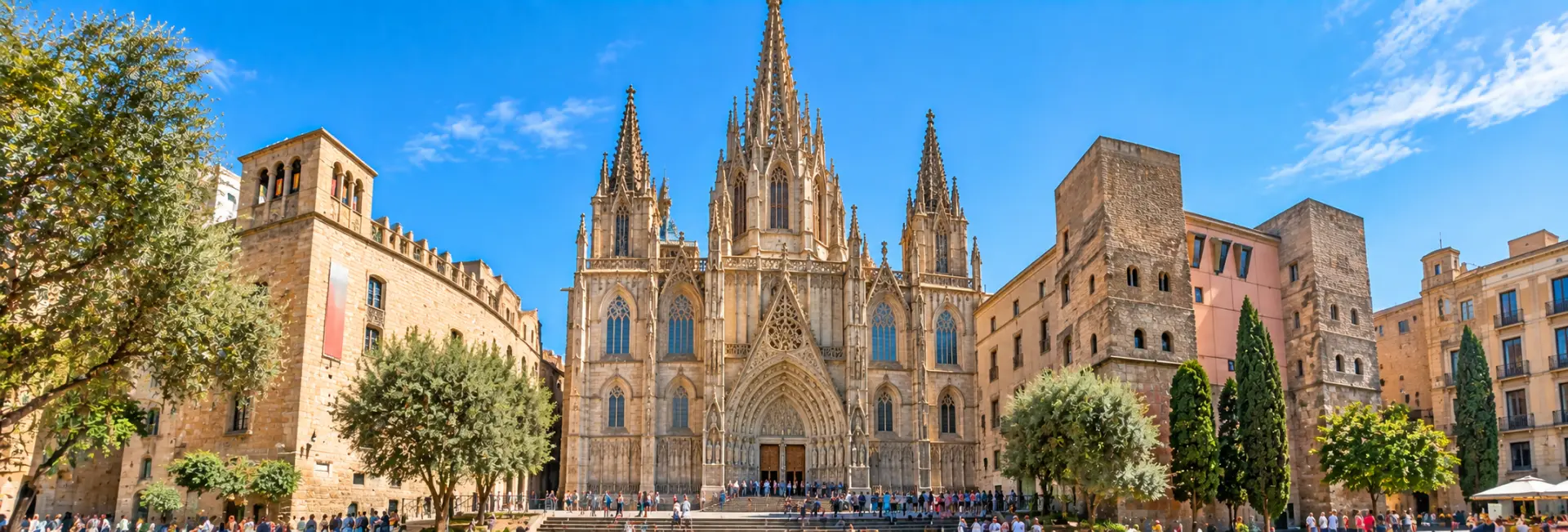
Barcelona Cathedral, formally the Cathedral of the Holy Cross and Saint Eulalia, is the seat of the Archbishop of Barcelona and the principal Gothic church of the city's old town. Rising over the Pla de la Seu at the heart of the Gothic Quarter, it was built mainly between the 13th and 15th centuries on the site of earlier Roman and Visigothic places of worship, though its now-iconic west facade and central spire were not added until the early 20th century. Visitors come for its soaring Gothic interior, a quiet cloister where thirteen white geese have lived for centuries, and a rooftop terrace with sweeping views across the surrounding rooftops of the old city.
History
Earlier Structures on the Site
The cathedral stands on ground that has held places of worship since at least the 4th century, when a paleochristian basilica occupied the site; traces of it survive underground and are visible today from the nearby Barcelona History Museum. A Romanesque cathedral followed and was consecrated in 1058, and its Chapel of Santa Llúcia still stands as part of the current building.
Building the Gothic Cathedral
Construction of the present Gothic cathedral began in 1298 under King James II of Aragon, with the architect Jaume Fabre credited as the first master builder. Work continued through the 14th and into the 15th century, with the cloister completed around 1448, giving the building the layered, centuries-long construction history typical of major Gothic cathedrals.
The 19th- and 20th-Century Facade
For much of its history, the cathedral's main facade remained plain and unfinished, in keeping with a common Catalan Gothic practice of leaving exteriors austere. In the late 19th and early 20th centuries, a Gothic Revival facade and central spire were added over this older exterior, largely funded by a local banker, giving the building the ornate, spired appearance most visitors recognise today; this facade and tower were completed in 1913.
Architecture & Design
The cathedral follows a Catalan Gothic plan, with a broad, relatively low nave lit less by soaring windows than by a dim, atmospheric interior typical of the regional style. Its layout is a pseudo-basilica with side chapels lining the nave, a raised choir at its centre, and an ambulatory circling behind the main altar. The 19th-century west facade, though built centuries after the rest of the structure, was designed to harmonise with the older Gothic fabric behind it, and its central spire and pinnacled towers are lined with gargoyles shaped as both real and fantastical creatures.
Notable Features
- Crypt of Saint Eulalia: beneath the main altar, holding the tomb of the city's co-patron saint in an alabaster sarcophagus
- The Cloister: a secluded Gothic courtyard centred on the Well of the Geese, where thirteen white geese are traditionally kept, said to represent Eulalia's age at her martyrdom
- The Choir: an enclosed set of elaborately carved wooden stalls at the centre of the nave, decorated with the coats of arms of the Order of the Golden Fleece
- Chapel of Christ of Lepanto: home to a crucifix said to have sailed on a ship at the 1571 Battle of Lepanto, with a figure of Christ whose body leans to one side, according to legend to dodge an incoming cannonball
- Rooftop Terrace: reached by lift, offering close views of the spire and gargoyles alongside a wider panorama over the Gothic Quarter
Cultural & Religious Significance
The cathedral is dedicated jointly to the Holy Cross and to Saint Eulalia, a young Christian martyr venerated as one of Barcelona's co-patron saints, and it remains an active place of Catholic worship and the seat of the city's archbishop. Local tradition ties the cloister's thirteen geese directly to Eulalia's story, and the courtyard's fountain is also the setting each year for "L'ou com balla," or the "dancing egg," a Corpus Christi custom in which an eggshell is balanced to spin on top of the water. On Sunday mornings, crowds regularly gather in the square outside to dance the sardana, a traditional Catalan folk dance closely associated with Catalonia's cultural identity.
Recognition & Status
Spain designated the cathedral a national historic monument in 1929, recognising it alongside the country's most significant protected heritage sites. It remains an active cathedral under the Archdiocese of Barcelona rather than a purely secular monument, meaning its opening hours and areas open to visitors are shaped around ongoing religious services.
- Spanish Cultural Heritage monument since 1929
- Active seat of the Archbishop of Barcelona
- Second-largest church in Barcelona after the Sagrada Família
Visiting Etiquette & Tips
As a working cathedral, the building sets aside specific hours for free worship-focused visits and separate paid hours for tourism, with access to the choir, chapter house, and rooftop terrace generally requiring a ticket.
- Check current opening hours before visiting, since free and paid entry windows vary by day and can change around religious holidays
- Dress modestly, covering shoulders and knees, as required at any active place of Catholic worship
- Keep your voice low and avoid flash photography inside the nave, particularly during services
- Buy a combined ticket if you want to see the choir, chapter house museum, and rooftop, since each is priced separately from basic entry
- Allow extra time for the lift to the rooftop terrace, which can have a short queue during busy periods
Best Time to Visit
Early morning, shortly after the cathedral opens for tourist visits, tends to be quieter than midday, especially before tour groups arrive in the Gothic Quarter. Sunday mornings bring a livelier atmosphere in the square outside, when locals often gather to dance the sardana, though the cathedral's Sunday visiting hours are more limited than on weekdays. Visiting outside the busiest summer months generally means shorter waits for the rooftop lift and a calmer experience in the cloister.
Nearby Attractions
Sitting at the centre of the Gothic Quarter, the cathedral is within easy walking distance of the district's other major sights.
- Plaça de Sant Jaume - the political heart of the city, just a short walk south of the cathedral
- Plaça del Rei - a medieval royal square with excavated Roman ruins beneath it
- El Call - Barcelona's former Jewish quarter, tucked into the narrow streets west of the cathedral
- La Rambla and La Boqueria market - a short walk away, marking the edge of the old town
FAQs about visiting Barcelona Cathedral
What is Barcelona Cathedral dedicated to? +
It's dedicated to the Holy Cross and to Saint Eulalia, a young Christian martyr and co-patron saint of Barcelona, whose tomb lies in the cathedral's crypt.
Is Barcelona Cathedral the same as the Sagrada Família? +
No, they're two different churches; Barcelona Cathedral is a Gothic-era building in the old town and the city's official cathedral, while the Sagrada Família is Antoni Gaudí's separate, still-developing basilica in the Eixample district.
Is entry to the cathedral free? +
Entry to the main nave and cloister is generally free during set worship hours, while a paid ticket, or a donation during certain midday hours, is required for the choir, chapter house, and rooftop terrace.
How long does a visit take? +
Seeing the nave and cloister takes around 30 to 45 minutes, with an extra 30 minutes or so if you also visit the choir, chapter house museum, and rooftop.
Why are there geese in the cathedral? +
Thirteen white geese are traditionally kept in the cloister, a custom often linked to the belief that Saint Eulalia was thirteen years old at the time of her martyrdom.
Can I go up to the rooftop? +
Yes, a lift near the cloister leads to a rooftop terrace with close-up views of the spire and gargoyles and wider views over the Gothic Quarter, usually included with the choir and chapter house ticket.
What should I wear to visit? +
Modest dress is expected, covering shoulders and knees, as the cathedral remains an active place of Catholic worship rather than only a historical monument.
What's nearby worth visiting? +
The cathedral sits within a short walk of Plaça de Sant Jaume, Plaça del Rei, the former Jewish quarter of El Call, and La Rambla, making it an easy anchor point for exploring the rest of the Gothic Quarter.
