
Table of Contents
Overview
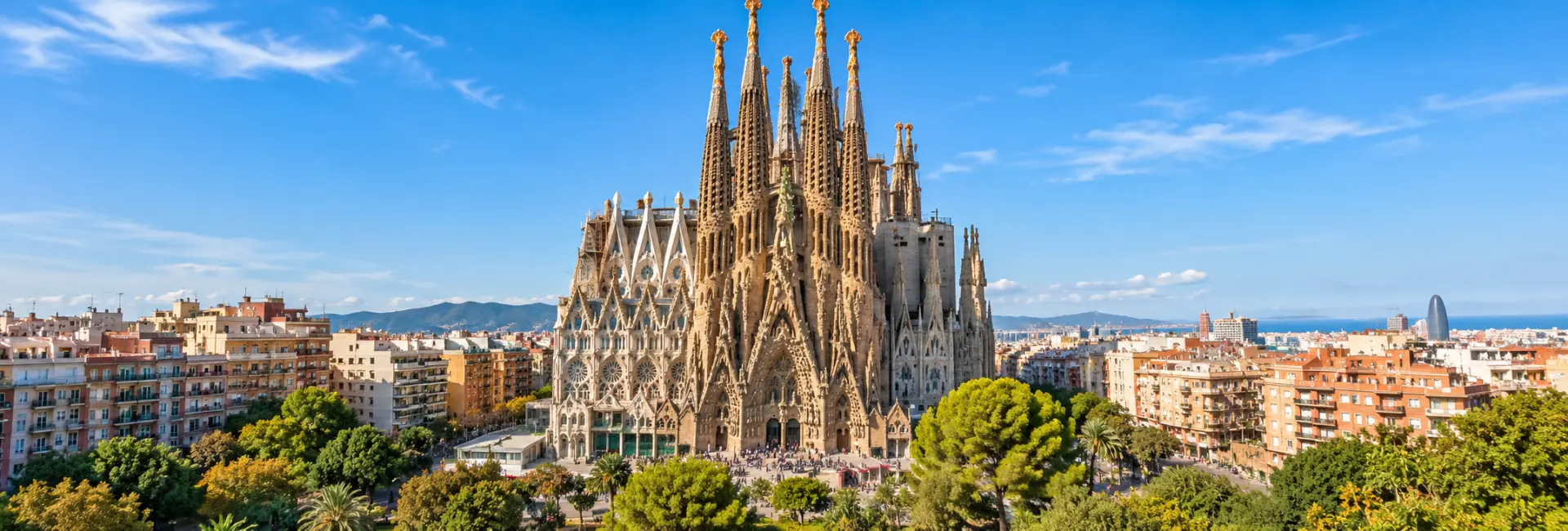
The Sagrada Família rises over Barcelona's Eixample district as Antoni Gaudí's unfinished masterwork, a basilica that has been under construction since 1882 and only reached its full designed height in 2026. Equal parts church, sculpture, and living construction site, it draws millions of visitors each year who come to see Gaudí's radical blend of Gothic ambition and organic, nature-inspired form. Every surface carries meaning: doorways narrate the life of Christ, towers stand in for apostles and evangelists, and shafts of coloured light turn the interior into something closer to a forest canopy than a conventional nave. Long a symbol of Barcelona itself, the basilica remains an active parish church even as scaffolding and cranes continue to shape its final details.
History
Origins and Groundbreaking
Construction began on 19 March 1882 under architect Francisco de Paula del Villar, who envisioned a conventional Gothic revival church funded by public donations. Villar resigned within a year over disagreements about the design, and in 1883 the young Antoni Gaudí took charge of the project. Gaudí radically reimagined the building, discarding the original plans in favour of a structure that would fuse Gothic engineering with the curving, organic forms he was developing elsewhere in his career.
Gaudí's Direction
From 1883 until his death in 1926, Gaudí devoted himself increasingly to the temple, eventually moving into a workshop on the site during his final years. He treated the building as an evolving experiment, testing structural ideas with hanging-chain models and refining the design well beyond what he had time to draw in full. By the time of his death, less than a quarter of the building existed above ground, and much of his vision survived only in fragmentary models and sketches, several of which were destroyed during the Spanish Civil War.
After Gaudí
Later architects and craftspeople have worked from what remained of Gaudí's models, archival photographs, and careful study of his methods to continue the project according to his intentions rather than inventing a new design. Construction slowed for decades due to funding gaps, war, and the sheer complexity of the engineering, relying almost entirely on ticket sales and donations rather than government or church funding.
Toward Completion
Momentum increased from the 1990s onward with the help of computer-aided design, which let builders model Gaudí's complex geometric surfaces with a precision that hand-drawn plans could not achieve. The central Tower of Jesus Christ reached its full height of 172.5 metres in February 2026, making the Sagrada Família the tallest church building in the world, and the basilica's exterior was substantially completed ahead of events marking the centenary of Gaudí's death in June 2026. Remaining work, including sculptural detail and the surrounding plaza, is expected to continue afterward.
Architecture & Design
Structural Innovations
Gaudí designed the Sagrada Família around a forest of branching, tilted stone columns that distribute weight without the external buttresses used in traditional Gothic cathedrals. He worked out the geometry using hanging-chain models, suspending weighted strings to find ideal catenary curves and then inverting the resulting shape into compression-only stone arches. The result looks organic rather than engineered, even though its forms follow careful mathematical logic drawn from ruled surfaces such as hyperboloids and paraboloids.
Naturalistic Forms
Throughout the building, columns branch upward like tree trunks into a canopy of vaulting, a deliberate echo of a forest that Gaudí wanted worshippers to sense as they looked toward the ceiling. Spiral staircases inside the towers resemble seashells, and stone surfaces are shaped to suggest bark, leaves, and other natural textures rather than smooth classical finishes.
Light and Colour
Stained glass windows on the building's east and west sides are tuned to the daily arc of the sun, with cooler blues and greens on the side that catches morning light and warmer reds, oranges, and yellows facing the afternoon sun. As sunlight moves through the nave over the course of a day, it washes the pale stone interior in shifting colour, an effect Gaudí planned as deliberately as the structure itself.
The Three Facades
Nativity Facade
Facing Carrer de la Marina, this is the only facade substantially completed under Gaudí's own supervision, built between 1894 and the early 1930s. Its three doorways, dedicated to Faith, Hope, and Charity, are crowded with carved scenes from Christ's birth and childhood alongside plants, birds, and other creatures, giving the facade a lush, almost overgrown quality that Gaudí intended as a joyful counterpoint to the church's other entrances.
Passion Facade
On the opposite side, facing Carrer de Sardenya, the Passion Facade depicts the trial, suffering, and death of Christ in stark, angular figures very different from the Nativity Facade's ornamentation. Gaudí left only a rough sketch of this facade before his death, and sculptor Josep Maria Subirachs completed the harsh, geometric figures visible today between 1987 and 2005, a style that has divided opinion among visitors and critics ever since.
Glory Facade
The Glory Facade, the largest of the three and the building's main entrance once finished, faces Carrer de Mallorca and represents the path to God through death, final judgment, and eternal glory. Long the least developed of the three, it has advanced substantially in recent years, with its monumental bronze doors, inscribed with the Lord's Prayer in dozens of languages, already installed and visible to visitors even while surrounding sculptural work continues.
Towers and Symbolism
Gaudí planned eighteen towers in total, each corresponding to a figure central to Christian belief: twelve for the apostles, four for the Evangelists Matthew, Mark, Luke, and John, one for the Virgin Mary, and the tallest, the Tower of Jesus Christ, rising above the crossing at the centre of the church. The apostle towers, grouped in fours above each facade, stand between roughly 98 and 120 metres and are topped with mosaic-covered pinnacles referencing a bishop's mitre, crosier, and ring. The Evangelist towers reach around 135 metres, the Tower of the Virgin Mary 138 metres, and the central Tower of Jesus Christ its full 172.5 metres, crowned with an illuminated four-armed cross.
- Apostle towers (12): distributed across the Nativity, Passion, and Glory facades
- Evangelist towers (4): rise above the four arms of the church around the central tower
- Tower of the Virgin Mary: marks the apse and is topped with a twelve-pointed star
- Tower of Jesus Christ: the tallest point of the building, completed in 2026
Recognition & Status
UNESCO added the Sagrada Família to its World Heritage list in 2005 as part of a wider inscription covering several of Gaudí's works in and around Barcelona, recognising the building's exceptional creativity and its role in the development of Modernisme architecture. Pope Benedict XVI consecrated the building and elevated it to the status of a minor basilica in November 2010, formally recognising it as a working place of Catholic worship rather than only a monument. The building remains privately funded through admission tickets and donations, a model that has shaped the pace of construction since work began.
- UNESCO World Heritage Site since 2005 (part of the Works of Antoni Gaudí inscription)
- Consecrated as a minor basilica by Pope Benedict XVI in 2010
- Funded entirely through visitor admissions and donations, with no public or church subsidy
Visiting Etiquette & Tips
Because the Sagrada Família is an active place of worship as well as a major monument, visitors are expected to dress modestly, covering shoulders and knees, and to remove hats before entering. Security checks resemble those at an airport, and large bags or suitcases are not permitted inside, so travellers carrying luggage should plan to store it elsewhere beforehand.
- Book tickets online in advance for a timed entry slot; walk-up availability is limited and queues can run long in peak season
- Arrive at least 15 minutes before your slot, since entry is tied to the time printed on your ticket
- Choose a tower-access ticket only if you're comfortable with a narrow spiral staircase on the way down
- Keep noise to a minimum inside the nave and avoid flash photography, especially during services
- Free audio guides are available in numerous languages through the official app
Best Time to Visit
Morning visits favour the Nativity Facade, which catches direct light earlier in the day, while afternoon light plays more dramatically across the Passion Facade on the opposite side. Weekday mornings shortly after opening tend to be calmer than midday and weekend slots, when tour groups fill the nave. Visiting roughly between October and April generally means shorter queues and cooler weather for exploring the surrounding Eixample streets, while the summer months from June to September bring the heaviest crowds and the greatest demand for tower tickets.
Nearby Attractions
The basilica sits within easy reach of several other Gaudí landmarks and central Barcelona sights, making it simple to combine into a longer day of sightseeing.
- Casa Milà (La Pedrera)- roughly a 20-minute walk along Avinguda de Gaudí, or a short metro ride
- Casa Batlló- a few stops away on Passeig de Gràcia, another of Gaudí's celebrated townhouses
- Park Güell- a short taxi or bus ride north, home to more of Gaudí's mosaic-covered structures
- Hospital de Sant Pau- a UNESCO-listed Modernisme complex linked to the basilica by the tree-lined Avinguda de Gaudí
FAQs about visiting the Sagrada Família
What is the Sagrada Família famous for? +
It's Antoni Gaudí's unfinished basilica in Barcelona, known for its organic, nature-inspired architecture, symbolic facades depicting the life of Christ, and its status as the tallest church in the world since 2026.
Is the Sagrada Família finished yet? +
The exterior reached its full designed height in 2026 with the completion of the central Tower of Jesus Christ, but decorative and sculptural work on the Glory Facade and surrounding areas is expected to continue for some time afterward.
How much time should I set aside for a visit? +
Most visitors spend around 1.5 to 2 hours inside the basilica; add extra time if you're also visiting one of the towers, since the climb, viewing platform, and descent take longer than the main nave alone.
Do I need to book tickets in advance? +
Yes, tickets are sold online with a fixed entry time slot, and walk-up availability is limited, so it's best to book at least several days ahead and further in advance during summer or holiday periods.
Is the Sagrada Família free to visit? +
Regular entry has a cost, though the basilica has occasionally offered free admission on specific dates tied to local festivals; these free slots are announced in advance and typically book out quickly.
Is it suitable for visitors with kids or mobility needs? +
Most of the ground floor and interior are accessible for wheelchairs and pushchairs, with ramps and wheelchair rental available at the entrance, though the towers are reached only by narrow stairs and are not wheelchair accessible.
What's the best way to get there? +
The Sagrada Família metro station, served by lines L2 and L5, sits right next to the basilica, making the metro the simplest option; several bus routes and a scenic walk along Avinguda de Gaudí from Casa Milà are also popular alternatives.
What should I pair my visit with? +
Many visitors combine it with other Gaudí sites nearby, such as Casa Milà, Casa Batlló, or Park Güell, or with the Hospital de Sant Pau, a Modernisme complex a short walk away.
