
Table of Contents
Overview
Park Güell is a hillside garden complex in Barcelona's Gràcia district, designed by Antoni Gaudí between 1900 and 1914 for his patron and friend, the industrialist Eusebi Güell. Conceived first as an exclusive residential development, it never attracted the buyers Güell hoped for and instead survives as one of the most visited public parks in the world, prized for its mosaic-covered terraces, sculptural viaducts, and sweeping views across the city to the Mediterranean. Wooded paths, stone colonnades, and Gaudí's playful, nature-inspired ornamentation give the park a fairy-tale character that has made it a defining image of Barcelona alongside the Sagrada Família.
History
Origins as a Garden City
Eusebi Güell commissioned the park in 1900, inspired by the English garden-city movement, with plans for around sixty private houses set within landscaped grounds on the slopes of Carmel Hill. He hired Gaudí, with whom he had already collaborated on other projects, to design the estate's roads, terraces, and communal spaces. The development was aimed at Barcelona's wealthy residents, who were expected to build homes on the plots surrounding Gaudí's shared infrastructure.
Gaudí's Design Years
Between 1900 and 1914, Gaudí laid out the estate's viaducts, staircases, and central plaza, working the structures into the hillside rather than levelling the land to suit them. He preserved much of the site's existing vegetation and rock formations, adapting his designs around them. Only two houses were ever built, one of which Gaudí purchased and lived in for roughly twenty years, and the wider residential scheme was eventually abandoned for lack of buyers.
From Private Estate to Public Park
After Eusebi Güell's death in 1918, his heirs offered the estate to Barcelona's city council, which acquired it in 1922 and opened it to the public as a municipal park in 1926. Gaudí's former home became the Gaudí House Museum in 1963, displaying furniture and objects he designed. In later decades, rising visitor numbers led the city to divide the site into a paid Monumental Zone, covering Gaudí's principal structures, and a larger free area of open parkland surrounding it.
Architecture & Design
Structural Techniques
Gaudí used inclined stone columns and viaducts built into the hillside to carry pathways across the steep terrain without disrupting its natural contours, a technique that let roads curve and rise gently rather than cutting straight lines into the slope. Load-bearing walls were built from stone quarried on site, keeping the structures visually and materially tied to the ground they stand on.
Trencadís Mosaic
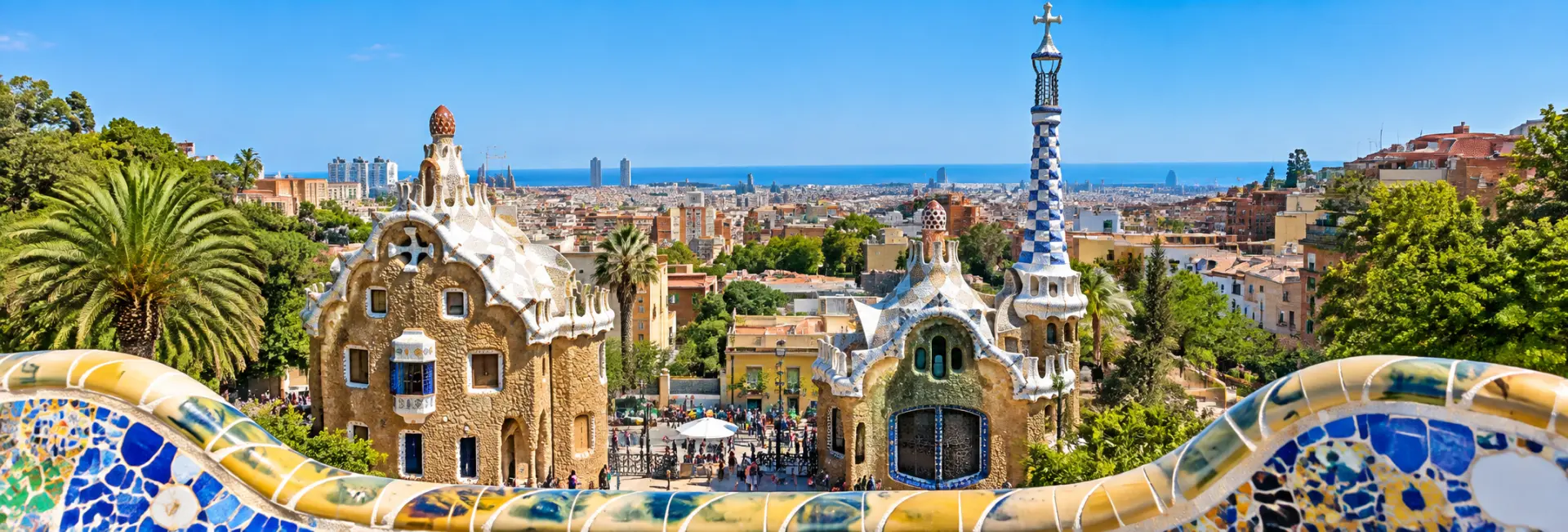
Much of the park's colour comes from trencadís, a mosaic technique Gaudí helped popularise in which broken fragments of ceramic tile, glass, and crockery are pieced together over curved surfaces. The method suited Gaudí's curving forms better than whole tiles could, and it let him reuse offcuts and factory seconds donated by local ceramics makers, turning waste material into some of the park's most recognisable decoration.
Blending Building and Landscape
Throughout the park, built structures echo natural forms: columns lean and branch like tree trunks, roof domes are shaped like rounded hilltops, and pathways follow the terrain's natural folds rather than imposing a grid. This approach reflects Gaudí's broader belief that architecture should grow out of its setting instead of being placed on top of it.
Key Areas & Landmarks
The Monumental Zone concentrates most of Gaudí's built structures within a compact area near the park's main entrance.
- Entrance Pavilions: two gatehouse buildings with curved, mosaic-tiled roofs that frame the park's main entrance on Carrer d'Olot
- Dragon Staircase: a tiered staircase leading up from the entrance, watched over by "El Drac," a mosaic salamander that has become an informal symbol of the park
- Hypostyle Room: a hall of 86 tilted stone columns, originally designed as a covered market for the planned residential estate
- Nature Square: the flat plaza above the Hypostyle Room, ringed by the undulating, trencadís-covered Serpentine Bench and offering panoramic views over Barcelona
- Laundry Room Portico: a sloped, colonnaded walkway whose leaning stone pillars were designed to look like tree trunks
- Gaudí House Museum: the architect's former home, now furnished with pieces he designed for this and other projects
Gardens & Views
Beyond the Monumental Zone, the park's free outer areas cover wooded slopes planted with Mediterranean species such as pine, carob, and olive, many of them preserved from the hillside's original vegetation rather than newly planted. Paths wind past the Austria Gardens, added later on the site of former plant nurseries, and climb toward the Turó de les Tres Creus, a hilltop marked with three stone crosses that was the highest point Gaudí planned to develop. From here and from Nature Square below, views stretch across the rooftops of Barcelona to the Sagrada Família and, on clear days, out to the Mediterranean coastline.
Recognition & Status
Spain designated Park Güell a Bien de Interés Cultural, its highest category of protected heritage site, in 1969. UNESCO inscribed the park as a World Heritage Site in 1984 under the "Works of Antoni Gaudí" listing, later extended in 2005 to include further Gaudí buildings across Barcelona. The park has been owned and managed by the city of Barcelona since its acquisition in 1922.
- Bien de Interés Cultural (Spanish national heritage protection) since 1969
- UNESCO World Heritage Site since 1984, as part of the Works of Antoni Gaudí
- Owned and operated by the Barcelona city council
Visiting Etiquette & Tips
Entry to the Monumental Zone, which includes the entrance pavilions, Dragon Staircase, Hypostyle Room, and Nature Square, requires a ticket with a fixed time slot, while the surrounding wooded areas of the park remain free to enter. Visitor numbers inside the Monumental Zone are capped at any given time, so tickets for popular dates can sell out well in advance.
- Book Monumental Zone tickets online ahead of your visit, especially for mornings and weekends in high season
- Arrive within your ticket's time window, since entry outside the slot is not guaranteed
- Avoid sitting directly on fragile sections of the Serpentine Bench where mosaic tiles are worn or under repair
- Wear comfortable shoes, as the park covers a steep hillside with staircases and uneven stone paths
- Bring water and sun protection, since much of the site has little shade in the middle of the day
Best Time to Visit
Early morning slots, shortly after the park opens, tend to be quieter and give the clearest light for photographing the mosaics on Nature Square before the terrace fills with visitors. Visiting outside the peak summer months of June through August generally means shorter queues and more comfortable temperatures for the uphill walk through the free zone. Late afternoon light can also work well for views back over the city, though the Monumental Zone closes in the early evening year-round.
Nearby Attractions
The park sits within the Gràcia district, a neighbourhood of narrow streets and small squares that rewards a bit of extra wandering after a visit.
- Casa Vicens - a short walk downhill, this early Gaudí house was his first major commission and is now open to the public
- Gràcia neighbourhood - a cluster of leafy plazas, independent shops, and cafes just below the park
- Bunkers del Carmel - a former anti-aircraft position turned popular viewpoint over the whole city
- Sagrada Família - roughly a 20-minute bus or taxi ride away, and easily combined with Park Güell in a single day of Gaudí sightseeing
FAQs about visiting Park Güell
What is Park Güell known for? +
It's a hillside park in Barcelona designed by Antoni Gaudí, known for its colourful mosaic terraces, the Serpentine Bench, the mosaic dragon at its entrance, and panoramic views over the city.
Do I need a ticket to visit Park Güell? +
Only for the Monumental Zone, which holds most of Gaudí's built structures; the surrounding wooded parkland is free to enter, but a timed ticket is required to access the paid, gated section.
How long should I plan to spend there? +
Most visitors spend around 1 to 1.5 hours in the Monumental Zone, with extra time if you also want to walk the free wooded areas or climb to the Turó de les Tres Creus viewpoint.
How do I get to Park Güell? +
The nearest metro stops are Lesseps and Vallcarca on line L3, both followed by a 15 to 20 minute uphill walk or a short connecting bus ride; several city bus routes also stop closer to the main entrance.
Is Park Güell suitable for kids or visitors with mobility needs? +
Children generally enjoy the park's playful sculptures and open spaces, though the site's steep slopes, staircases, and uneven stone paths make full wheelchair access difficult in parts of the Monumental Zone.
Is Park Güell free to visit? +
The outer parkland is free, but entry to the Monumental Zone, where the main mosaic structures are located, requires a paid, timed ticket.
What's the best time of day to visit? +
Early morning shortly after opening tends to have smaller crowds and better light for photos on Nature Square, while midday in summer can be both crowded and hot with little shade.
What should I combine my visit with? +
Many visitors pair Park Güell with nearby Casa Vicens, a stroll through the Gràcia neighbourhood, or a trip to the Bunkers del Carmel viewpoint, all within easy walking or short transit distance.
