
Table of Contents
Overview
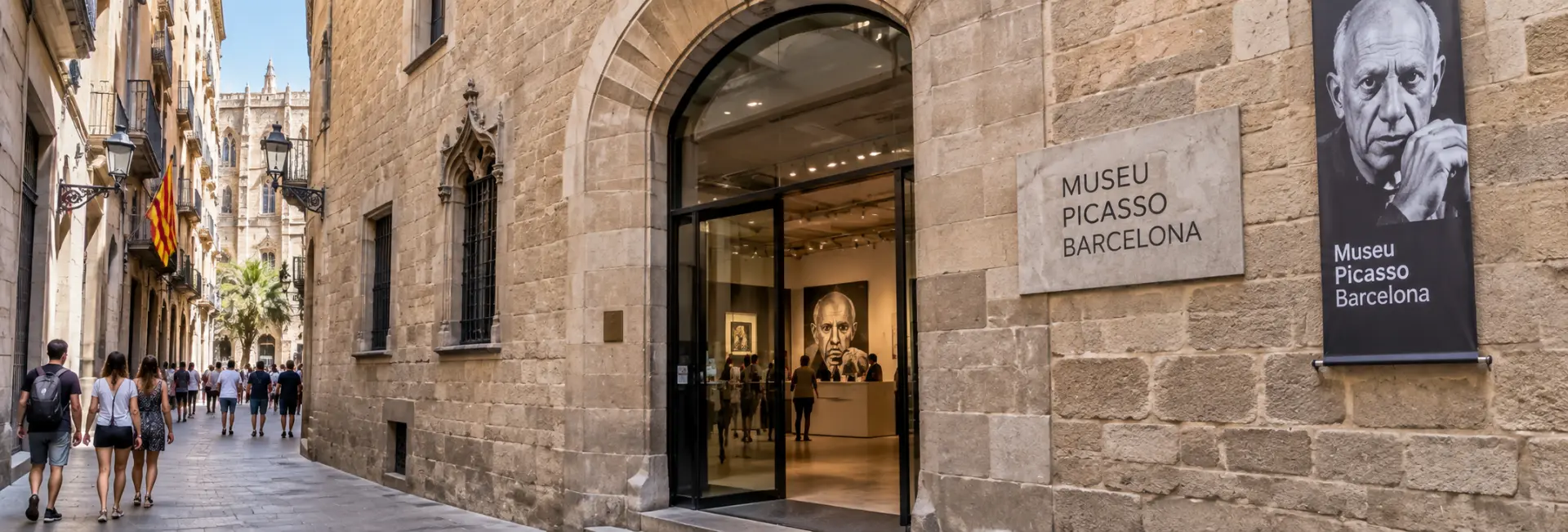
The Museu Picasso sits on Carrer de Montcada, a narrow medieval street in Barcelona's La Ribera neighborhood, occupying five adjoining Gothic palaces that date back to the city's noble past. It was the first museum in the world dedicated to Pablo Picasso and the only one established during the artist's own lifetime, opened in 1963 at his own wish.
Rather than attempting to cover Picasso's entire career, the museum focuses on something no other collection can match: the years he spent growing up and training as an artist in Barcelona, from his teenage academic studies through his early Blue Period. That focus, combined with the setting inside a row of medieval merchant palaces, makes it one of the most distinctive art museums in Europe as much for its architecture as for what hangs on its walls.
History of the Museum
An Idea Born from Friendship
The museum's existence owes a great deal to Jaume Sabartés, Picasso's lifelong friend and personal secretary. Sabartés first proposed the idea of a museum dedicated to the artist, and Picasso, though born in Málaga, chose to have it established in Barcelona instead, a reflection of how much the city had shaped him during his adolescence and youth. Sabartés donated 574 works from his own collection to form the museum's original core, and the museum opened to the public on 9 March 1963 in the Palau Aguilar on Carrer de Montcada.
Growing Across Five Palaces
As the collection expanded, the museum gradually took over the neighboring medieval buildings on the same street, eventually occupying the Palau del Baró de Castellet, Palau Meca, Palau Finestres, and Casa Mauri alongside the original Palau Aguilar. Picasso himself continued to donate and support the institution throughout his life, and after his death his wife Jacqueline Picasso added further gifts, including a collection of his ceramic work. The museum has since been recognized by the Government of Catalonia as a museum of national interest, and it remains one of the most visited museums in the city.
Architecture & Buildings
The five palaces that make up the museum are considered among the finest surviving examples of civil Catalan Gothic architecture, and the whole of Carrer Montcada is protected as a historic and artistic monument. The oldest of the buildings, Palau Aguilar, has roots in the thirteenth and fourteenth centuries and was acquired by the merchant Berenguer d'Aguilar in 1400, though most of the palaces along the street underwent significant renovation in the fifteenth through eighteenth centuries.
Despite belonging to different noble and merchant families over the centuries, the palaces share a common layout: rooms arranged around an internal courtyard, reached by a grand open-air staircase leading up to the main floor. That shared structure is what allowed the museum to link the buildings into a single continuous circuit of galleries, so that visitors move from one former private residence to the next while touring the collection.
Collections & Exhibits
The permanent collection holds more than 4,000 works by Picasso, making it the most complete collection anywhere of his formative years, roughly 1895 to 1904, along with important later additions. It includes paintings, drawings, prints, and ceramics that trace his progress from a technically gifted teenager trained by his father to a young artist absorbing the avant-garde currents of turn-of-the-century Barcelona and Paris.
- Academic studies and early paintings from Picasso's training years in Barcelona and A Coruña
- Works from the Blue Period, including portraits of Sabartés himself
- A group of oil paintings from 1917, produced during a stay in Barcelona
- The complete Las Meninas series, along with a rare preparatory sketch for it
- Ceramic pieces donated by Jacqueline Picasso in the 1980s
Because the collection concentrates so heavily on Picasso's early development, it does not include many of the large, world-famous canvases from his later Cubist and post-war years, which are held elsewhere. What it offers instead is an unusually detailed record of how his style formed in the first place.
Must-See Highlights
A few works stand out even to visitors unfamiliar with Picasso's full body of work.
- Science and Charity (1897), a large academic painting completed when Picasso was only fifteen or sixteen, widely considered his first major work
- The First Communion (1896), another early academic canvas showing his formal training
- The Las Meninas series, 58 paintings from 1957 in which Picasso reworked Velázquez's masterpiece, donated by the artist as a complete set and never broken up
- Portraits of Jaume Sabartés from the Blue Period, honoring the friend who first proposed the museum
- The Gothic courtyards and staircases of the palaces themselves, which are part of the experience of walking through the galleries
Ways to Experience It
Most visitors move through the museum's chronological galleries at their own pace, following Picasso's development from his student years through to Las Meninas. The museum also runs guided tours, audio guides, and periodic workshops for different audiences, including school groups.
- Self-guided visit through the permanent collection, arranged roughly by period
- Audio guides covering the collection's key works and the history of the palaces
- Guided tours, available in various languages, for a more in-depth look at specific pieces
- Temporary exhibitions exploring Picasso's contemporaries or his influence on later artists
- Educational workshops for schools and families
Best Time to Visit
Mornings on weekdays tend to be the quietest time to visit, before tour groups and the busiest midday hours arrive. The museum is a popular stop year-round, so weekends and holiday periods generally see longer waits, particularly for anyone without a pre-booked ticket.
Because gallery space inside the medieval palaces is limited compared to purpose-built museums, capacity can fill up on the museum's periodic free-entry sessions, so visitors aiming for those times should plan to arrive early or book an entry slot online in advance.
Visitor Tips
A little planning goes a long way given how popular this museum is.
- Book tickets online in advance, especially in high season, since the museum has limited daily capacity
- Check the museum's official website for current opening hours, ticket prices, and scheduled free-entry sessions, as these are subject to change
- Large bags must be left in the free cloakroom before entering the galleries
- Photography inside the museum is generally limited to personal, non-flash use
- The Jaume I metro station on Line 4 is the closest stop, a short walk from the entrance
- Allow at least an hour to an hour and a half to see the permanent collection without rushing
Nearby Attractions
The museum sits in the heart of El Born and La Ribera, one of Barcelona's richest areas for a walk after the visit.
- Santa Maria del Mar, a striking Gothic basilica just a few minutes' walk away
- El Born Cultural Centre, built over the remains of an old market and archaeological site
- Passeig del Born and the surrounding streets, known for small shops, galleries, and tapas bars
- Parc de la Ciutadella, a short walk east, with gardens, a lake, and the Arc de Triomf beyond it
FAQs about visiting the Picasso Museum
What is the Picasso Museum known for? +
It's the first museum ever dedicated to Pablo Picasso and the only one created during his lifetime, known for holding the world's most complete collection of his early, formative work rather than his later famous masterpieces.
Why is the museum in Barcelona instead of Picasso's birthplace of Málaga? +
Picasso chose Barcelona for the museum himself, out of loyalty to the city where he spent his teenage years and trained as an artist, even though he was born in Málaga.
What are the must-see works at the Picasso Museum? +
Science and Charity, an academic painting Picasso completed as a teenager, and the complete 58-painting Las Meninas series are generally considered the collection's centerpieces.
How long does it take to visit the Picasso Museum? +
Most visitors spend around one to one and a half hours moving through the permanent collection, longer with an audio guide or if a temporary exhibition is also on view.
Do I need to book tickets in advance? +
It's strongly recommended, since the museum's galleries inside the historic palaces have limited daily capacity and popular time slots can sell out, especially in peak season.
Is the Picasso Museum ever free to visit? +
The museum offers periodic free-entry sessions, including certain hours and specific dates each year; checking the museum's official website for the current schedule is the best way to plan around these.
How do you get to the Picasso Museum? +
The Jaume I metro station on Line 4 is the closest stop, and the museum is also an easy walk from Barcelona's Gothic Quarter or the Barceloneta waterfront.
What's nearby the Picasso Museum worth visiting? +
Santa Maria del Mar basilica, the El Born Cultural Centre, and Parc de la Ciutadella are all within a short walk, making it easy to combine with a longer visit to the El Born district.
