
Table of Contents
Overview
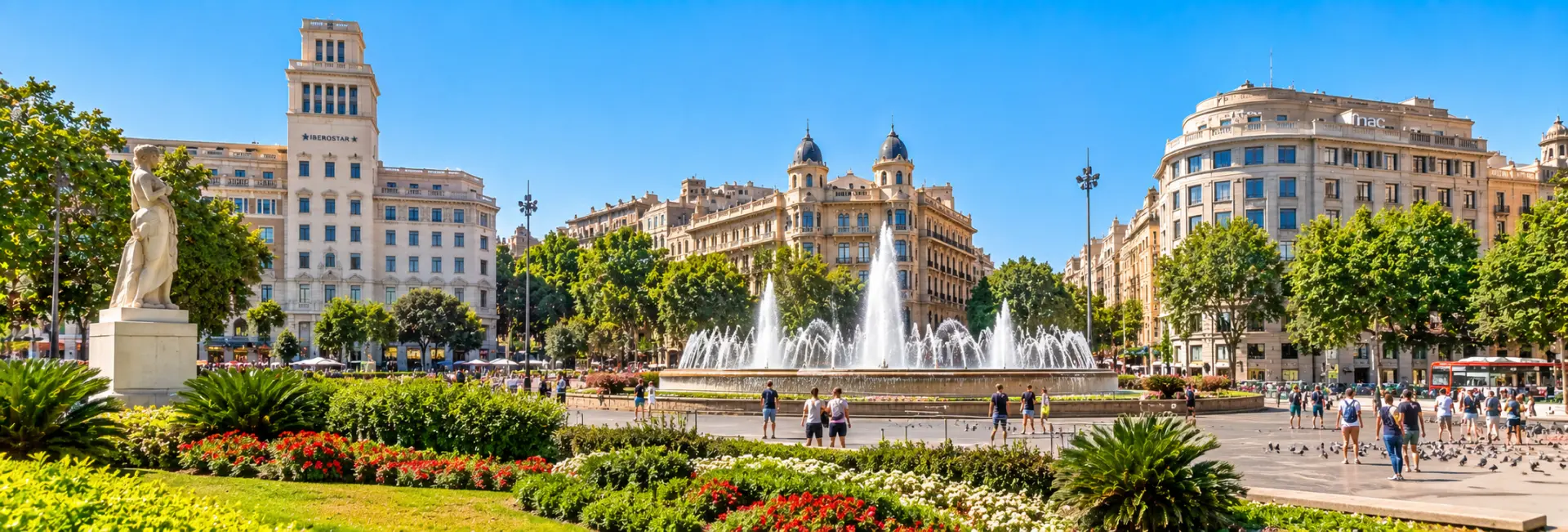
Plaça de Catalunya is the vast, open square that marks the point where Barcelona's old town gives way to the grid-planned Eixample district, and it is widely treated as the symbolic centre of the city. Covering roughly five hectares, it brings together some of Barcelona's busiest streets, including La Rambla, Passeig de Gràcia, and Rambla de Catalunya, and sits above one of the city's busiest transport interchanges. Beyond its role as a crossing point, the square is a destination in its own right, lined with fountains, early 20th-century sculpture, grand banking and department-store buildings, and the flocks of pigeons that have long been one of its trademarks.
History
Beyond the City Walls
Until the middle of the 19th century, the area now occupied by the square lay outside Barcelona's defensive walls, used as open, largely undeveloped land. The walls were demolished starting in 1854, freeing the city to expand northward, and by the 1860s planners were already discussing a square at this junction between the old city and whatever new district would follow.
Competing Visions for a New District
Two rival plans shaped the debate over how Barcelona should grow: one by local architect Antoni Rovira i Trias, favoured by the city council, and another by engineer Ildefons Cerdà, ultimately backed by the central government in Madrid and built as the grid-patterned Eixample district. The compromise that emerged kept Cerdà's grid for the new district while preserving space for a large connecting square where the old town met it, an arrangement approved by the city following the 1888 Universal Exposition.
Building the Modern Square
The square was first laid out in 1902 and substantially rebuilt between 1925 and 1929 to coincide with Barcelona's 1929 International Exposition, under a design led by architect Francesc de Paula Nebot. This phase gave the square its current oval central area, fountains, and much of its sculptural decoration, and the finished square was formally opened by King Alfonso XIII in 1927.
Design & Layout
Nine streets converge on Plaça de Catalunya, making it one of the busiest pedestrian and traffic junctions in Barcelona despite its largely car-free central area. An oval pedestrian zone at the heart of the square is lined with a single row of trees and rows of benches, offering a shaded, relatively quiet space set back from the surrounding traffic. Large circular fountains sit toward the northern side of the square and are lit at night, while grand early 20th-century buildings, including bank headquarters and department stores, form a formal, largely symmetrical frame around the open space.
Notable Monuments & Features
- La Deessa (The Goddess): a white marble female figure by sculptor Josep Clarà, set within a pool near the centre of the square
- Monument a Francesc Macià: a 1991 monument by sculptor Josep Maria Subirachs honouring Francesc Macià, president of the Catalan government in the early 1930s
- Pastor de la Pau (Shepherd of Peace): a sculptural work by Pau Gargallo, one of several early 20th-century pieces placed around the square
- Additional sculptures: further works by Catalan sculptors including Josep Llimona are placed throughout the square's central area
- El Corte Inglés: a large department store building forming one edge of the square, a Barcelona landmark in its own right since the 1960s
A Transport and Civic Hub
Beneath the square lies one of Barcelona's busiest transport interchanges, where multiple metro lines meet regional rail services and numerous bus routes, making Plaça de Catalunya a natural starting point for exploring the rest of the city. Above ground, the square regularly hosts public gatherings, from cultural festivals and concerts to political demonstrations and New Year's Eve celebrations, reflecting its status as a default meeting point and stage for civic life in Barcelona.
Recognition & Status
Plaça de Catalunya is not a protected monument in its own right, but several of its individual sculptures and surrounding buildings hold heritage recognition under Catalan and Spanish cultural protection schemes. Its status rests less on formal designation than on its function: as the point where the medieval old city and the planned 19th-century Eixample meet, it is treated by planners, residents, and visitors alike as Barcelona's de facto central square.
Ways to Experience It
- Simply pass through: most visitors experience the square as a starting or ending point for walks along La Rambla or Passeig de Gràcia
- People-watching: the benches around the oval central area are a popular spot to sit and take in the square's constant movement
- Sculpture spotting: a short walk around the square's perimeter takes in its main early 20th-century statues and fountains
- Shopping: El Corte Inglés and surrounding streets offer some of central Barcelona's most convenient shopping
- Events and gatherings: check local listings, since the square periodically hosts concerts, markets, or public celebrations worth timing a visit around
Best Time to Visit
Early morning offers the calmest view of the square, before commuter traffic through its transport hub picks up and the central area fills with visitors passing through on their way to nearby attractions. Evenings bring a livelier atmosphere as the fountains are lit and the surrounding cafes and restaurants fill up. Because it functions as a transit hub as much as a destination, the square is busy at most hours of the day, so quieter visits are more a matter of timing than season.
Nearby Attractions
As the meeting point of several of Barcelona's key streets, Plaça de Catalunya makes a natural base for exploring in several directions.
- La Rambla - Barcelona's famous pedestrian boulevard, beginning at the square's southern edge and leading toward the old port
- Passeig de Gràcia - a grand avenue of Modernisme architecture and high-end shopping, starting at the square's northeastern corner
- Gothic Quarter - the city's medieval old town, a short walk south through the surrounding streets
- El Raval - a diverse, historic district on the square's southwestern side
FAQs about visiting Plaça de Catalunya
What is Plaça de Catalunya known for? +
It's Barcelona's central square, known for marking the boundary between the old town and the Eixample district, its fountains and early 20th-century sculptures, and its role as a major transport hub.
Is there an entry fee to visit the square? +
No, the square is a public open space with free access at all times; only individual shops or attractions around its edges, such as El Corte Inglés, operate on their own hours and pricing.
How do I get to Plaça de Catalunya? +
It's served directly by metro lines L1 and L3, along with several regional rail lines and numerous city bus routes, making it one of the easiest points in Barcelona to reach by public transport.
How much time should I spend there? +
Most visitors pass through in 15 to 30 minutes on their way to nearby streets, though allowing extra time to sit by the fountains or look at the square's sculptures can easily extend that.
Is Plaça de Catalunya safe for visitors? +
It's generally safe and heavily trafficked at all hours, though as one of the busiest tourist areas in the city it does see occasional pickpocketing, so keeping an eye on belongings is worthwhile.
What's the best time of day to visit? +
Early morning is quieter for photos and a calmer walk around the sculptures, while evenings bring a livelier atmosphere once the fountains are illuminated.
Is the square good for shopping? +
Yes, El Corte Inglés department store sits directly on the square, and Portal de l'Àngel, one of Barcelona's busiest shopping streets, begins just off its northern edge.
What should I combine my visit with? +
Plaça de Catalunya works naturally as a starting point for a walk down La Rambla toward the old port, or up Passeig de Gràcia toward the Eixample's Modernisme landmarks.
