
Table of Contents
Overview
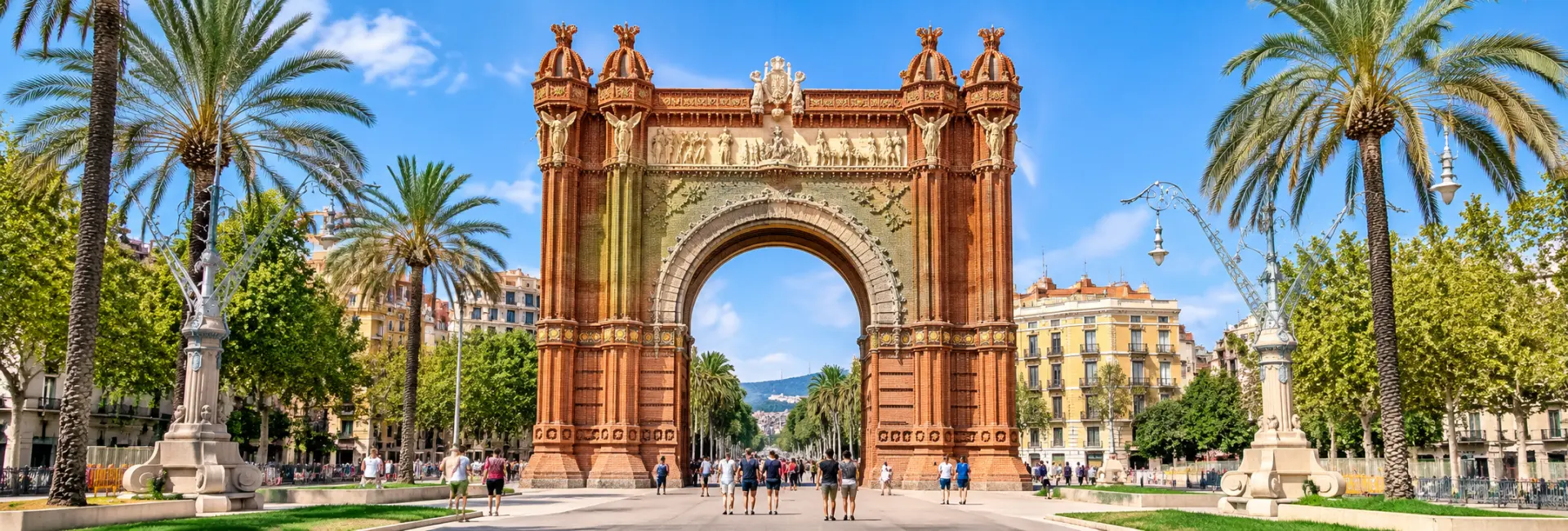
The Arc de Triomf is one of Barcelona's most photographed landmarks, a soaring red-brick archway that stands at the top of the Passeig de Lluís Companys in the Ciutat Vella district. Rising close to 30 metres, it was raised in 1888 as the ceremonial entrance to the city's first Universal Exposition, and it has anchored this stretch of the city ever since.
Unlike the war memorials it superficially resembles, the arch was never meant to mark a military triumph. It was designed as a civic welcome, a statement about progress, industry, and openness to the wider world, and that spirit still comes through in its warm brickwork and dense sculptural decoration. Today it functions less as a monument to visit up close and more as a striking backdrop and meeting point, framing the wide, palm-lined promenade that leads south toward Ciutadella Park.
History
Built for a World's Fair
Barcelona's Universal Exposition of 1888 was the event that put the city on the international map, and the organizers wanted an entrance worthy of the occasion. The commission went to architect Josep Vilaseca i Casanovas, who designed a freestanding arch to sit at the head of the Saló de Sant Joan, the broad avenue that led fairgoers toward the exhibition grounds in what is now Ciutadella Park. The arch was inaugurated on 20 May 1888, ahead of the fair's opening, and quickly became the symbolic gateway to the event and to the modern city Barcelona was trying to present to the world.
A Landmark That Outlasted the Fair
Most of the temporary pavilions built for the 1888 exposition were dismantled once the event ended, but the arch was always intended to be permanent, and it remained in place as the surrounding avenue evolved into a public promenade. Over the twentieth century the street below it changed use several times, carrying traffic for long stretches before being reworked into the pedestrian- and cyclist-friendly boulevard seen today. The arch itself underwent a significant restoration in 1990 to repair the brickwork and decorative elements and stabilize the structure for future generations, and it has kept its place as a fixture of the neighborhood's identity, including as a rallying point for public gatherings on the promenade in front of it.
Architecture & Design
Neo-Mudéjar in Red Brick
Vilaseca gave the arch a classical, symmetrical shape but broke from convention in his choice of material and ornament. Rather than building in stone, he used exposed reddish brick, a cheaper and more modest material that stood in deliberate contrast to the marble typically favored for grand civic monuments. He combined it with decorative ceramic and carved stonework in the Neo-Mudéjar style, a revival of Moorish-influenced design that was fashionable in Spain in the late nineteenth century, giving the arch a warm, textured appearance that sets it apart from most other triumphal arches around the world.
Friezes and Symbolic Details
The arch's two main faces carry large sculpted friezes. The one facing Passeig de Sant Joan, by sculptor Josep Reynés, depicts Barcelona welcoming visitors from abroad, while the frieze on the opposite face, an early work by Josep Llimona, shows the city distributing awards to exhibition participants. The narrower side friezes add further allegories, representing agriculture and industry on one flank and trade and art on the other. Higher up, a band of stone shields runs around the structure representing the Spanish provinces that took part in the exposition, gathered beneath Barcelona's own coat of arms, while carved bats, a traditional emblem linked to the medieval king Jaume I, decorate the arch's pillars.
Recognition & Cultural Status
The Arc de Triomf is registered as a Bé Cultural d'Interès Local, a local-level heritage protection status in Catalonia that recognizes buildings and structures of significant architectural or historical value to the city. While it does not carry an international heritage designation, it is widely regarded as one of the defining Modernista-era landmarks of Barcelona and is frequently cited alongside the city's better-known Art Nouveau buildings as an example of the period's inventive, decorative style.
- Listed as a Bé Cultural d'Interès Local (BCIL) heritage asset
- Associated with the transitional period between Catalan neo-Classicism and Modernisme
- Regularly used as a backdrop for civic and cultural gatherings on the promenade
What to See There
The arch itself is the main attraction, and it rewards a slow walk around its base to take in the sculptural detail on all four sides. Visitors typically are not able to climb inside or reach the top, so the experience centers on viewing the structure from the plaza and promenade around it rather than an interior visit.
- The two main friezes, "Barcelona rep les nacions" and "Recompensa," facing the promenade on either side
- The side reliefs depicting agriculture, industry, trade, and art
- The band of provincial shields and Barcelona's coat of arms near the top of the arch
- The carved bats on the pillars, linked to the emblem of King Jaume I
- The palm-lined Passeig de Lluís Companys, which the arch opens onto
Just beyond the arch, the promenade leads directly toward Ciutadella Park, where sights such as the Cascada monumental fountain, the Castell dels Tres Dragons, and the Parliament of Catalonia make for a natural continuation of a visit.
Ways to Experience It
Because it sits in the open air on a public promenade, the Arc de Triomf can be visited at any hour, free of charge, without booking. Most people take it in as part of a longer walk, pairing it with time in Ciutadella Park or a stroll along Passeig de Sant Joan into the Eixample district.
- Self-guided visit: walk the full perimeter of the arch to see all four friezes and side reliefs
- Combine with Ciutadella Park: continue south along the promenade to the park's fountains, gardens, and museums
- Guided walking tours: several Barcelona history and Modernisme-themed tours include the arch as a stop
- Photography: the wide, tree-lined approach along the promenade offers one of the most reliable vantage points for a full view of the structure
Best Time to Visit
Early morning and early evening tend to be the most comfortable times to visit, especially in the warmer months, when the midday sun on the open plaza can be intense. Evening light also brings out the warmth of the red brick and makes for some of the best photographs of the arch.
Spring and autumn generally offer the mildest weather for lingering on the promenade or continuing into Ciutadella Park afterward. Because the site is outdoors and unticketed, there is no seasonal closure to plan around, though the surrounding area can feel busiest on weekend afternoons when locals gather on the promenade.
Visitor Tips
A visit to the arch is quick, but a few practical points can make it more enjoyable.
- The arch is free to view at any time, with no tickets or opening hours to check
- The nearest metro stop, Arc de Triomf on Line 1, sits right at the foot of the promenade
- The area is flat and fully accessible for wheelchairs and strollers
- Bring water and sun protection in summer, as the plaza offers little shade
- Pair the visit with Ciutadella Park just beyond it to make the most of the walk
- Keep an eye on belongings, as the plaza is a popular and sometimes crowded gathering spot
FAQs about visiting the Arc de Triomf
What is the Arc de Triomf? +
It's a large red-brick triumphal arch in Barcelona, built in 1888 as the ceremonial entrance to the city's Universal Exposition, and it now stands as one of the city's best-known landmarks.
Is the Arc de Triomf free to visit? +
Yes, it sits in an open public plaza with no tickets or entry fee, and it can be viewed at any time of day.
Can you go inside or climb the Arc de Triomf? +
No, the arch is not generally open for visitors to climb or enter; the experience is limited to viewing it from the surrounding plaza and promenade.
How much time do you need to see it? +
Most visitors spend 15 to 30 minutes walking around the arch and taking photos before continuing on to nearby Ciutadella Park.
What's the best time to visit the Arc de Triomf? +
Early morning or early evening works best, both for softer light and to avoid the strongest midday sun on the open plaza.
How do you get to the Arc de Triomf? +
The Arc de Triomf metro station on Line 1 sits directly at the base of the promenade, and the site is also an easy walk from the Born and Gothic Quarter neighborhoods.
What's nearby the Arc de Triomf? +
Ciutadella Park is just a short walk south along the promenade, home to the Cascada monumental fountain, the Barcelona Zoo grounds, and the Parliament of Catalonia building.
Is the Arc de Triomf suitable for kids or visitors with mobility needs? +
Yes, the surrounding plaza and promenade are flat, open, and stroller- and wheelchair-friendly, making it an easy stop for families and visitors with limited mobility.
