
Table of Contents
Overview
Gundulić Square, known locally as Gundulićeva poljana, is one of the liveliest open spaces in Dubrovnik's Old Town. It lies just behind the cathedral, on the quieter side of Stradun, and it has a very different feel from the polished tourist promenade a few streets away.
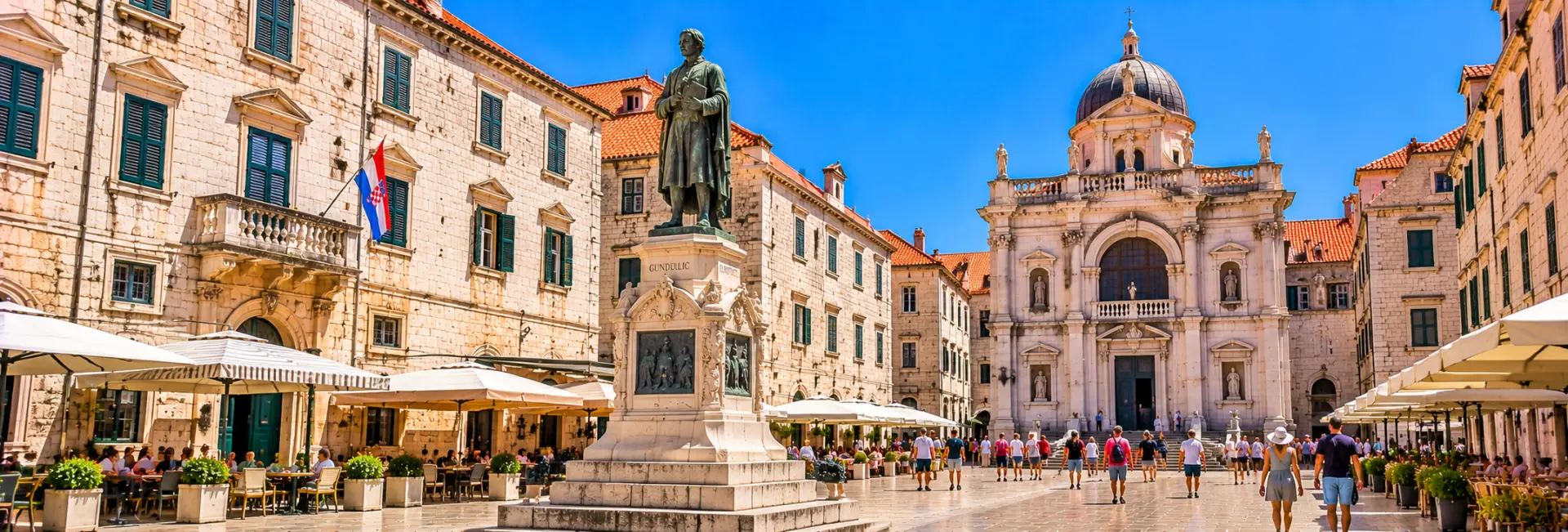
In the middle of the square stands a bronze monument to Ivan Gundulić, the great Baroque poet of the Republic of Ragusa. Around it, every morning, a market fills the space with stalls, parasols and the sounds of local life. By evening the stalls have gone and café and restaurant terraces take over the same stones.
At one end of the square, a sweeping Baroque staircase rises toward the Church of St Ignatius, one of the most photographed corners of the Old Town. Together, the monument, the market and the stairs make this a rewarding stop for anyone who wants to see Dubrovnik as a living city and not only as a museum.
The square is free to enter, open at all hours, and easy to combine with the cathedral, the Rector's Palace and Luža Square, all of which are only a few minutes away on foot.
History of the Square and Its Monument
A square named for a poet
Gundulić Square takes its name from Ivan Gundulić, who lived from 1589 to 1638 and is widely regarded as the most important poet of Dubrovnik's Baroque age. He is often described as a national poet of Croatia, and his work is still read and quoted in the country today.
The plan for a monument
The idea of honoring him with a monument took shape in the 19th century. In March 1880, the Municipal Council of Dubrovnik approved a proposal from a local youth association to raise a monument in time for the 300th anniversary of Gundulić's birth in 1888. The project took longer than first planned, and the work was finally completed several years later.
The unveiling in 1893
The monument by the Croatian sculptor Ivan Rendić was installed and unveiled in 1893. The ceremony grew into a multi-day civic celebration and also reflected the political debates of the time, since Gundulić was claimed as a symbol by different groups in the city. The square has been the setting for the monument ever since.
A working square through the centuries
Today the square is above all a place where people gather and trade. The morning market, in which farmers from the surrounding countryside bring their produce into the Old Town, is one of the main reasons locals come here.
The Gundulić Monument
The statue
The monument shows the poet in bronze, standing on a tall stone pedestal at the center of the square. It was made by Ivan Rendić, one of the best-known Croatian sculptors of his era, who worked on the commission between 1892 and 1893 with studios in Trieste and elsewhere.
The reliefs
The base of the monument carries bronze reliefs. Several of them illustrate scenes from Osman, Gundulić's most famous epic poem, which tells of a war between the Ottoman Empire and Poland and is considered a masterpiece of Croatian literature. Another relief honors Saint Blaise, the patron saint of Dubrovnik, a reminder that the poet is very much a city figure as well as a national one.
Who was Gundulić?
Gundulić was born in Dubrovnik and wrote plays, religious poetry and epic verse. His writing helped shape the literary language of the region, and he remains a point of pride for the city. He is buried in the Franciscan church near Pile Gate, only a short walk away.
The noon pigeons
A small local ritual takes place at midday, when pigeons gather in front of the statue and are fed grain. It is a charming moment to watch, and many visitors time their stop to see it.
The Morning Market
What is on offer
The market is the heart of the square for much of the day. Stalls sell seasonal fruit and vegetables, herbs, honey, dried lavender and lavender oil, local liqueurs and brandies such as homemade rakija, and handmade crafts and table linens. In summer you will see tomatoes, peaches and melons piled high, while the colors and scents change with each season.
Who comes here
This is a market used by locals as much as by visitors, and it is a good place to see everyday life in the Old Town. Farmers and producers from the area around Dubrovnik set up their tables early, and regular customers stop to chat and compare prices.
Hours and rhythm
The market usually runs in the morning, starting early, on six days of the week, and it is normally closed on Sundays. By midday the stalls begin to pack up and the square slowly returns to its quieter self.
Buying tips
- Fresh fruit makes a good picnic or a snack for a walk on the city walls.
- Honey, lavender and herbs are popular and easy-to-carry souvenirs.
- Ask before photographing stallholders, and be friendly, as vendors usually appreciate a little conversation.
- Carry small bills or coins, since some sellers prefer cash.
The Jesuit Steps and Surroundings
The Baroque staircase
At the upper end of the square, a broad staircase climbs in graceful curves toward the Church of St Ignatius. Built in the first half of the 18th century and often compared to the Spanish Steps in Rome, it is one of the most striking pieces of Baroque design in Dubrovnik. The steps were damaged during the siege of the city in the early 1990s and have since been restored.
The staircase will also be familiar to fans of the television series Game of Thrones, which used it for a famous scene. Even without that association, it is a wonderful place to pause, sit and watch the square below.
The Church of St Ignatius
At the top of the steps stands the Jesuit Church of St Ignatius, completed in 1725 and modeled on the Church of the Gesu in Rome. Its interior is decorated with frescoes showing scenes from the life of the founder of the Jesuit order. The church tower is said to hold the oldest bell in Dubrovnik.
Collegium Ragusinum
Beside the church is the former Jesuit college, founded in the 17th century, where many of the republic's scholars were educated. The open space in front of the college is now named for Ruđer Bošković, the 18th-century scientist who studied there.
Buildings around the square
The square is framed by stone houses, shops and restaurants with terraces. Look for the architectural details above the street level, including balconies, carved doorways and, according to some visitors, a lion-shaped fountain tucked onto the corner of one of the buildings.
Ways to Experience It
Browse the market
The simplest and most satisfying way to experience the square is to arrive in the morning, walk slowly between the stalls and buy something fresh. A coffee at a nearby café lets you watch the market at its busiest.
Climb the Jesuit Steps
Walking up the staircase takes only a few minutes and rewards you with views back over the square and the rooftops. At the top you can look into the Church of St Ignatius, when it is open, and enjoy the quieter space in front of the former college.
Join a walking tour
Many guided walks of the Old Town pass through the square, often finishing here. A guide can explain the story of Gundulić, point out the details of the stairs and place the square in the wider history of the republic.
Linger for lunch or dinner
In the late morning and evening, the square's restaurants and cafés set out tables. Eating here is a pleasant way to spend an hour, especially after the market crowd has thinned and the square feels more relaxed.
Photography
The monument framed by market umbrellas, the steps at golden hour and the quiet square in the late evening each make a different picture. Early mornings are best for color and activity, while evenings are best for calm.
Best Time to Visit
Time of day
- Morning, from early until around midday, is the best time to see the market at full strength and enjoy the energy of the square.
- Noon is the moment for the pigeon feeding at the statue.
- Late afternoon and evening are calmer, with café tables, softer light on the stairs and fewer people around the monument.
Day of the week
Because the market is normally closed on Sundays, plan your visit for another day if you want to see the stalls. The square is still pleasant on Sundays, but quieter and without the market atmosphere.
Season
The square can be visited all year. Summer is busiest, with the widest range of fresh produce and the most visitors in the nearby streets. Spring and autumn bring comfortable temperatures and a more local feel, while winter has a smaller market but a peaceful atmosphere.
Visitor Tips
- Arrive in the morning if you want to see the market, and check ahead for any changes to its days and hours.
- Bring a small bag for your purchases, and carry cash for the smaller stalls.
- Keep an eye on your belongings in busy moments, as in any crowded market.
- Wear comfortable shoes with good grip, as the stone paving and the steps can be slippery, especially after rain.
- Visit the Jesuit Steps early or late in the day if you want a clear photograph without crowds.
- Pair your visit with the cathedral and the Rector's Palace, which are only a minute or two away.
Accessibility
The square itself is mostly level and easy to cross, although the stone surface can be uneven in places. The Jesuit Steps are, naturally, not step-free, so visitors with limited mobility may prefer to enjoy the view of the staircase from below.
Facilities
Cafés and restaurants around the square offer seating and restrooms for customers, and there are shops nearby for water, snacks and everyday items.
Nearby Attractions
Dubrovnik Cathedral
The cathedral stands just beside the square and is the city's principal church. It was built on the site of an earlier basilica and is known for its Baroque design and its treasury of relics and religious art.
Rector's Palace
Only a short walk away, this Gothic-Renaissance palace was the seat of the elected rector of the republic. It now houses a museum that shows how the city was governed and how its leaders lived.
Luža Square, Sponza Palace and the City Bell Tower
The main public square of the Old Town lies a few minutes toward the sea, with the Sponza Palace, Orlando's Column and the bell tower all within a short distance.
Church of St Blaise
Dedicated to the patron saint of Dubrovnik, this Baroque church stands on Luža Square and is a good stop for anyone who has noticed the saint's image throughout the Old Town.
Dubrovnik City Walls
The walls are close enough that you can visit them in the same outing. Climbing up from the Old Town gives wide views over the rooftops, the sea and the market square you have just left behind.
FAQs about visiting Gundulić Square
What is Gundulić Square known for? +
It is known for its morning market, for the bronze monument to the poet Ivan Gundulić at its center, and for the Baroque Jesuit Steps at its upper end. It is one of the most atmospheric everyday spaces in the Old Town.
Where is Gundulić Square located? +
It is in Dubrovnik's Old Town, just behind the cathedral and a short walk from Luža Square and the Rector's Palace. The local name is Gundulićeva poljana.
What time does the Gundulić Square market open? +
The market usually runs in the morning, starting early, on most days of the week, and it is normally closed on Sundays. Hours can change by season, so check locally before you go.
Who was Ivan Gundulić? +
He was a poet of the Republic of Ragusa who lived from 1589 to 1638 and is best known for the epic poem Osman. He is often considered one of the great figures of Croatian literature.
Is it free to visit Gundulić Square? +
Yes, the square is a public space and is free to visit at any time. You only pay if you buy something at the market or sit down at a café or restaurant.
What are the Jesuit Steps? +
They are a Baroque staircase at one end of the square that leads up to the Church of St Ignatius. Built in the first half of the 18th century, they are often compared to the Spanish Steps in Rome and have appeared in Game of Thrones.
Why do people feed pigeons at the statue at noon? +
It is a small local tradition in which grain is scattered in front of the monument at midday. Many visitors enjoy watching the pigeons gather around the statue.
How long should I spend at Gundulić Square? +
Around thirty to forty-five minutes is enough to browse the market, see the monument and climb the steps. Allow more time if you want to sit for a coffee or meal.
