
Table of Contents
Overview
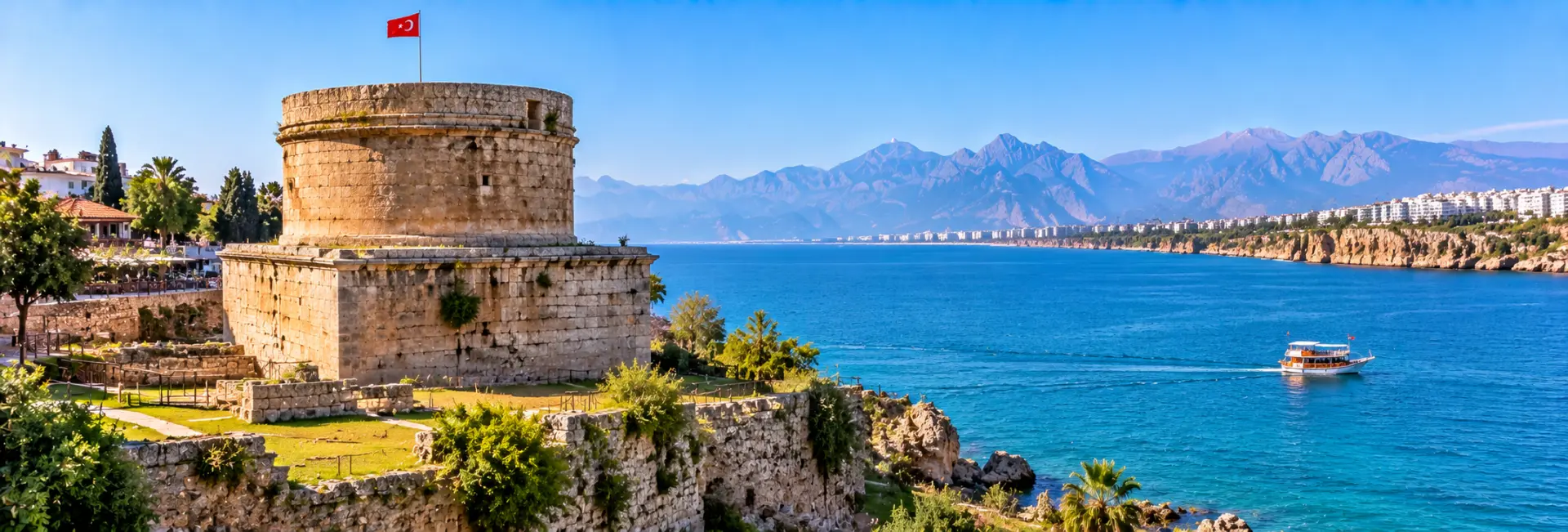
Hıdırlık Tower stands at the exact point where Antalya's old walled quarter, Kaleiçi, runs out of streets and meets open cliffside above the sea. Built from tawny local stone around fourteen metres high, it has looked out over Antalya's harbor for close to two thousand years, making it one of the few Roman-era structures in the city still standing largely intact, alongside Hadrian's Gate.
Unlike some of Antalya's better-documented ancient monuments, Hıdırlık Tower keeps a genuine air of mystery: historians still don't agree on whether it began life as a tomb, a lighthouse, a watchtower, or some combination of the three. That uncertainty, paired with one of the widest sea views in the old town, is a large part of what draws visitors to this quiet corner of Kaleiçi, especially toward sunset.
History
Roman Origins
Most evidence points to Hıdırlık Tower being built in the 2nd century AD, when Antalya was the prosperous Roman port city of Attaleia. Architectural details, including the quality of its stonework and its cylindrical upper section sitting on a square base, have led many historians to argue that the structure began as a monumental tomb built outside the city walls, in keeping with Roman burial customs that generally kept graves separate from the living city. Some sources connect the tomb to a prominent Roman official of the period, though the exact individual it may have honored is not firmly established.
Byzantine and Later Use
Whatever its original purpose, the tower's position directly above the harbor mouth made it a natural fit for later defensive and navigational roles. Under Byzantine rule it is thought to have served as a military outpost as part of the city's wider fortifications, and some accounts suggest it may also have functioned for a time as a church or chapel. Its elevated, highly visible position kept it useful across several different eras of the city's history, which likely explains why it survived so much better than many of Antalya's other ancient structures.
Seljuk and Ottoman Restoration
Long after the Roman and Byzantine periods, the tower continued to be maintained rather than left to decay. Visible signs of restoration work on its upper section date to the Seljuk and Ottoman eras, suggesting that later rulers of the city recognized its value, whether as a landmark, a fortification, or a navigational aid for ships approaching the harbor. That pattern of continued upkeep across very different periods of Antalya's history is part of why the tower remains one of the city's most intact ancient structures today.
Architecture and an Uncertain Purpose
The tower combines a square lower section with a round, drum-like upper section, an unusual two-part design that has fueled much of the debate over its original function. Its entrance sits on the eastern side, opening into a small ground-floor room from which a narrow interior staircase once climbed to the upper level, though public access inside the tower is limited today.
On either side of the entrance portal, twelve axe-like motifs are carved into the stone, a detail some historians read as a marker of the high status of whoever the structure was originally built to honor, if it did indeed begin as a tomb. Faint traces of fresco reported inside add further support to that theory, though the same commanding position above the harbor made it just as plausible a lighthouse or lookout point for ships approaching Antalya's ancient port.
- Approximately 14 metres tall
- Square base transitioning into a cylindrical upper section
- Entrance and small interior room on the eastern side
- Twelve carved axe-like motifs flanking the entrance portal
The Name and Local Legend
The tower's Turkish name, Hıdırlık, is generally connected to Hızır (also spelled Hıdır or Khidr), a figure revered in Islamic tradition and associated with water, travel, and protection. The name literally translates to something like "a place of Khidr," and sites named this way are common across Anatolia, often linked to places near water or crossroads where travelers might seek his protection. Hıdırlık Tower's position above Antalya's harbor fits that pattern closely.
Such sites are also traditionally connected to Hıdırellez, a spring festival observed in parts of the Muslim world that marks the legendary yearly meeting of Hızır and the prophet Elijah. Hıdırlıks, or places named for Hızır, are often chosen as gathering points for Hıdırellez ceremonies, and Antalya's own tower carries that same layer of folk meaning today. Local folklore over the centuries has effectively layered new meaning onto a structure whose original Roman purpose had likely already been forgotten by the time the name took hold, a reminder of how a single landmark can pick up different identities as the community around it changes.
The View and Karaalioğlu Park
Whatever debate surrounds its history, most visitors come to Hıdırlık Tower for the view rather than the archaeology. The tower anchors the western edge of Karaalioğlu Park, a green, tree-lined space along Antalya's clifftop, and from its base visitors get one of the widest uninterrupted sea views in the old town, looking out over the Old Harbour and the Gulf of Antalya beyond.
Karaalioğlu Park itself has been reshaped more than once over the past century, including a redesign of its western section in the early 2000s and the later removal of an old stadium that once stood on its eastern edge to make more room for green space. That ongoing investment in the park has helped keep the immediate surroundings of the tower pleasant and walkable, even as the tower itself has stayed largely unchanged.
The short walk from Kaleiçi to the tower, often along Hesapçı Sokak starting near Hadrian's Gate, is itself part of the appeal: the narrow lanes of the old town gradually open up until the ground simply ends at the cliff edge, with the tower marking that transition.
Ways to Experience It
Most visitors combine Hıdırlık Tower with a walk through Kaleiçi, following the old town's lanes down toward the cliffside before continuing into Karaalioğlu Park. The tower itself takes only a few minutes to see up close, so it works well as one stop on a longer walk rather than a standalone destination, and many visitors continue afterward to the marina below or down to Mermerli Beach, a small cliffside cove a short walk away.
- Walk from Hadrian's Gate along Hesapçı Sokak, about 600 metres to the tower
- Continue into Karaalioğlu Park for shaded walking paths and further sea views
- Time your visit for late afternoon or sunset, when the light over the Gulf of Antalya is at its best
- Combine the stop with a broader Kaleiçi walking tour, since most other old-town sights are within easy walking distance
Best Time to Visit
Late afternoon and early evening are generally considered the best time to visit, since the low sun over the water makes for some of the most striking views and photographs in the old town. Spring and autumn bring more comfortable walking temperatures for the approach through Kaleiçi than the height of summer, when the old town's narrow streets can feel warm with little shade.
Because the site is small, open-air, and free to visit at any time of day, there's no need to plan around opening hours the way you would for a ticketed museum or archaeological park.
Visitor Tips
- Wear comfortable shoes, since the approach from Kaleiçi involves cobbled and uneven old-town streets
- Visit around sunset for the best light over the harbor and Gulf of Antalya
- Combine the tower with a walk through Karaalioğlu Park rather than treating it as an isolated stop
- Bring a camera, since the clifftop view is one of the most photographed spots in the old town
- Be mindful near the cliff edge, as railings and barriers are minimal in places
Nearby Attractions
- Kaleiçi (Antalya Old Town) - the historic walled quarter surrounding the tower, with Ottoman-era houses and narrow lanes
- Hadrian's Gate - a well-preserved Roman triumphal arch about 600 metres away, at the start of Hesapçı Sokak
- Karaalioğlu Park - a clifftop green space directly adjoining the tower, popular for walking and sea views
- Antalya Old Harbour and Marina - the historic port below the cliffs, now used by yachts and tour boats
- Mermerli Beach - a small beach tucked into the cliffs a short walk from the tower
- Suna-İnan Kıraç Kaleiçi Museum - an ethnographic museum in a restored Ottoman-era mansion in Kaleiçi
FAQs about visiting Hıdırlık Tower
What was Hıdırlık Tower originally built for? +
Historians aren't certain, but most evidence points to it starting as a Roman tomb in the 2nd century AD, though its position above the harbor also made it well suited as a lighthouse or watchtower.
Where does the name Hıdırlık come from? +
It's generally linked to Hızır (or Khidr), a protective figure in Islamic tradition often associated with water and travel, a naming pattern common at sites near water across Anatolia, and such sites are also traditionally tied to the spring festival of Hıdırellez.
Is there an entrance fee to visit Hıdırlık Tower? +
No, the tower and the surrounding area are freely accessible, and there's no ticket booth or set visiting hours the way there are at Antalya's larger archaeological sites.
How do I get to Hıdırlık Tower from Kaleiçi? +
It's about a 600-metre walk from Hadrian's Gate along Hesapçı Sokak, or you can reach it directly through Karaalioğlu Park.
Can I go inside the tower? +
Public access to the tower's interior is limited, so most visitors experience it from the outside, taking in the structure and the surrounding sea views rather than climbing it.
What's the best time of day to visit? +
Late afternoon or sunset, when the light over the Gulf of Antalya is most dramatic and the temperature is more comfortable for the walk through the old town.
Is Hıdırlık Tower worth visiting on its own? +
It's a quick stop on its own, so most visitors combine it with a walk through Kaleiçi and Karaalioğlu Park rather than making a special trip just for the tower.
Is the area around the tower safe for children? +
The tower sits right at a cliff edge with minimal barriers in places, so supervision is recommended for children exploring the immediate area.
