
Table of Contents
Overview
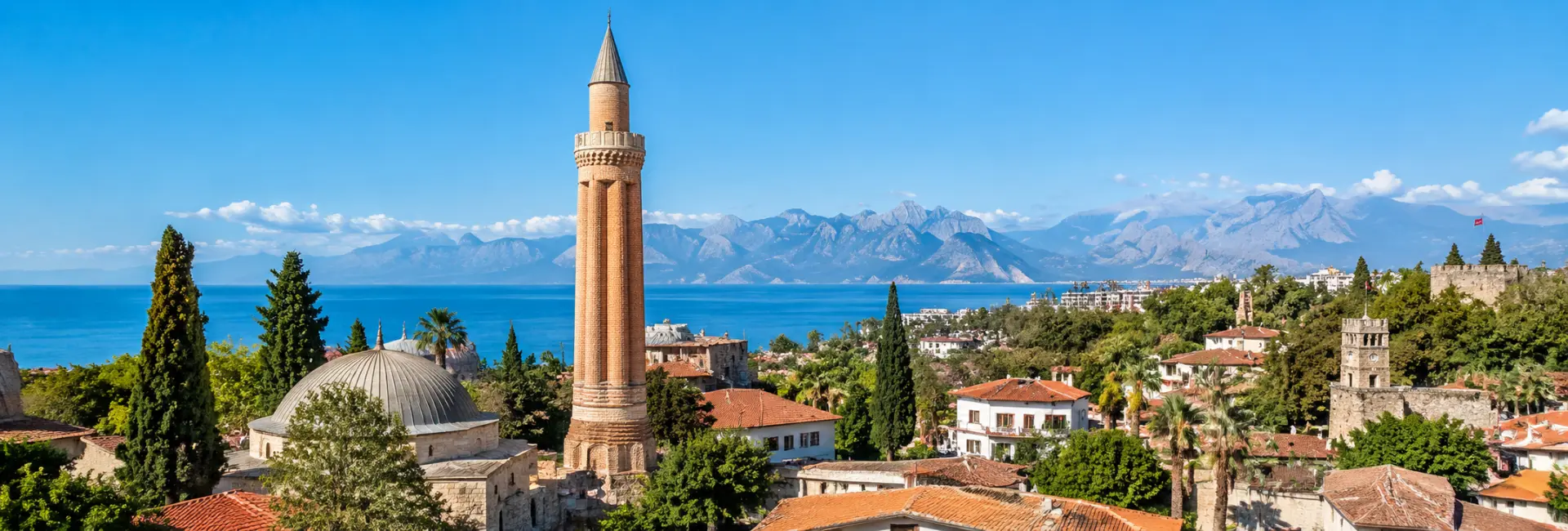
Yivli Minaret rises above the rooftops of Kaleiçi, Antalya's old walled town, along Cumhuriyet Caddesi near Kalekapısı Square. Built of brick in eight fluted, semi-cylindrical sections and topped with traces of turquoise and dark blue tile, it has become the single most recognizable symbol of the city, appearing on everything from postcards to municipal logos.
The minaret belongs to a working mosque complex first raised in the early 13th century under Seljuk rule, making it one of the oldest surviving pieces of Islamic architecture in Antalya. Unlike many historical landmarks that exist purely as museum pieces, the mosque beside the minaret remains in active use today, and the wider complex around it still includes a restored seminary, tombs, and a former dervish lodge worth a slower look. It sits right in the middle of Kaleiçi's restored old town, a district whose careful preservation has itself been internationally recognized, which makes the minaret a natural anchor point for exploring the surrounding lanes.
History
A Seljuk Foundation on Byzantine Ground
Following the Seljuk conquest of Antalya in 1207, Sultan Alaeddin Keykubad I ordered the construction of a mosque on the site around 1230, choosing the ruins of an earlier Byzantine church as its foundation. Building directly over an existing church was a common Seljuk practice at the time, both practical and symbolic, marking the shift of a newly won city from Byzantine to Islamic rule. Traces of the earlier structure are still visible today beneath a glassed section of the mosque floor.
The Minaret and Its Inscription
The fluted minaret that gives the complex its name is generally attributed to the same period and the same sultan, with an inscription on the structure crediting Alaeddin Keykubad I directly. Its distinctive eight-sided fluted shape made it an unusual design even by the standards of early Seljuk architecture in Anatolia, and that originality is a large part of why it endured as a recognizable landmark long after the surrounding city changed around it.
Destruction and Fourteenth-Century Rebuilding
The original prayer hall did not survive intact. It was destroyed or fell into serious disrepair during the 14th century, and in 1373 it was rebuilt at the order of Mehmet Bey, a member of the Hamitoğlu family who governed the region at the time. An inscription at the entrance records this reconstruction, crediting the work to Yunus, son of Mahmud, son of Mübarizeddin Mehmed. This rebuilt mosque, with its six domes resting on twelve columns, is essentially what stands next to the minaret today, making the minaret itself the older of the two structures by well over a century.
Architecture and Design
The minaret stands about 38 metres tall on a square stone base, from which its brick shaft rises in eight rounded flutes decorated with bands of turquoise and dark blue tilework, much of which has weathered away but remains visible in patches. A narrow internal staircase of roughly 90 steps once allowed access to the top, from where a muezzin's call could carry clearly across the old town and harbor below.
The mosque itself is built on a rectangular plan measuring roughly 16.5 by 26.5 metres, with a prayer hall covered by six dome-topped bays resting on twelve columns, an arrangement considered one of the earliest surviving examples of a multi-domed mosque design in Anatolia. Builders reused stone, brick, and other materials from earlier structures on the site, including elements from the Byzantine church beneath it, a common and practical approach in Seljuk construction of the period. The building has two main entrances, on its northern and eastern sides, and its walls run over a metre thick in places, which has helped the structure withstand centuries of continuous use.
- Minaret height of approximately 38 metres on a square stone base
- Eight fluted, semi-cylindrical brick sections with turquoise and dark blue tile accents
- Roughly 90 internal steps within the minaret shaft
- A six-domed prayer hall resting on twelve columns
The Wider Külliye Complex
Yivli Minaret was never meant to stand alone. It forms the centerpiece of a külliye, a Seljuk-style complex of religious and charitable buildings that historically included a medrese (the Gıyaseddin Keyhüsrev seminary), a dervish lodge, a bathhouse, and several tombs. Two of these tombs still stand just west of the minaret, one dating to the late 14th century and the other to 1502, associated with local figures remembered in Seljuk-era records as Zincirkıran and Nigar Hatun.
The former dervish lodge within the complex, a domed structure dating to 1377, was restored in 2018 and now operates as a small museum focused on Mevlevi (whirling dervish) culture and craft traditions, giving visitors a way to connect the site's religious architecture to a broader strand of Anatolian spiritual history. Because of its combination of early Islamic architecture and this cluster of surrounding structures, the wider Yivli Minaret complex has been included on Turkey's UNESCO World Heritage Tentative List since 2016.
Cultural and Religious Significance
As the oldest mosque in Antalya and one of the earliest Islamic monuments in the region, Yivli Minaret carries weight well beyond its role as a photogenic city symbol. Its construction marked a turning point in the city's history, signaling the start of sustained Seljuk and later Ottoman presence in a city that had spent centuries under Byzantine and earlier Roman rule.
The mosque next to the minaret remains an active place of worship, which means visitors are sharing the space with a living religious community rather than touring a purely historical ruin. That continued use, alongside the surrounding tombs and former dervish lodge, gives the complex a layered sense of history that spans from medieval conquest to present-day daily life in Kaleiçi. The old town around it has itself been recognized for careful, ongoing restoration work, which has helped keep monuments like Yivli Minaret standing within a living, walkable neighborhood rather than isolated behind museum fencing.
Visiting Etiquette and Tips
- Dress modestly when visiting, since the mosque remains an active place of worship
- Remove your shoes before entering the prayer hall, as is customary at any working mosque
- Avoid visiting the mosque interior during active prayer times if you're only sightseeing
- Look for the glassed floor section inside that reveals the earlier Byzantine remains beneath the mosque
- Combine your visit with the nearby tombs and former dervish lodge museum, since they're only steps away
- Photograph the minaret from Kalekapısı Square for one of the classic views of the structure against the old town skyline
Best Time to Visit
Yivli Minaret can be appreciated from the outside at any time of day, but early morning or late afternoon light tends to bring out the color in its tilework and brickwork most clearly, and also avoids the heat of midday in the narrow streets of Kaleiçi. Weekday visits are generally quieter than weekends, when both the surrounding bazaar streets and the old town in general see more foot traffic.
Because the mosque is an active place of worship, visitors hoping to see the interior should avoid arriving during the five daily prayer times, when access for sightseeing may be limited.
Nearby Attractions
- Kaleiçi (Antalya Old Town) - the historic walled quarter surrounding the minaret, with Ottoman-era houses and narrow lanes
- Hadrian's Gate - a well-preserved Roman triumphal arch a short walk away
- Saat Kulesi (Clock Tower) and Kalekapısı Square - an Ottoman-era clock tower marking one of the old town's main entrances
- Kesik Minare (Broken Minaret) - a nearby structure that served in turn as a Roman temple, Byzantine church, and mosque
- Hıdırlık Tower - a Roman-era tower and clifftop viewpoint on the southern edge of Kaleiçi
FAQs about visiting Yivli Minaret
Who built Yivli Minaret and when? +
It was commissioned by the Seljuk Sultan Alaeddin Keykubad I around 1230, making it one of the oldest Islamic monuments in Antalya, though the mosque beside it was rebuilt in 1373 after the original prayer hall was destroyed.
What does "Yivli" mean? +
It means "fluted" or "grooved" in Turkish, referring to the minaret's eight rounded, channel-like sections that give it its distinctive silhouette.
Can I go inside the mosque? +
Yes, the mosque remains an active place of worship and is generally open to respectful visitors outside of prayer times, with modest dress and shoe removal expected as at any working mosque.
Can I climb the minaret itself? +
Public access to climb the minaret's interior staircase is limited, so most visitors experience it from the outside rather than from the top.
What else is part of the Yivli Minaret complex? +
The wider complex includes two historic tombs, a restored former dervish lodge that now operates as a small museum, and the remains of a Seljuk-era seminary, all clustered around the minaret and mosque.
Is there an entrance fee? +
The mosque itself is generally free to enter as a place of worship, though associated museum spaces within the complex, such as the former dervish lodge, may charge a small admission fee.
How do I get to Yivli Minaret? +
It's located along Cumhuriyet Caddesi in Kaleiçi, within easy walking distance of Hadrian's Gate, Kalekapısı Square, and most other old-town landmarks.
Why is Yivli Minaret considered the symbol of Antalya? +
Its distinctive fluted silhouette and turquoise tilework have made it the most visually recognizable landmark in the city for centuries, and it appears widely in Antalya's tourism branding and municipal imagery today.
