
Table of Contents
Overview
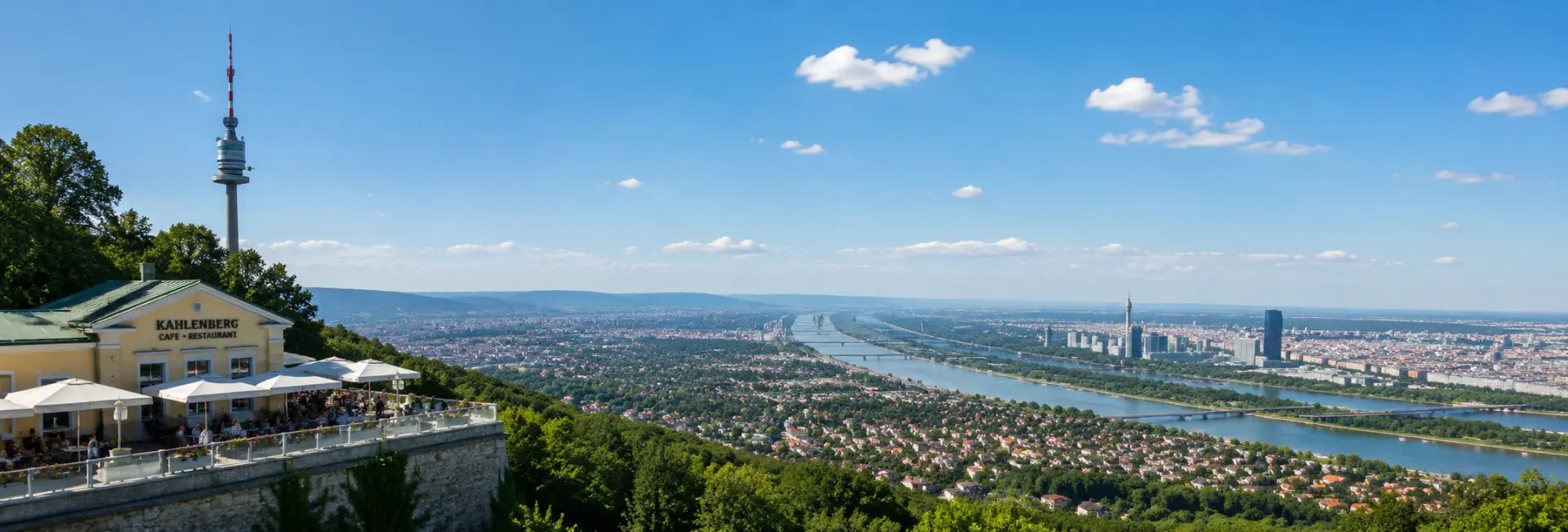
Kahlenberg is a forested hill rising on the northern edge of Vienna, in the city's 19th district, and it has long served as the place locals send visitors for the single best view over the whole city. At roughly 484 metres, it isn't a serious climb by mountain standards, but its position at the point where the Vienna Woods meet the Danube basin gives it an outsized view: the historic center, the river, and on clear days the plains stretching toward Slovakia and Hungary all lay out below the summit terrace.
Beyond the panorama, Kahlenberg carries real historical weight. It was here that a combined European relief army gathered before breaking the Ottoman siege of Vienna in 1683, a turning point still marked today by a small church at the summit. Vineyards, wine taverns, and forest trails fill out the rest of the hill, making it as much a half-day escape into nature as a viewpoint.
History
The Battle of Vienna
Kahlenberg's best-known moment in history came in September 1683, when a relief force under the command of Polish King Jan III Sobieski assembled on the hill before descending to break the Ottoman siege of Vienna below. The battle is widely regarded as a turning point in the long struggle between the Habsburg and Ottoman empires, and Kahlenberg's role in it is still commemorated at the site today.
From Hermitage to Parish
Long before the battle, the hill was granted to the Camaldolese religious order in the late 1620s, who built a hermitage and began work on what became St. Joseph's Church. The church was badly damaged during the 1683 siege but was gradually rebuilt over the following decades. After Emperor Joseph II dissolved contemplative religious orders in the 1780s, the surrounding settlement was refounded as the village of Josefsdorf, though it never grew much beyond a small hamlet.
A Polish Memorial Takes Shape
The church changed hands several times over the following century before a Polish religious order took charge of it in the early 1900s, restoring the building and dedicating a memorial chapel to Sobieski. Polish Pope John Paul II visited the site in 1983 to mark the battle's 300th anniversary, cementing Kahlenberg's status as a place of Polish as well as Austrian historical memory.
Natural Setting & Views
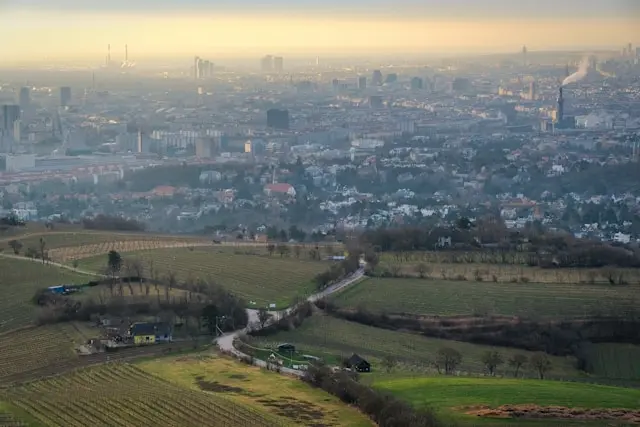
Kahlenberg sits at the eastern edge of the Wienerwald, the belt of forested hills that wraps around Vienna's northwestern flank, and its summit marks one of the highest points easily reached from the city center. The slopes below are covered largely in vineyards rather than dense forest, a legacy of centuries of local winemaking that continues in the villages at the base of the hill.
From the main viewing terrace, the view stretches across the entire Viennese basin: the compact historic core, the looping Ringstrasse, the Danube and its parallel channel, and the green expanse of the Prater park, where the Riesenrad ferris wheel is often visible as a small landmark in the distance. On especially clear days, visibility can extend as far as the Schneeberg massif some 80 kilometres to the south, or even toward Bratislava to the east.
Key Areas & Landmarks
The Main Viewing Terrace
A broad paved platform behind the church forms the hill's principal viewpoint and the spot most visitors head for first, offering an unobstructed view southeast over the city.
St. Joseph's Church and the Sobieski Chapel
This modest Baroque church anchors the summit and houses the Sobieski Memorial Chapel, decorated in the late 1920s with paintings commemorating the 1683 battle. A small museum space adjoining the chapel is not generally open to the public, but the church itself can be visited.
Stefaniewarte
A short walk from the main terrace stands the Stefaniewarte, a brick observation tower completed in 1897 and named for Crown Princess Stefanie. Climbing its roughly 125 steps rewards visitors with a different vantage point looking north over the Vienna Woods, away from the city itself.
Ways to Experience It
Kahlenberg can be reached on foot, by bus, or by car, and each route shapes the visit differently.
- Hike up via Vienna's City Hiking Trail 1, starting from the Nussdorf tram terminus and winding through vineyards and past several wine taverns on the way, a walk of roughly one and a half to two hours
- Take bus 38A directly from Heiligenstadt subway station, a ride of under 30 minutes with no transfer required
- Drive the Höhenstraße, a scenic 15-kilometre road that threads through the Vienna Woods and passes multiple viewpoints on its way to and past Kahlenberg
- Combine the visit with a stop in Grinzing or Nussdorf, wine villages at the foot of the hill known for their traditional Heurigen taverns
For those wanting more than a quick viewpoint stop, the hiking trail can be extended to the neighboring peak of Leopoldsberg, adding a further stretch of forest walking and a second summit view.
Best Time to Visit
- Clear mornings, especially after rain has cleared the air, tend to offer the longest and sharpest views over the city
- Sunrise and sunset are popular times for photography, when the light over the Danube basin is at its most dramatic
- Autumn days after rainfall are often cited as offering some of the best visibility of the year
- Weekends can bring more visitors to the summit terrace, so a weekday visit generally means a quieter experience
Visitor Tips
- Visibility varies significantly with weather, so don't expect the same dramatic view on a hazy or overcast day as on a clear one
- Wear comfortable shoes if hiking up from Nussdorf or Grinzing, since the trail passes through vineyards on uneven ground
- The Stefaniewarte tower involves a fair number of stairs with no elevator, so it may not suit visitors with mobility limitations
- Restaurants and cafés at the summit can get busy around midday, particularly on weekends, so arriving earlier or later in the day can mean a shorter wait
- Bring a layer even in summer, since the hilltop is noticeably cooler and windier than central Vienna
Nearby Attractions
- Leopoldsberg, a neighboring hill reachable by trail, with its own summit views and a historic church
- Grinzing, a traditional wine village known for its Heurigen taverns, at the base of the hill
- Nussdorf, another wine village and the starting point for the main hiking trail up Kahlenberg
- Cobenzl, a nearby vineyard hill with its own viewpoint and gardens along the Höhenstraße
FAQs about visiting Kahlenberg
What is Kahlenberg known for? +
It's known chiefly for its panoramic view over Vienna and the Danube, and for its role in the 1683 Battle of Vienna, when a relief army gathered here before breaking the Ottoman siege of the city below.
Is Kahlenberg free to visit? +
Yes, the viewing terrace and surrounding paths are free and open to the public; only the restaurants, cafés, and the Stefaniewarte tower may involve a small charge.
How do I get to Kahlenberg without a car? +
Bus 38A runs directly from Heiligenstadt subway station and takes under 30 minutes, or you can hike up via City Hiking Trail 1 from the Nussdorf tram terminus in about one and a half to two hours.
How long should I plan for a visit? +
A quick viewpoint stop can take as little as 30-45 minutes, while combining the hike, the church, the Stefaniewarte tower, and a meal or wine stop can easily fill half a day.
Is Kahlenberg suitable for kids or less experienced hikers? +
Yes, the bus route makes the summit easy to reach without any walking at all, and the hiking trail, while a couple of hours long, follows well-marked forest and vineyard paths rather than steep or technical terrain.
What's the best time of day or year to visit? +
Clear mornings and evenings around sunset generally offer the best visibility, and autumn days following rain are often especially good for long-distance views.
What else can I combine with a Kahlenberg visit? +
The neighboring hill of Leopoldsberg, and the wine villages of Grinzing and Nussdorf with their traditional Heurigen taverns, are all within easy reach and pair naturally with a half-day trip to the hill.
