
Table of Contents
Overview
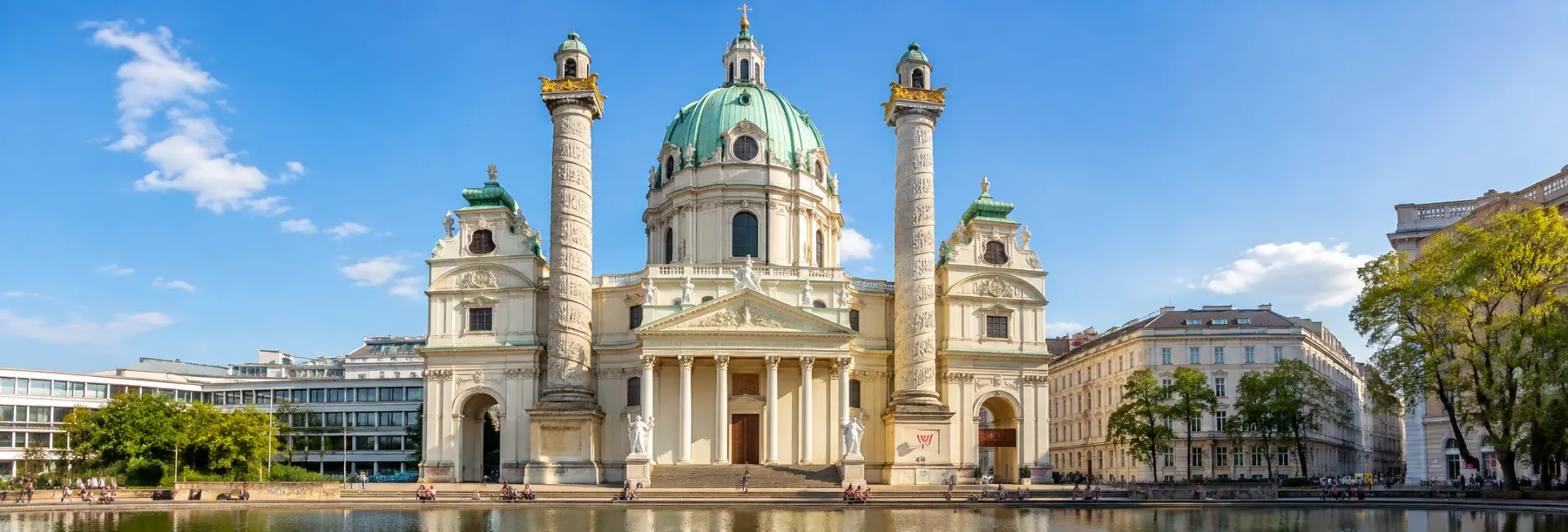
Karlskirche, or St. Charles's Church, stands on the south side of Karlsplatz as one of Vienna's most distinctive Baroque landmarks. Commissioned as a votive offering after a devastating plague outbreak, it combines an elliptical dome, a Roman-style portico, and two towering relief-carved columns into a design unlike any other church in the city.
Unusually for a historic church, visitors here can ride a panoramic elevator up close to the dome's frescoes, giving a perspective on the building's interior artwork that few other churches in Europe offer in quite the same way.
History
A Plague-Era Vow
The church's origins trace to a vow made by Emperor Charles VI during a severe outbreak of plague that struck Central Europe in the early 18th century. Charles VI pledged to build a church dedicated to Saint Charles Borromeo, a 16th-century cardinal remembered for his care of plague victims in Milan and who also happened to share the emperor's name, if Vienna was spared further devastation. Once the plague passed, construction was formally announced in 1713.
Design and Construction
Ground was broken in 1716 under the direction of court architect Johann Bernhard Fischer von Erlach, whose ambitious design blended classical, Baroque, and Byzantine architectural influences into a single structure. Fischer von Erlach died in 1723 before the project was finished, and his son, Joseph Emanuel Fischer von Erlach, completed the church, adjusting parts of the original plan along the way. The church was consecrated in 1737, shortly before the deaths of both Charles VI and the younger Fischer von Erlach's period of active work on the project.
A Living Landmark
Since the restoration of Karlsplatz as a coherent architectural ensemble in the late 1980s, Karlskirche has become an even more prominent fixture of the square, valued as much for its striking silhouette against the Musikverein and Vienna University of Technology as for its religious history.
Architecture & Design
The Dome and Portico
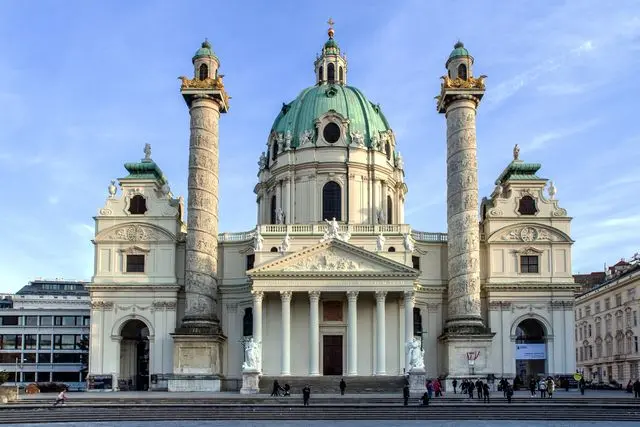
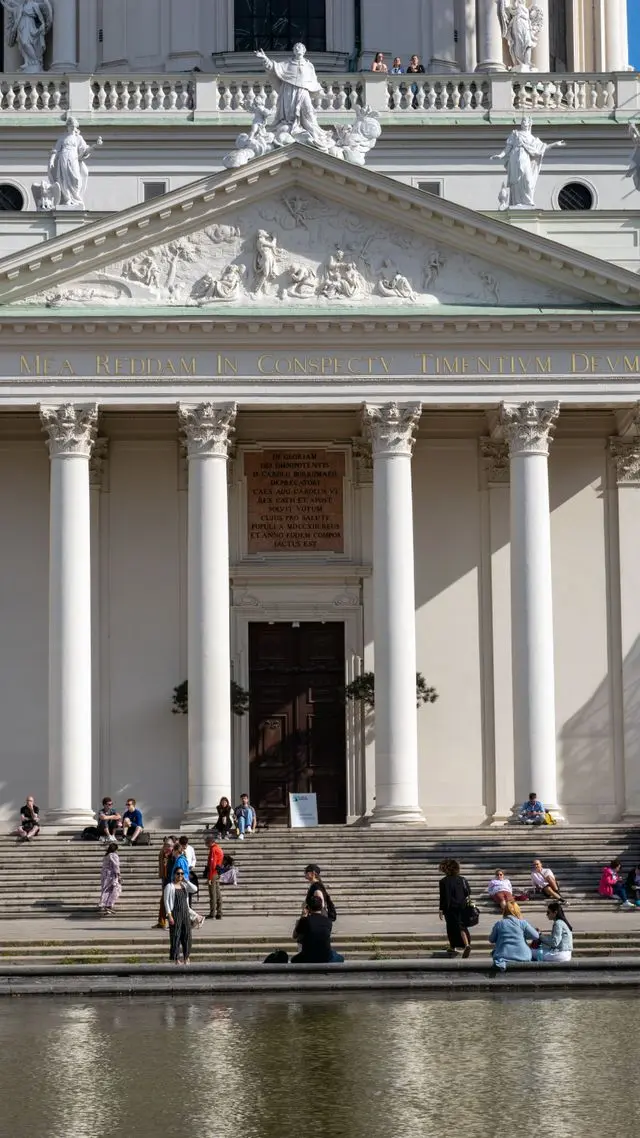
The church's outer dome rises to roughly 70 meters, giving Karlskirche one of the most recognizable skylines in Vienna. Below it, a Roman-style portico modeled on classical temple facades gives the entrance a monumental, templelike presence rarely seen on a Baroque church elsewhere in the city.
The Twin Columns
Flanking the entrance are two freestanding columns roughly 47 meters tall, their surfaces wrapped in spiraling relief carvings depicting scenes from the life of Saint Charles Borromeo. Their form directly echoes Rome's ancient triumphal columns, reworking an imperial Roman architectural device to celebrate a religious rather than military figure.
A Fusion of Styles
Taken together, the building's mix of Greek and Roman classical elements, Baroque ornamentation, and Byzantine-influenced massing makes Karlskirche something of an architectural curiosity, a deliberate statement of Habsburg cultural ambition as much as a place of worship.
Interior & Artwork
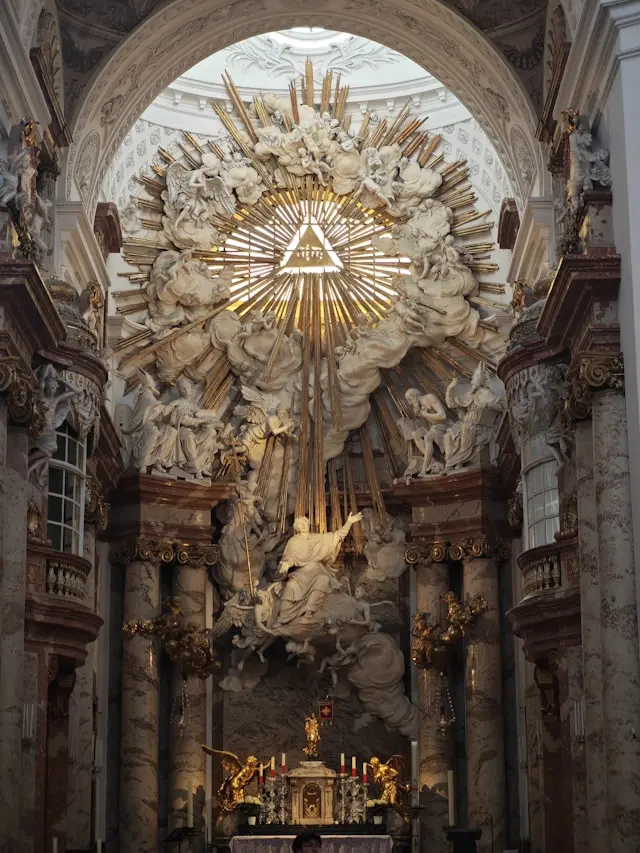
Inside, the dome is covered by a vast fresco by Johann Michael Rottmayr depicting the apotheosis of Saint Charles Borromeo, spanning roughly 1,250 square meters of painted surface. A high altar designed by Fischer von Erlach himself anchors the sanctuary, while marble finishes in red and gold tones carry the same lavish Baroque character found throughout the building.
In the vestibule, a detailed scale model of the church, standing nearly two and a half meters tall, lets visitors study the building's design up close before or after seeing the real thing. From the organ gallery, an outdoor terrace above the entrance portal offers a further vantage point over Karlsplatz.
Notable Features & Highlights
A few details make Karlskirche stand out even among Vienna's many historic churches:
- A panoramic elevator, unusual for a church of this age, carries visitors up close to the dome frescoes for a detailed view impossible to get from the floor.
- The composer Antonio Vivaldi was buried near the church in 1741, though his exact grave has since been lost, and the church now hosts regular concerts in his honor.
- Actress and inventor Hedy Lamarr married in the church's chapel in 1933, in a high-profile society wedding of its era.
- A reflecting pool in front of the church, featuring a sculpture by Henry Moore, creates one of Vienna's most photographed views of the dome and columns.
Ways to Experience It
Karlskirche offers more than a quick look from the square outside.
- Buy a ticket to enter the church and ride the panoramic elevator up toward the dome for a close view of the frescoes.
- Continue up to the terrace above the entrance portal for a broader view over Karlsplatz.
- Attend one of the church's regular classical music concerts, including performances tied to Vivaldi and Mozart.
- Examine the scale model of the church in the vestibule for a clearer sense of its overall design before exploring the interior.
Visiting Etiquette & Tips
As an active parish church, Karlskirche expects visitors to behave with the same respect due at any place of worship.
- A ticket is required to enter outside of scheduled services and events, with proceeds supporting the church's ongoing restoration work.
- Keep noise to a minimum and be mindful of visitors attending Mass or private prayer.
- The elevator to the dome typically stops running earlier than the church's general closing time, so check the last ride time before planning a visit around it.
- Dress modestly, as is customary when visiting active churches in Vienna.
- Photography is generally allowed inside, though flash photography near the altar and during services should be avoided.
Best Time to Visit
Late afternoon light tends to flatter the church's pale facade and the reflecting pool in front of it, making this a popular time for photographs. Weekday visits generally mean smaller crowds inside than weekend afternoons, particularly during peak tourist season.
Checking the schedule for concerts in advance can also shape the timing of a visit, since attending a performance inside the church offers a very different experience from a daytime sightseeing visit.
Nearby Attractions
Karlskirche sits at the heart of Karlsplatz, one of Vienna's best-connected squares, within walking distance of several other sights.
- The Musikverein, home of the Vienna Philharmonic's regular concerts, is just steps away.
- The Wien Museum, dedicated to the city's history, sits directly on the square.
- The Naschmarkt, Vienna's largest and liveliest market, is a short walk from the church.
- The Vienna State Opera and the inner city's main sights are within easy reach by foot or a quick tram ride.
FAQs about visiting Karlskirche
Why was Karlskirche built? +
It was built in fulfillment of a vow made by Emperor Charles VI during a severe plague outbreak, dedicating the church to Saint Charles Borromeo, a saint associated with plague relief and the emperor's namesake.
Can I go up to the dome? +
Yes, a panoramic elevator takes visitors up close to the dome's frescoes, and stairs continue on to a terrace above the entrance for wider views over Karlsplatz.
Is Karlskirche free to enter? +
No, a ticket is generally required to enter outside of religious services, with proceeds going toward the church's restoration.
What do the two columns outside represent? +
The twin columns are carved with relief scenes from the life of Saint Charles Borromeo and were modeled on ancient Roman triumphal columns like Trajan's Column in Rome.
Are concerts held at Karlskirche? +
Yes, the church regularly hosts classical concerts, including performances tied to Antonio Vivaldi, who was buried nearby, and other composers associated with Vienna.
How do I get to Karlskirche? +
The church sits on Karlsplatz, directly above the Karlsplatz U-Bahn station where the U1, U2, and U4 lines meet, and is also served by several tram lines.
Is Karlskirche still an active church? +
Yes, it remains an active parish church and hosts regular Mass alongside its role as a major tourist attraction.
