
Table of Contents
Overview
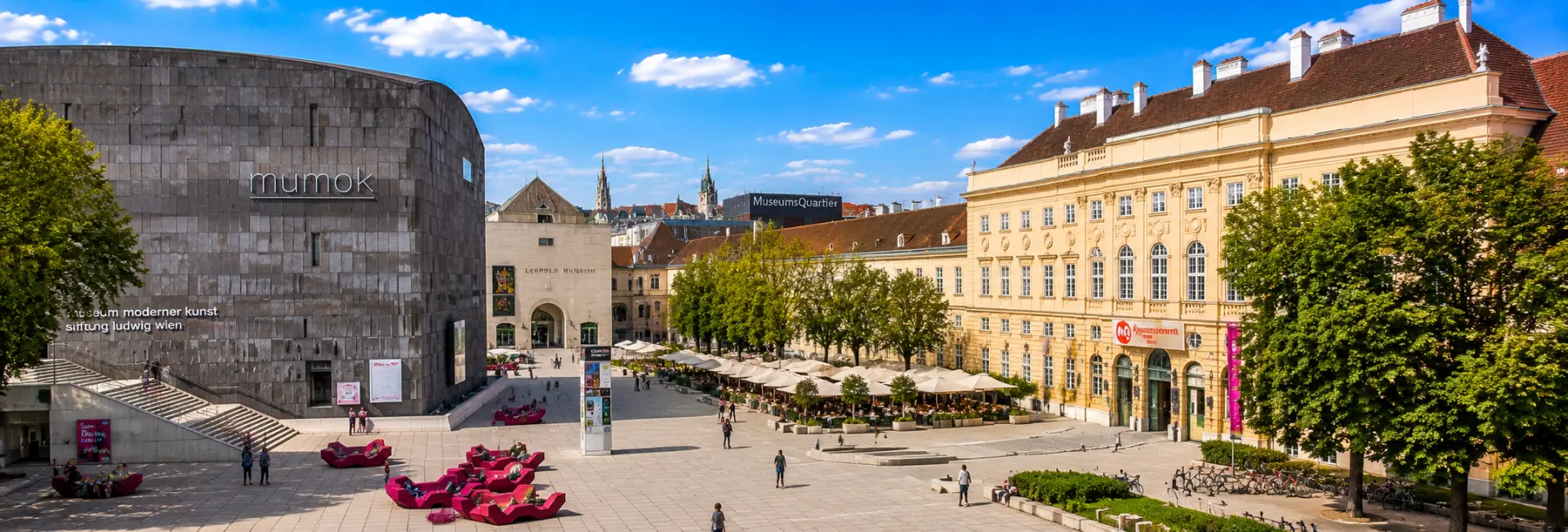
The MuseumsQuartier, often shortened to MQ, is a large arts and culture complex in Vienna's 7th district, built inside the former imperial court stables. It brings together major museums, smaller galleries, performance spaces, cafés, and shops within a single site that mixes restored Baroque buildings with contemporary architecture.
Unlike a single museum with one collection, the MQ functions more like a cultural neighborhood: visitors can move between an Egon Schiele retrospective, a contemporary art exhibition, and a relaxed afternoon in an open courtyard without ever leaving the grounds.
History
Imperial Stables
The site began as the Hofstallungen, the imperial court stables, built in the early 18th century under Emperor Charles VI to designs by architect Johann Bernhard Fischer von Erlach. At its height, the complex housed several hundred horses and the carriages used by the Habsburg court, making it one of the largest stable buildings of its era.
From Stables to Exhibition Halls
As the monarchy's need for large-scale stabling declined, the buildings were repurposed in the early 20th century for trade fairs and exhibitions, operating for decades as the Wiener Messepalast, or Vienna Fair Palace, before falling into partial disuse later in the century.
Creating the MuseumsQuartier
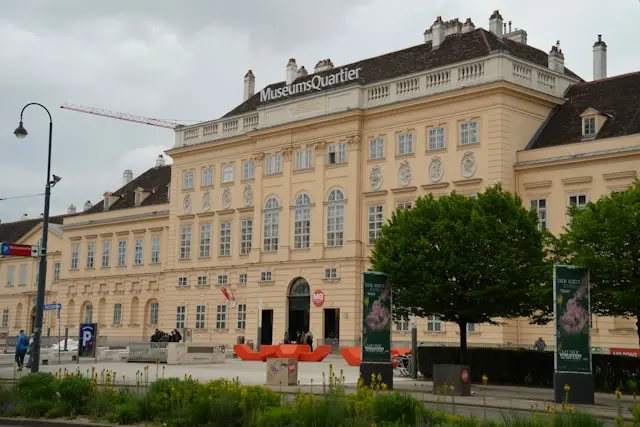
Plans to convert the site into a dedicated arts district took shape over the 1990s, following an extended public debate about how much of the historic stable buildings should be preserved versus replaced with new construction. The MuseumsQuartier opened in 2001, combining the restored Baroque exterior facing Museumsplatz with new museum buildings built within and around the historic shell.
Architecture & Design
The Baroque Facade
The long, pale facade facing Museumsplatz preserves the look of the original 18th-century stables, giving the complex a historic street presence that contrasts with the modern architecture found deeper inside the grounds.
Contemporary Additions
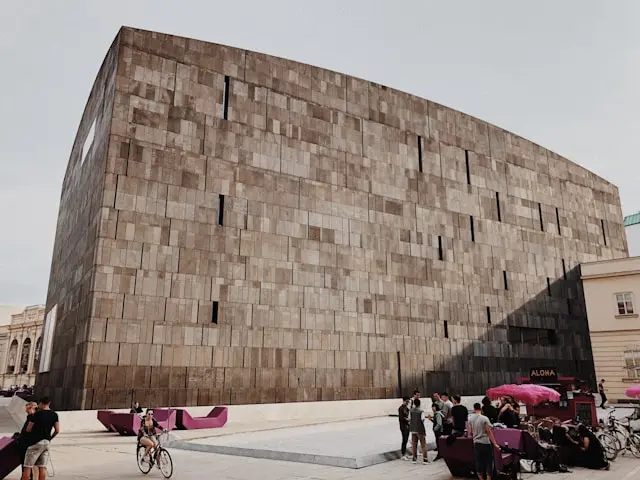
Architects Laurids and Manfred Ortner designed the new museum buildings inserted into and alongside the historic structure, most visibly the pale limestone volume of the Leopold Museum and the dark brick tower of MUMOK, both of which sit within the main courtyard alongside the older stable wings.
Public Courtyards
Large open courtyards run through the complex, designed as much for lingering as for moving between buildings, and are furnished with the MQ's distinctive chunky, modular seating known locally as the Enzis.
Key Institutions
The MuseumsQuartier houses dozens of cultural institutions, with a handful forming its main draws for most visitors:
- The Leopold Museum holds one of the world's largest collections of works by Egon Schiele, alongside major holdings of Gustav Klimt and other Austrian modernists.
- MUMOK, the Museum of Modern Art, focuses on 20th- and 21st-century art, including Pop Art, Fluxus, and Viennese Actionism.
- Kunsthalle Wien presents rotating contemporary art exhibitions across two exhibition halls within the complex.
- Architekturzentrum Wien examines architecture and urban planning through changing exhibitions.
- ZOOM Kindermuseum offers hands-on, interactive exhibits designed specifically for children.
- Tanzquartier Wien serves as a venue and production house for contemporary dance and performance.
Notable Features & Highlights
A few details help explain why the MQ draws repeat visitors, not just museum-goers passing through once:
- The Enzis, brightly colored modular loungers scattered across the main courtyard, have become an informal symbol of the complex and a popular spot to relax between museum visits.
- Quartier21, a section dedicated to design, digital culture, and independent creative studios, offers a more experimental counterpoint to the complex's larger museums.
- Seasonal installations and festivals are regularly staged in the courtyards, changing the character of the space throughout the year.
- The contrast between the preserved Baroque stable wings and the newer museum buildings gives the complex a layered, walkable architectural story in its own right.
Ways to Experience It
Because the MQ combines several independent institutions, visitors can shape a visit around their own interests rather than following one fixed route.
- Buy a combined ticket covering several museums if planning to visit more than one collection in a day.
- Focus on a single museum, such as the Leopold Museum for Austrian modernism or MUMOK for contemporary art, if time is limited.
- Spend time in the main courtyard itself, using the Enzis to people-watch or rest between exhibitions.
- Check the schedule for temporary festivals, film screenings, or design markets that regularly take over the courtyards.
- Bring children to ZOOM Kindermuseum for exhibits built specifically for younger visitors.
Best Time to Visit
Weekday mornings tend to be the quietest time to visit the individual museums, before tour groups and weekend crowds arrive. The courtyards themselves are busiest, and arguably most enjoyable, on warm afternoons and evenings when locals and visitors alike use the Enzis as an outdoor social space.
Because the complex includes both indoor museums and open-air courtyards, it works well as a year-round destination, though the courtyard atmosphere shifts considerably between a lively summer evening and a quieter winter afternoon.
Visitor Tips
A few practical points can make navigating the MQ's many institutions easier.
- Each museum sells its own ticket, though combined passes are available for visitors planning to see multiple collections.
- Opening hours vary by institution, so check individual museum schedules rather than assuming one set of hours applies to the whole complex.
- The complex is large and spread across multiple courtyards, so allow extra time to walk between institutions, especially with children in tow.
- Courtyard seating is free to use even without museum tickets, making it a good rest stop during a longer day of sightseeing nearby.
- Check for temporary exhibitions or events before visiting, since the program of activities in the courtyards changes frequently.
Nearby Attractions
The MuseumsQuartier sits within easy walking distance of several other major Vienna sights.
- The Kunsthistorisches Museum and Natural History Museum face each other just across Maria-Theresien-Platz, a short walk away.
- The Hofburg Palace and the shopping streets of the inner city are reachable on foot in a matter of minutes.
- The Volkstheater, one of Vienna's major stages for spoken drama, sits directly adjacent to the complex.
- Mariahilfer Strasse, one of Vienna's principal shopping streets, runs nearby for those looking to combine culture with retail.
FAQs about visiting the MuseumsQuartier
Do I need separate tickets for each museum? +
Yes, each institution within the MuseumsQuartier sells its own ticket, though combined passes are available if you plan to visit more than one museum in a day.
Is the MuseumsQuartier good for families? +
Yes, ZOOM Kindermuseum offers exhibits designed specifically for children, and the open courtyards give kids room to move around between museum visits.
How much time should I plan for a visit? +
A single major museum can take one to two hours, so if you want to see two or three collections along with time in the courtyards, plan for at least half a day.
Are the courtyards free to visit? +
Yes, the outdoor courtyards and their seating are open to the public at no charge, separate from paid entry to the individual museums.
What's the best museum to visit if I only have time for one? +
The Leopold Museum, with its extensive Egon Schiele and Klimt holdings, is the most commonly recommended single stop for visitors focused on Austrian art.
How do I get to the MuseumsQuartier? +
The MuseumsQuartier U-Bahn station on line U2 sits right at the complex, and it's also an easy walk from the Volkstheater station and the inner city.
Is the MuseumsQuartier open year-round? +
Yes, though individual museum hours vary and some exhibitions rotate seasonally, so it's worth checking specific institutions' schedules before visiting, especially around holidays.
