
Table of Contents
Overview
The Hofburg is the former principal palace of the Habsburg dynasty, sitting at the heart of Vienna's Innere Stadt district. For more than six centuries it served as the winter residence of the rulers of the Holy Roman Empire and later of the Austro-Hungarian Empire, while Schönbrunn Palace served as their summer retreat.
What began as a small medieval fortress in the 1270s grew, through generation after generation of building work, into one of the largest palace complexes in the world, with 18 wings, 19 courtyards, and roughly 2,600 rooms. Today the Hofburg is no museum piece frozen in time: it houses the offices of Austria's federal president, several major museums, the Austrian National Library, and the Spanish Riding School, all within walking distance of one another.
History
Medieval Origins
The oldest core of the Hofburg, known as the Alte Burg or Swiss Wing, was built in the 1270s under Ottokar II of Bohemia and taken over shortly after by the Habsburgs, who made it their seat as Dukes of Austria. Construction of this original fortified castle was substantially completed by 1552, with the Schweizertor, or Swiss Gate, added the following year.
Habsburg Expansion
Over the following centuries, successive emperors added new wings around the medieval core rather than replacing it. The freestanding Amalienburg went up under Rudolf II, the Leopoldine Wing followed under Leopold I in the 1660s to link the older buildings together, and after the failed Ottoman siege of 1683 the court architect Johann Bernhard Fischer von Erlach and his son Joseph Emanuel added the Winter Riding School, the Imperial Library, and the Imperial Chancellery Wing through the 18th century.
An Empire's Final Additions
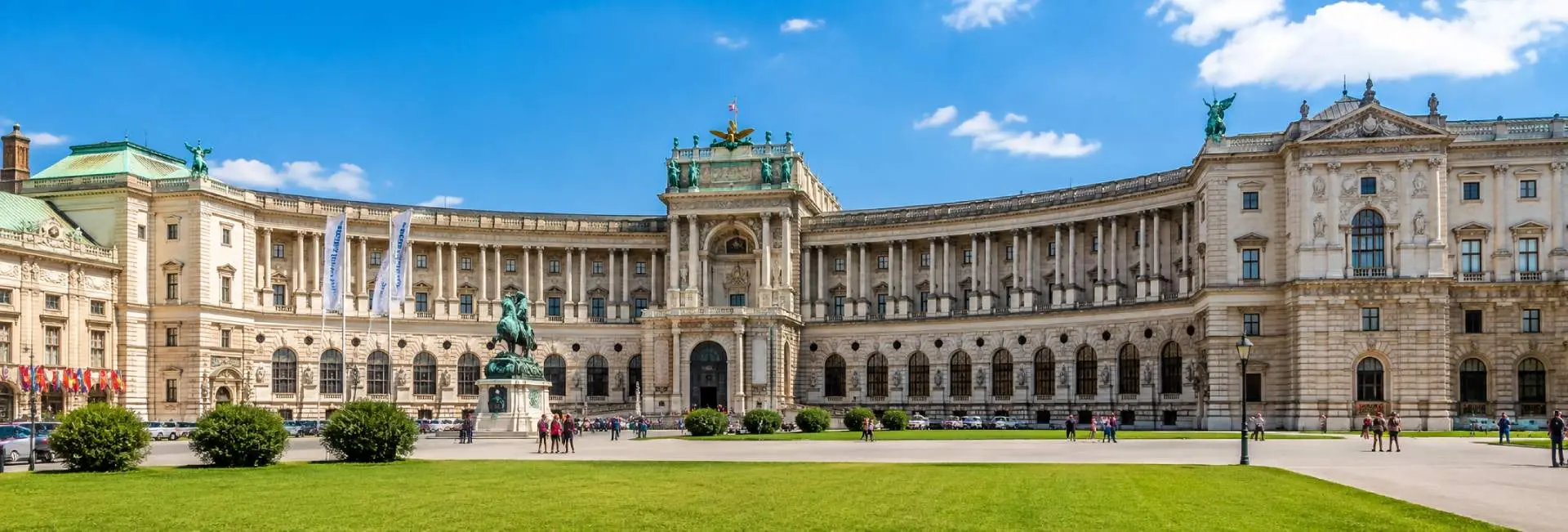
The 19th and early 20th centuries brought the palace's grandest expansion under Emperor Franz Joseph I, including the curved Neue Burg overlooking Heldenplatz, completed only in 1913, and the long-delayed Michaelertrakt, finished in the 1890s. Just five years after the Neue Burg was finished, the Habsburg monarchy collapsed at the end of the First World War, and the palace passed into the hands of the new Austrian republic.
Recognition
The Hofburg forms a central part of Vienna's historic centre, which UNESCO added to the World Heritage List in recognition of the city's exceptional architectural and cultural heritage. Several of its rooms, including the National Library's Baroque State Hall, are considered among the finest surviving court interiors in Europe.
Architecture & Key Wings
Because the Hofburg grew organically over roughly 700 years rather than being built to a single plan, it reads as a layered timeline of European architecture, from Gothic and Renaissance beginnings through Baroque grandeur to 19th-century Historicism. Walking from the old Swiss Court toward Heldenplatz means passing through several centuries of building styles in the space of a few hundred metres.
Notable Wings and Courtyards
- Swiss Wing (Schweizertrakt) – the oldest surviving section, entered through the striking red-and-gold Swiss Gate
- Amalienburg – a freestanding Renaissance residence later used as the private apartments of Empress Elisabeth ("Sisi")
- Leopoldine Wing – home to the offices of Austria's federal president since 1946
- Imperial Chancellery Wing (Reichskanzleitrakt) – decorated with monumental sculptures of the Labours of Hercules, leading into the Imperial Apartments
- Michaelertrakt – the curved Baroque facade with its green dome that forms the palace's grand entrance from Michaelerplatz
- Neue Burg – the palace's final, most monumental addition, overlooking the open expanse of Heldenplatz
Museums & Imperial Collections
Several of the Hofburg's wings have been turned into museums, letting visitors move from grand state architecture into the everyday and ceremonial life of the Habsburg court. Three collections in particular draw most visitors: the Sisi Museum, the Imperial Silver Collection, and the Imperial Treasury.
Sisi Museum and Imperial Apartments
Set within the Reichskanzleitrakt and Amalienburg, this self-guided route moves through around two dozen rooms telling the story of Empress Elisabeth of Austria, alongside the preserved private apartments of Emperor Franz Joseph I, who reportedly slept on a simple iron camp bed his entire reign.
Imperial Silver Collection
Included on the same ticket, this collection holds thousands of pieces of court tableware and kitchen equipment, giving a sense of the scale required to host imperial banquets for hundreds of guests at a time.
Imperial Treasury
Housed separately in the Swiss Wing, the Kaiserliche Schatzkammer displays the crown jewels and regalia of the Holy Roman Empire and the Austrian Empire, including elaborate ceremonial vestments and relics accumulated by the Habsburgs over hundreds of years.
The Spanish Riding School
The Spanish Riding School, housed in the Baroque Winter Riding School hall within the Hofburg, has practised classical academic horsemanship for more than 450 years. Its Lipizzaner stallions perform choreographed movements that trace back to Renaissance-era riding traditions, making it one of the oldest institutions of its kind still in active use.
Visiting the School
- Watch a full performance in the historic riding hall on scheduled show days
- Attend a morning training session to see the horses and riders at work outside of performances
- Take a guided tour of the stables and riding hall on non-performance days
Ways to Experience It
Because the Hofburg is really a cluster of separate sights sharing one address, most visitors pick a handful of highlights rather than trying to see everything in one visit. Tickets can usually be combined to cover several attractions at once, which helps keep both cost and walking distance manageable.
- Combined ticket covering the Sisi Museum, Imperial Apartments, and Imperial Silver Collection
- Separate ticket for the Imperial Treasury and its crown jewels
- Spanish Riding School performances, training sessions, or stable tours
- Self-guided walk through the public courtyards and squares, which is free
- Guided tours of the State Apartments or the Austrian National Library's State Hall
Best Time to Visit
The Hofburg's interior museums keep consistent hours year-round, so the main variable for visitors is crowding rather than seasonal opening. Arriving at opening time or in the early afternoon on weekdays tends to mean shorter queues at the ticket counters.
- Spring and autumn bring mild weather for exploring the outdoor squares and courtyards without summer's peak crowds
- Summer mornings are the busiest time inside the Sisi Museum and Treasury, especially on weekends
- Winter visits are quieter indoors and pair well with Vienna's Christmas markets nearby
Visitor Tips
- Buy tickets online in advance for the Sisi Museum, Imperial Apartments, or Treasury to skip the on-site queue
- Combined tickets that bundle several Hofburg sights together are usually cheaper than paying for each separately
- The Michaelerplatz entrance is the main access point, but the complex also has entrances from Heldenplatz and Josefsplatz
- Photography without flash is generally allowed in the museum interiors, but check current signage on arrival
- Comfortable shoes help, since the full complex covers a large area with several separate buildings to walk between
Nearby Attractions
The Hofburg sits at the centre of Vienna's Innere Stadt, so several other major sights are within a short walk of its gates.
- St. Stephen's Cathedral, roughly a seven-minute walk through the Graben and Kohlmarkt shopping streets
- The Albertina museum, adjoining the palace complex near Albertinaplatz
- Burggarten and Volksgarten, the palace's neighbouring public parks
- Vienna State Opera, a short walk south of the palace grounds
FAQs about visiting Hofburg Palace
What is Hofburg Palace famous for? +
It was the winter residence and seat of power of the Habsburg dynasty for over six centuries, and it's now known for the Sisi Museum, the Imperial Treasury, and the Spanish Riding School's Lipizzaner horses.
How much time do I need to visit the Hofburg? +
Plan on at least two to three hours to cover the Sisi Museum, Imperial Apartments, and Silver Collection, and add extra time if you also want to see the Imperial Treasury or a Spanish Riding School performance.
Is Hofburg Palace free to visit? +
Walking through the public courtyards and squares is free, but the museums, apartments, and Spanish Riding School performances all require separate paid tickets.
How do I get to Hofburg Palace? +
The palace is served by the U3 underground line at Herrengasse station, a short walk from the Michaelerplatz entrance, and by several tram and bus lines stopping nearby along the Ringstrasse.
Is the Hofburg suitable for kids and visitors with limited mobility? +
The palace grounds and main museum routes are generally accessible, and the site is used to hosting large numbers of visitors, though some historic staircases and older rooms have limited step-free access, so it's worth checking current accessibility details before visiting.
What's the difference between the Hofburg and Schönbrunn Palace? +
The Hofburg was the Habsburgs' winter residence in the centre of Vienna, while Schönbrunn was their summer palace on the city's outskirts; many visitors choose to see both on separate days rather than combining them into one visit.
Do I need to book Spanish Riding School tickets in advance? +
Yes, performances and popular morning training sessions can sell out, especially in high season, so booking ahead is recommended if seeing the Lipizzaner horses is a priority.
What should I combine my Hofburg visit with? +
St. Stephen's Cathedral, the Albertina museum, and the Burggarten and Volksgarten parks are all within easy walking distance and pair naturally with a Hofburg visit.
