Table of Contents
Overview
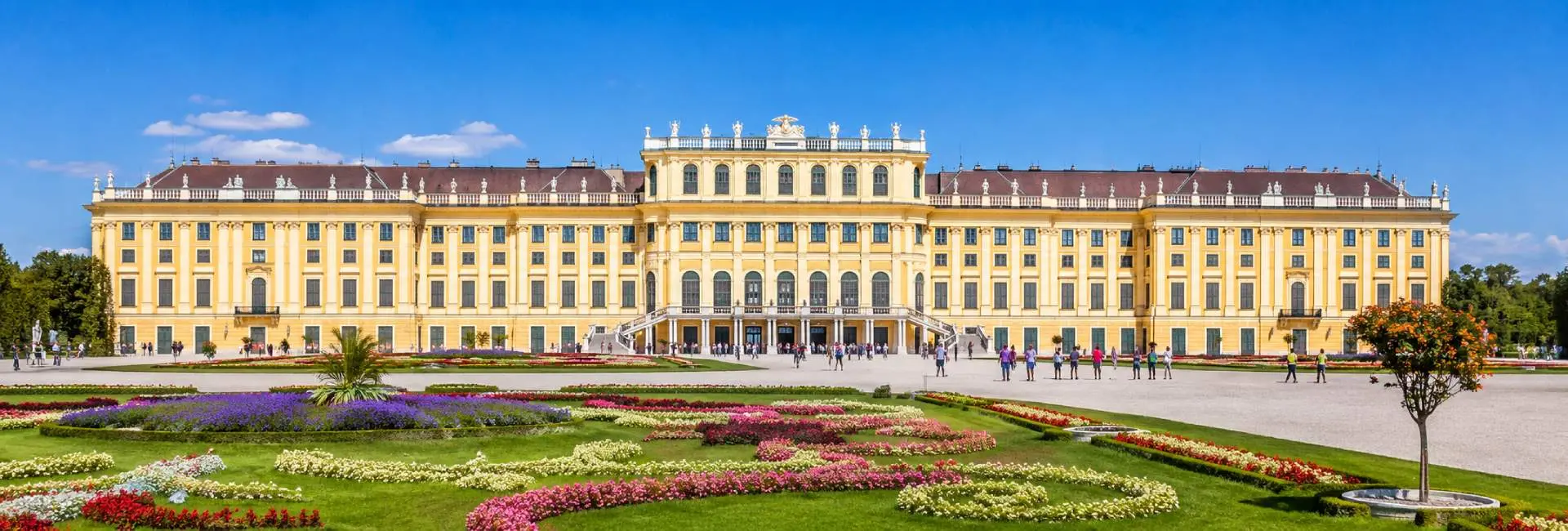
Schönbrunn Palace is the former summer residence of the Habsburg emperors, set in Vienna's Hietzing district just a few kilometers from the historic city center. With 1,441 rooms spread across a sprawling Baroque complex, it ranks among the most visited sights in Austria and offers a vivid picture of imperial life at the height of the Habsburg dynasty's power.
Beyond the palace walls, an extensive landscaped park stretches out behind the building, anchored by the hilltop Gloriette monument and dotted with fountains, sculpted hedges, and the world's oldest continuously operating zoo. Together, the palace and grounds form a single, cohesive work of art that captures nearly three centuries of Austrian history in one place.
History
Origins and Early Construction
The site takes its name, meaning "beautiful spring," from an artesian well once used to supply the imperial court with drinking water. After the earlier hunting lodge on the grounds was destroyed during the 1683 Ottoman siege of Vienna, Emperor Leopold I commissioned architect Johann Bernhard Fischer von Erlach to design an ambitious new residence intended to rival the Palace of Versailles.
Construction began in 1696, and the first festivities were held in the newly built central section of the palace just three years later. Fischer von Erlach's original, even grander vision was never fully realized, and the project was later scaled back and reworked under subsequent rulers.
The Maria Theresa Era
Schönbrunn reached its defining form under Empress Maria Theresa, who made it her preferred summer residence starting in 1743. Her court architect, Nikolaus Pacassi, remodeled the interiors into the Rococo showpiece visitors see today, while Johann Ferdinand Hetzendorf von Hohenberg later added the Gloriette, the Neptune Fountain, the Roman Ruin, and the Obelisk during the 1770s.
It was in the palace's Hall of Mirrors that a six-year-old Wolfgang Amadeus Mozart is said to have performed for Maria Theresa in 1762, one of many stories that tie the palace to Austria's cultural life alongside its political history.
Napoleon, the Congress of Vienna, and the Habsburg Twilight
Napoleon Bonaparte used Schönbrunn as his military headquarters during his occupations of Vienna and stayed in rooms now known as the Napoleon Suite; the 1809 Treaty of Schönbrunn was signed within its walls. A few years later, the Great Gallery hosted sessions of the Congress of Vienna in 1814 and 1815, where European powers redrew the map of the continent after the Napoleonic Wars.
Emperor Franz Joseph I was born at Schönbrunn in 1830, ruled from the palace for 68 years, and died there in 1916, making it deeply woven into the final decades of Habsburg rule.
20th-Century Uses and Restoration
After the fall of the monarchy following World War I, the palace was converted into a museum. It suffered damage during World War II and was subsequently restored. During the Allied occupation of Austria (1945–1955), parts of the building served as offices for the British delegation and military garrison in Vienna.
Since 1992, the palace and gardens have been owned and managed by a limited-liability company wholly owned by the Republic of Austria, which oversees their preservation and public access today.
UNESCO World Heritage Status
The Palace and Gardens of Schönbrunn were inscribed as a UNESCO World Heritage Site in 1996, recognized for illustrating the tastes, interests, and political ambitions of successive Habsburg monarchs across more than two centuries. The listing covers roughly 160 hectares (400 acres) encompassing the palace building, formal gardens, and surrounding park.
- UNESCO reference number: 786
- Inscription year: 1996
- Criteria: Cultural (i, iv), recognizing outstanding architectural and landscape design
- Protected area: approximately 160 hectares (400 acres)
Architecture & Design
Schönbrunn is a textbook example of Baroque and Rococo design, built and remodeled in stages by three major architects: Johann Bernhard Fischer von Erlach, Nikolaus Pacassi, and Johann Ferdinand Hetzendorf von Hohenberg. Despite the long construction history, the complex reads as a unified whole, with the palace's rooms arranged in an enfilade, or straight axial sequence, in the French courtly manner, creating sweeping sightlines through the interiors out toward the gardens.
The palace's exterior is instantly recognizable for its warm ochre-yellow facade, a color later standardized in the 19th century and now informally known as "Schönbrunn Yellow." Before that, the walls had been painted in other shades over the centuries, including grey during a brief Neoclassical phase.
The State Rooms & Interiors
Scale and Access
Of the palace's 1,441 rooms, 45 are open to the public across the two main tour routes. The interiors showcase Rococo craftsmanship at its height, with gilded stucco, mirrored walls, and elaborate ceiling paintings celebrating the power of the Habsburg dynasty.
Notable Rooms
- The Great Gallery – the grand ceremonial hall where the Congress of Vienna convened in 1814–15
- The Hall of Mirrors – a gilded Rococo state room associated with Mozart's childhood performance
- The Millions Room – paneled in rosewood and set with rare Indo-Persian miniatures, considered one of the finest Rococo rooms in existence
- The Round Chinese Cabinet – where Maria Theresa held private conferences with her state chancellor
- The Vieux-Laque Room – used by Napoleon for conferences during his occupation of the palace
- The Blue Chinese Salon – site of Emperor Charles I's 1918 renunciation of governmental affairs, marking the end of the monarchy
- The Bergl Rooms – ground-floor apartments painted with exotic landscape murals commissioned by Maria Theresa between 1769 and 1777
The Gardens & Park
The palace grounds have been open to the public since 1779 and remain free to enter year-round. Laid out in formal Baroque style, the park stretches from the rear of the palace up a gently rising hill, with clipped hedges, statuary, and fountains framing the main vistas.
The Gloriette
Perched on the crest of the hill behind the palace, the Gloriette is a colonnaded monument completed in 1775 to a design by Hohenberg. Originally conceived as a monument to just and glorious warfare, it now doubles as a viewing terrace with sweeping views back over the palace and across Vienna, and its glazed central hall was designed as a banqueting space for imperial celebrations.
Fountains and Features
- Neptune Fountain – the dramatic centerpiece at the foot of the hill, completed as part of Maria Theresa's 1770s garden design
- Roman Ruin – an artificial "ancient ruin" folly built as a picturesque garden feature
- Obelisk Fountain – marks the end of the eastern diagonal avenue and forms one of the park's key focal points
- Palm House – a striking 19th-century glass conservatory housing exotic plants from around the world
- Maze and labyrinth – a hedge maze near the rear of the palace, popular with families
Schönbrunn Zoo
Tucked into the grounds is Schönbrunn Zoo, founded in 1752 on the initiative of Maria Theresa's husband, Emperor Franz I Stephan, making it the oldest continuously operating zoo in the world. What began as an imperial menagerie built around a central pavilion has grown into a modern zoo spanning about 17 hectares (42 acres).
The zoo combines its original Baroque-era structures with contemporary animal enclosures and is home to several thousand animals across hundreds of species, drawing more than two million visitors a year in its own right.
Ways to Experience It
Most visitors experience Schönbrunn through one of two main interior tour routes, which can be paired with time in the gardens, the Gloriette, and the zoo depending on how much of the estate you want to cover.
- Imperial Tour – covers 22 rooms and takes roughly 40 minutes, focused on the state apartments
- Grand Tour – covers 40 rooms in about an hour, including the private apartments of Maria Theresa
- Gloriette visit – climb to the terrace for panoramic views over the gardens and city (seasonal access, typically early April to early November)
- Garden and park walks – self-guided routes through the formal gardens, maze, and Palm House
- Combined passes – ticket bundles that pair the palace tour with the gardens, Gloriette, and zoo for visitors planning a full day
Best Time to Visit
Schönbrunn is a year-round destination, but the experience changes considerably with the seasons. Spring and early autumn tend to offer the most comfortable balance of mild weather and manageable crowds, since the gardens are in bloom or turning color without the peak-summer congestion.
Seasonal Notes
- Spring (April–May) – gardens in full bloom, Gloriette terrace reopens for the season
- Summer (June–August) – warmest weather and the busiest period, especially midday; early morning visits help avoid the largest crowds
- Autumn (September–October) – comfortable temperatures and thinner crowds, still within the Gloriette's open season
- Winter (November–March) – palace interiors remain open, and the grounds take on a quieter, atmospheric character, though some outdoor features like the Gloriette terrace close for the season
Visitor Tips
- Book timed-entry tickets online in advance, especially for weekends and the summer high season, to avoid long queues at the gate
- Wear comfortable, closed-toe shoes, since the grounds involve cobblestone paths and a fair amount of walking between the palace, gardens, and Gloriette
- Strollers are welcome in the gardens but not inside the palace's staterooms; a cloakroom is available for storing them during the tour
- Arrive via the U4 subway line to Schönbrunn station, then walk about 5 to 10 minutes to the main entrance, rather than driving, since on-site parking is limited relative to demand
- Set aside a half day or more if you want to combine the palace tour with the gardens, Gloriette, and zoo rather than rushing through
- Check official visiting hours and any current ticket prices before your trip, since these details can change seasonally
Nearby Attractions
Schönbrunn sits about 7 km from central Vienna, making it easy to pair with other major sights on the same day via the city's public transit network.
- Vienna State Opera – roughly 6.2 km away, reachable by U-Bahn from Schönbrunn station
- Belvedere Palace – about 6.5 km away, another Habsburg-era palace complex with notable art collections
- St. Stephen's Cathedral – around 7 km away, at the heart of Vienna's historic center
- Hietzing district – the palace's immediate neighborhood, worth a stroll for its residential Viennese character
FAQs about visiting Schönbrunn Palace
What is Schönbrunn Palace known for? +
It's the former summer residence of the Habsburg emperors, famous for its 1,441 rooms, Rococo state apartments, and Baroque gardens, and it has been a UNESCO World Heritage Site since 1996.
How much time should I plan for a visit? +
Budget at least 2 to 3 hours for the palace interior and gardens, or a half day or more if you also want to visit the Gloriette and the zoo.
Is entry to Schönbrunn free? +
The gardens and park are free to enter year-round, but visiting the palace interior requires a paid ticket, and the Gloriette terrace and zoo also charge separate admission.
Do I need to book tickets in advance? +
It's strongly recommended, especially in summer and on weekends, since timed-entry palace tours can sell out and advance booking helps you skip long lines at the gate.
How do I get to Schönbrunn Palace from central Vienna? +
The easiest way is the U4 subway line to Schönbrunn station, about a 15 to 20 minute ride from Karlsplatz or Schwedenplatz, followed by a short walk to the main entrance; trams 10 and 60 also stop directly outside the gates.
Is Schönbrunn Palace suitable for kids and visitors with mobility needs? +
Yes, the gardens are stroller-friendly and the zoo is a major draw for families, though strollers must be left at a cloakroom before touring the palace's state rooms, and comfortable walking shoes are recommended for the cobblestone paths throughout the grounds.
What's the difference between the Imperial Tour and the Grand Tour? +
The Imperial Tour covers 22 rooms in about 40 minutes and focuses on the main state apartments, while the Grand Tour covers 40 rooms in roughly an hour and adds Maria Theresa's private chambers for a more in-depth visit.
Can I visit the Gloriette and the zoo on the same ticket as the palace? +
Combined passes are available that bundle the palace tour with garden features like the Gloriette and with Schönbrunn Zoo, which is useful for visitors planning to see the whole estate in one day.
What should I combine with a Schönbrunn Palace visit? +
Its location a short subway ride from the city center makes it easy to pair with sights like the Vienna State Opera, Belvedere Palace, or St. Stephen's Cathedral on the same day.