Table of Contents
Overview
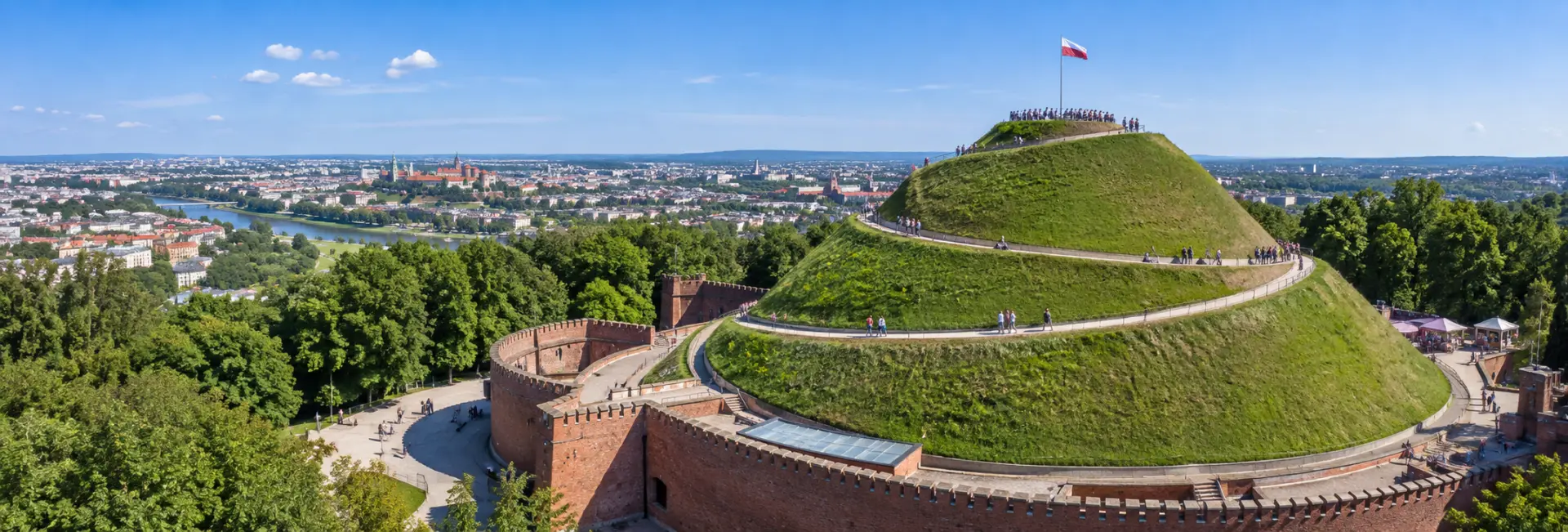
Rising above the rooftops of Kraków's Podgórze district, Krakus Mound is a grass-covered earthen hill that has puzzled historians for close to a century. Locally known as Kopiec Krakusa, it sits atop Lasota Hill, at roughly 271 meters above sea level, and is widely regarded as the oldest man-made structure in the city, older even than Wawel Castle. Standing about 16 meters tall with a base some 60 meters across, it is also the largest prehistoric earthwork surviving anywhere in Poland. Tradition holds that it marks the burial place of Krakus, the legendary prince credited with founding Kraków after slaying a fire-breathing dragon.
No one has ever proven who built the mound or exactly why, and that unresolved mystery is a large part of its appeal. Less than three kilometers from Wawel Hill as the crow flies, it draws far fewer crowds than the Old Town's landmarks, rewarding the short climb with a free, wide-open view across the Vistula valley and one of the most atmospheric walks in the city.
History & Origins
An Unsolved Age
Archaeologists have never settled on a firm construction date for Krakus Mound. Excavations carried out between 1934 and 1937 cut into the hill and found a solid core of interwoven wooden beams packed with soil, stones, and turf, rather than the loose earth fill typical of a simple burial heap. Fragments recovered from inside date to the 8th–10th centuries CE, but they did not conclusively date the mound's construction, and no human remains were ever uncovered inside it, leaving the excavation team of the 1930s with more open questions than answers.
A separate and still-debated theory pushes the mound's origins back much further, to around the 2nd or 1st century BCE, tying it to Celtic communities who may have once occupied the area later known as Kraków. Because the two theories are separated by roughly a thousand years, the mound's true builders, construction date, and original purpose remain genuinely unknown, and no single excavation has managed to close that gap.
From Pagan Hilltop to City Fortification
Whatever its original use, the hill and its surroundings were long treated as sacred ground, likely serving pre-Christian communities as a place of ritual and remembrance rather than a simple grave marker. Four smaller satellite mounds once encircled the main hill but were leveled in the 19th century to make way for the Kraków Fortress, an Austrian-era ring of defenses built around the city. A fort was built directly around the mound in 1849 and stood until it was dismantled in 1954; faint traces of these fortifications, including old embankments and wall footings, can still be spotted on the surrounding slopes today by anyone willing to look closely.
The Legend of King Krakus
Kraków's own founding myth is inseparable from this hill. According to legend, Prince Krakus rid the area of a ravenous dragon that had been terrorizing the local population from a cave beneath what is now Wawel Hill, and in gratitude the people made him their ruler, founding the city that bears his name. Some versions of the tale credit Krakus himself with the killing, while others give the honor to his sons; either way, the dragon story and the founding of Kraków have become permanently intertwined in local memory. When Krakus eventually died, the story goes that his grieving subjects carried soil to this spot by the handful, sleeve-load by sleeve-load, piling it higher and higher until it formed a mountain fit to honor the man who had once ruled over the land below.
It is this act of collective mourning that gives the mound its enduring emotional pull: rather than being a monument commissioned by a king, folklore frames it as a memorial built entirely by ordinary people, one handful of earth at a time. Whether or not a historical Krakus ever existed, the legend has shaped how generations of Cracovians have understood their city's beginnings, and it still lends the mound a weight that its modest, grass-covered appearance might not otherwise suggest.
Sister Mounds & Astronomical Alignment
Krakus Mound does not stand alone. Across the river to the northeast lies the smaller Wanda Mound, said in legend to be the resting place of Krakus's daughter, Princess Wanda, who supposedly drowned herself in the Vistula rather than marry a foreign suitor. Together with two much later, 19th- and 20th-century memorial mounds built for Tadeusz Kościuszko and Józef Piłsudski, these four earthworks make up what Cracovians call the city's "four mounds."
Researchers have also noted a striking alignment between the two prehistoric mounds: standing on Krakus Mound and looking toward Wanda Mound around sunrise on May 1st, close to the ancient Celtic festival of Beltane, the sun appears to rise directly over the smaller hill. This apparent solar alignment, similar in spirit to observations made at sites like Stonehenge, fuels the theory that the mound had a ceremonial or calendrical role for whichever community first raised it.
The Rękawka Festival
Each year on the Tuesday following Easter, the slopes of Krakus Mound host Rękawka, a folk festival with roots that predate written records of the city. Historically it combined the remembrance of the dead with the arrival of spring, blending older pre-Christian customs with later Christian practice, and it was traditionally observed at the mound before being pushed to the nearby hill around St. Benedict's Church in the 19th century after Austrian authorities banned gatherings at the site itself in the 1830s.
Rękawka fell out of practice for a long stretch of the 20th century but has been revived since the 2000s and is now once again celebrated annually, drawing costumed re-enactors, craft stalls, and demonstrations of early medieval life and combat to the area around the mound. For visitors happening to be in Kraków at the right time of year, it offers a rare chance to see the hill filled with activity rather than its usual quiet.
Ways to Experience It
There is no single "correct" way to visit Krakus Mound; most people simply follow the worn dirt path that spirals up from the base to the flat summit platform, a walk that takes most visitors well under fifteen minutes at an easy pace.
- Walk to the top for a 360-degree view that takes in the Vistula River, the rooftops of Podgórze, and, on a clear day, the outline of the Tatra Mountains far to the south.
- Combine the climb with a stop at the neighboring Liban Quarry, a disused 19th-century limestone quarry, once run by the Jewish Liban and Ehrenpreis families, that later became a wartime forced-labor site and, in 1993, a film set for the Płaszów camp scenes in Schindler's List; overgrown paths now wind past rusting machinery and abandoned kilns.
- Photograph the mound from a distance along ul. Wielicka or from the surrounding green slopes, where its distinctive conical shape stands out against the skyline.
- Bring a picnic blanket; the grassy slopes are a popular, unofficial spot for locals to relax away from the busier Old Town parks.
- Extend the outing into a longer loop by continuing on foot toward the Church of St. Benedict and, further afield, Wanda's Mound across the river.
Best Time to Visit
Krakus Mound is open around the clock and can be visited in any season, but late spring through early autumn offers the most comfortable footing on its grass-and-dirt path and the clearest long-distance views. Early morning and the hour before sunset are especially good times to climb, when the light is softer and the summit is quieter.
Visiting on the Tuesday after Easter lets travelers combine the hike with the Rękawka festival, while winter visits, though colder and occasionally slippery, offer a starkly beautiful, near-empty summit and crisp views across the valley.
Visitor Tips
- The mound is free to enter and has no set opening hours, but daylight visits are recommended since the path has no lighting.
- Wear shoes with good grip; the earthen path can turn muddy or slick after rain.
- There are no facilities, food stalls, or ticket booths on site, so bring water, especially in warmer months.
- The closest tram and bus stops are a short walk away in Podgórze; there is also limited street parking nearby for those arriving by car.
- Accessibility is limited: the summit is reached by an unpaved, sloped path that is not suitable for wheelchairs or strollers.
Nearby Attractions
The mound sits within easy reach of several other Podgórze landmarks, making it simple to combine with a wider half-day walk through the district that mixes ancient legend with more recent, sobering history.
- Liban Quarry – a striking abandoned limestone quarry just steps from the mound's base, layered with 19th-century industry, wartime history, and leftover film props.
- Church of St. Benedict – a small medieval chapel on the adjoining hillside, historically linked to the Rękawka festival.
- Wanda's Mound – the legendary resting place of Krakus's daughter, located across the river.
- Oskar Schindler's Enamel Factory – the museum housed in Schindler's former factory, a short tram ride away in Podgórze.
- Kraków Ghetto Memorial (Plac Bohaterów Getta) – a poignant square of empty chairs commemorating the victims of the wartime Kraków Ghetto, also within Podgórze.
FAQs about visiting Krakus Mound
What is Krakus Mound? +
It is a large, ancient earthen mound in Kraków's Podgórze district, traditionally believed to be the burial place of the city's legendary founder, King Krakus.
Is Krakus Mound free to visit? +
Yes, there is no entrance fee and no set opening hours, so it can be visited at any time.
How long does it take to climb Krakus Mound? +
Most visitors reach the summit in under fifteen minutes along the spiral dirt path from the base.
How old is Krakus Mound? +
Its age is disputed: excavation finds point to the 8th–10th centuries, while another theory places its origins as far back as the 2nd–1st century BCE, and no definitive date has ever been confirmed.
Is Krakus Mound worth visiting? +
For travelers who enjoy free viewpoints, local legend, and quieter corners of the city away from the Old Town crowds, it's a rewarding short detour with genuine historical intrigue.
How do you get to Krakus Mound? +
It's reachable by tram or bus to the Podgórze district followed by a short uphill walk, or by car with limited street parking nearby.
Is Krakus Mound suitable for kids or people with mobility issues? +
Children generally manage the climb easily, but the unpaved, sloped path is not accessible for wheelchairs, strollers, or visitors with significant mobility limitations.
What else can I see near Krakus Mound? +
The neighboring Liban Quarry, the Church of St. Benedict, Wanda's Mound, and the Oskar Schindler Factory museum are all within easy reach in the surrounding Podgórze district.
What is the Rękawka festival? +
It's an annual folk festival held on the Tuesday after Easter near the mound, reviving pre-Christian spring traditions with costumed re-enactments and craft stalls.