Table of Contents
Overview
Kraków's Old Town, known locally as Stare Miasto, is the historic core of the city and one of the best-preserved medieval town centers in Europe. Laid out on a regular grid in the 13th century, it still follows almost the same street pattern today, anchored by Europe's largest surviving medieval market square and ringed by a green belt of parkland where the old city walls once stood.
Because Kraków largely escaped the destruction that leveled much of Warsaw and other Polish cities during the Second World War, its Old Town retains an unusually intact collection of Gothic, Renaissance, and Baroque architecture. Walking its streets today means passing directly through centuries of layered Polish history, all within an easily walkable area.
History
A New City After the Mongol Raids
Kraków received its city charter in 1257 under Magdeburg Law, shortly after Mongol invasions had devastated the earlier settlement. The charter laid out a new, orderly grid plan centered on a vast main square, with regular streets radiating outward, a layout that has survived with remarkably little change ever since.
Growth as a Royal and Academic Center
Over the following centuries, Kraków flourished as the capital of the Polish-Lithuanian state, its city walls expanded and reinforced, and grand churches and townhouses replaced earlier wooden structures. In 1364, King Casimir the Great founded what would become Jagiellonian University, one of the oldest universities in Central Europe, cementing the Old Town's role as a center of learning as well as royal power.
Losing the Walls, Gaining a Park
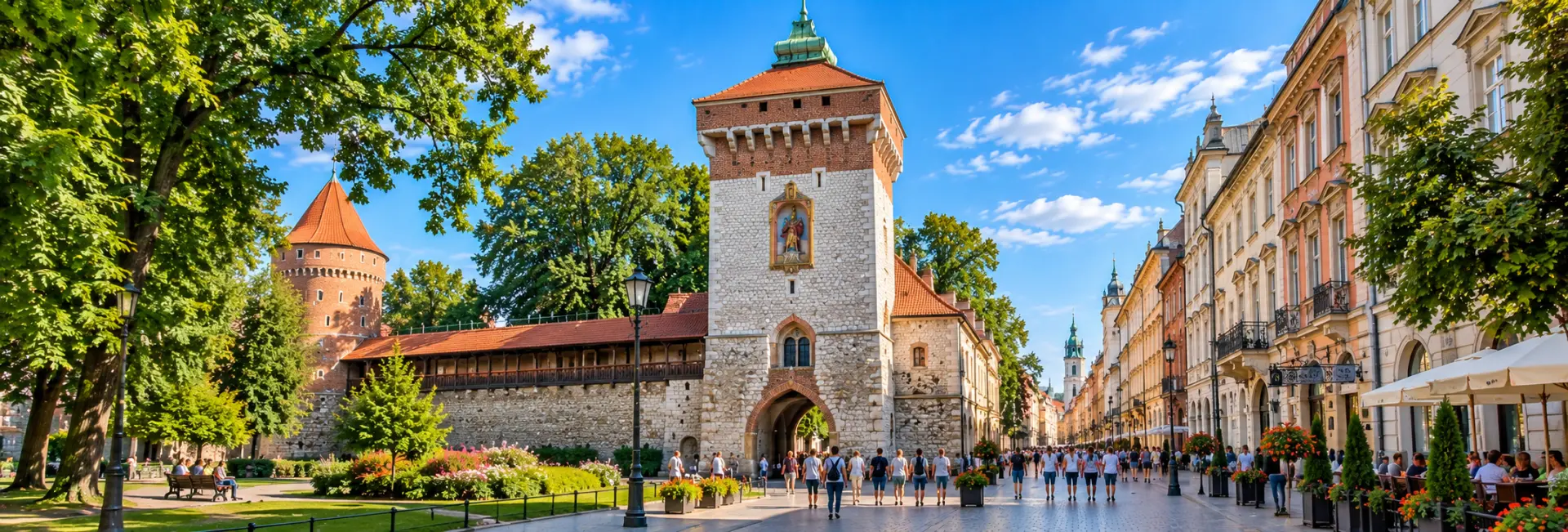
As Kraków's fortifications became militarily obsolete, Austrian authorities ordered much of the medieval city walls dismantled in the early 19th century. A local university professor successfully campaigned to preserve a small surviving section, including the Barbican and St. Florian's Gate, while the rest of the fortified ring was transformed into Planty, a landscaped park that still traces the outline of the old walls today.
Surviving the 20th Century
Unlike much of Poland, Kraków's historic core suffered relatively little physical destruction during the Second World War, largely because German occupying forces used the city as an administrative center. This unusual survival left the Old Town's medieval and Renaissance fabric largely intact, and in 1978 it became one of the first sites ever inscribed on the UNESCO World Heritage list.
Layout & Fortifications
The Old Town's defining feature remains its 13th-century grid, radiating outward from the Main Market Square in a pattern of streets that has changed remarkably little over more than seven centuries. This grid is enclosed by Planty, a roughly three-kilometer ring of parkland created where a double line of medieval walls, moats, and towers once stood.
Only a small fragment of the original fortifications survives today, centered on the Barbican, a round fortified outpost built around 1498, and the adjoining St. Florian's Gate, both preserved thanks to a 19th-century campaign led by a Jagiellonian University professor. Together they mark the historic northern entrance to the city and the start of the ceremonial route once used by Polish monarchs.
Key Areas & Streets
The Royal Route
Running from St. Florian's Gate through the Main Market Square and on toward Wawel Hill, the Royal Route traces the path once taken by Polish kings entering the city for coronations and other ceremonial occasions. Today it forms the natural spine for a walking tour of the Old Town.
Floriańska Street
One of the Old Town's principal streets, Floriańska connects the Barbican to the Main Market Square and is lined with historic townhouses, including the house where painter Jan Matejko lived and died, now preserved as a museum.
The University Quarter
West of the Main Square, a cluster of streets has been associated with Jagiellonian University since the late Middle Ages, centered on Collegium Maius, the university's oldest surviving building.
Kanonicza Street
Running toward Wawel Hill, this quiet street preserves rows of Renaissance-era townhouses and offers one of the Old Town's most atmospheric walks away from the busier main routes.
Notable Landmarks
Several major sights sit within the Old Town's compact grid, many worth a dedicated visit in their own right.
- The Main Market Square, the vast 13th-century square at the district's center, home to the Cloth Hall and St. Mary's Basilica
- The Barbican and St. Florian's Gate, the best-preserved remnants of the medieval fortifications
- Collegium Maius, the oldest building of Jagiellonian University, purchased for the school in 1400
- Planty Park, the green ring encircling the entire Old Town along the line of the former walls
- Wawel Hill, at the Old Town's southern edge, home to the Royal Castle and Cathedral
Ways to Experience It
The compact, walkable layout of the Old Town makes it easy to explore at a range of paces and interests.
- Walk the Royal Route from St. Florian's Gate through the Main Market Square to Wawel Hill, following the path once used by Polish monarchs
- Stroll the full loop of Planty Park for a green, tree-lined alternative to the busier streets inside the old walls
- Join a guided walking tour focused on the Old Town's medieval history or its university heritage
- Take a horse-drawn carriage ride around the Main Market Square and nearby streets
- Explore quieter side streets, such as Kanonicza, for a slower look at the district's historic townhouses
Best Time to Visit
The Old Town can be enjoyed year-round, with a lively atmosphere in summer when outdoor cafés fill the Main Market Square, and a quieter, more atmospheric mood in the cooler months. The Christmas and Easter markets bring a distinct seasonal energy to the square, drawing crowds from across the region.
Early mornings offer the calmest time to walk the district's streets and Planty Park before day-trippers and tour groups arrive in force, particularly during the busy summer season.
Visitor Tips
A few practical notes help visitors make the most of a walk through the Old Town.
- The district is compact and best explored on foot, since most major sights sit within a fifteen- to twenty-minute walk of each other
- Wear comfortable shoes for cobblestone streets throughout the district
- Individual landmarks, such as St. Mary's Basilica, the Cloth Hall galleries, and Collegium Maius, each keep their own opening hours and ticket prices worth checking in advance
- Café and restaurant prices directly on the Main Market Square tend to run higher than those on quieter side streets
- Consider allotting a full day to cover the Old Town thoroughly, especially if combining it with a visit to Wawel Hill
Nearby Attractions
The Old Town sits at the center of a wider historic city, with several other significant areas close by.
- Wawel Royal Castle and Wawel Cathedral, directly adjoining the Old Town's southern edge
- Kazimierz, Kraków's historic Jewish quarter, a short walk southeast and part of the same UNESCO-listed historic center
- The Vistula Boulevards, running along the riverbank below Wawel Hill
- The Main Market Square and its surrounding landmarks, forming the heart of the Old Town itself
- Podgórze, across the river, home to the former Kraków Ghetto area and Schindler's Factory Museum
FAQs about visiting Kraków Old Town
What is Kraków Old Town known for? +
It is known as one of Europe's best-preserved medieval town centers, built around a 13th-century street grid and Europe's largest surviving medieval market square.
How old is Kraków's Old Town? +
Its layout dates to 1257, when the city was rebuilt on a new grid plan under Magdeburg Law following earlier Mongol raids.
Why did Kraków's Old Town survive so well? +
Unlike much of Poland, Kraków suffered relatively little physical destruction during the Second World War, largely because German occupying forces used it as an administrative center, leaving its historic architecture largely intact.
What is Planty Park? +
It is a roughly three-kilometer ring of parkland encircling the Old Town, created in the 19th century on the site of the demolished medieval city walls.
How much time should I plan for the Old Town? +
A full day allows time to walk the Royal Route, explore the Main Market Square, and visit a few landmarks in depth, though a shorter visit can still cover the highlights.
Is the Old Town walkable? +
Yes, it is compact and best explored on foot, with most major sights within a fifteen- to twenty-minute walk of one another.
What is the Royal Route? +
It is the historic path Polish monarchs once took from St. Florian's Gate through the Main Market Square to Wawel Hill, and it remains a popular route for visitors today.
What else is nearby if I want to keep exploring? +
Wawel Royal Castle, the Kazimierz district, and the Vistula Boulevards are all within easy walking distance, making the Old Town a natural base for exploring the rest of historic Kraków.