Table of Contents
Overview
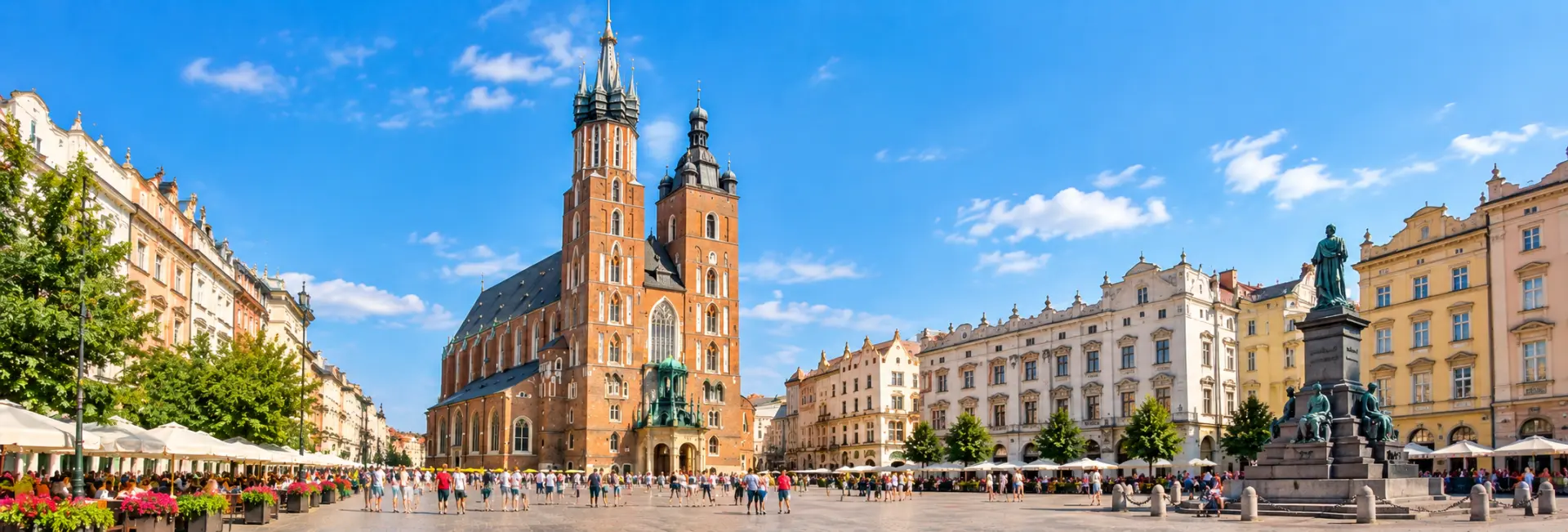
St. Mary's Basilica stands at the northeast corner of Kraków's Main Market Square, its two mismatched Gothic towers forming one of the most recognizable silhouettes in the city. Formally known as the Church of the Assumption of the Blessed Virgin Mary, it draws visitors for its richly decorated interior, its towering altarpiece, and the trumpet call played from its taller tower every hour of every day.
Still an active Roman Catholic parish, the basilica manages to feel both intimate and monumental at once, with a hushed, art-filled interior that stands in vivid contrast to the crowds and street performers filling the square just outside its doors.
History
Origins on the Market Square
A church has stood on this site since at least the early 13th century, though the earlier structure was destroyed during Mongol raids on the city. The present Gothic church was built through the 14th century, with construction largely completed by 1355 to 1365, and later expanded with additional side chapels in the following century.
Rebuilding After Disaster
According to long-standing local accounts, part of the church's vaulting collapsed following an unusual seismic event in 1442, requiring significant rebuilding work in the years that followed. Over subsequent centuries, the basilica's interior was repeatedly updated and embellished as Kraków's wealth and religious life evolved.
A 19th-Century Transformation
Between 1887 and 1891, architect Tadeusz Stryjeński oversaw a major neo-Gothic restoration of the interior, during which celebrated Polish painter Jan Matejko designed the basilica's now-famous decorative scheme, working alongside young artists Stanisław Wyspiański and Józef Mehoffer, who created much of the stained glass. In 1978, the basilica was inscribed as part of the UNESCO-listed Historic Centre of Kraków.
Architecture & Design
Built largely of brick in the Gothic style, the basilica is considered one of the finest surviving examples of Polish Gothic architecture. Its most distinctive external feature is its pair of unequal towers, the taller reaching around 80 meters and long used as a watchtower and the source of the city's hourly trumpet signal, while the shorter tower houses the church's bells.
Inside, tall Gothic arches rise toward a vaulted ceiling painted deep blue and scattered with gold stars, part of Jan Matejko's 19th-century decorative program, which also covers the walls with ornamental patterns, heraldic motifs, and painted figures of angels.
Cultural & Religious Significance
As an active parish church, St. Mary's Basilica continues to hold regular services and remains a working place of worship at the same time as one of Poland's most visited religious sites. Its trumpet call, known as the Hejnał, has been played from the tower every hour for centuries and is broadcast nationally at noon each day, making the basilica a recognizable part of Polish cultural life far beyond Kraków itself.
The church has also hosted significant national moments, including the funeral of Polish President Lech Kaczyński and his wife in 2010, underscoring its continued role in Polish civic and religious life alongside its historic character.
Notable Features
A handful of features draw the most attention from visitors stepping inside.
- The Veit Stoss altarpiece, carved between 1477 and 1489 and considered the largest Gothic wooden altarpiece in the world, depicting the death of the Virgin Mary in lifesize polychrome figures
- The blue, star-covered vaulted ceiling designed by Jan Matejko in the 19th century
- Stained glass windows created by Stanisław Wyspiański and Józef Mehoffer, filling the chancel with color
- The hourly Hejnał trumpet call, played from the taller tower and famous for breaking off abruptly mid-melody
- The legend of the two brothers said to have built the mismatched towers, commemorated by a knife displayed nearby in the Cloth Hall
Visiting Etiquette & Tips
A visit combines the practicalities of a major tourist site with the etiquette expected of an active church.
- Tickets for tourist visits are purchased at a separate entrance from the one used for worship, and entry for prayer or attending Mass is always free
- Keep voices low and avoid visiting during services if your goal is sightseeing rather than worship
- Photography inside is often restricted or limited to certain areas, so check current signage on arrival
- Climbing the towers requires a separate ticket with limited daily availability, and tickets typically cannot be booked in advance, so arriving early improves your chances
- Children under a certain age are generally not permitted to climb the towers, so check current age restrictions if traveling with young children
Best Time to Visit
The basilica can be visited comfortably throughout the year, though mornings tend to be quieter than midday, when tour groups moving through the Main Market Square often peak. Because the tower-climbing tickets are limited and sold same-day, arriving early is especially important for visitors hoping to go up.
Visiting on the hour, whenever convenient, offers the chance to hear the Hejnał trumpet call played live from the tower, a small but memorable moment that repeats around the clock every day of the year.
Nearby Attractions
The basilica's location on Kraków's Main Market Square puts it within a short walk of many of the city's most visited sights.
- The Cloth Hall, standing at the center of the Main Market Square just steps away
- The Rynek Underground Museum, accessible beneath the Cloth Hall nearby
- Wawel Royal Castle and Wawel Cathedral, a walk of about fifteen minutes south
- The Barbican and St. Florian's Gate, remnants of Kraków's medieval fortifications to the north
- Kazimierz, the historic Jewish quarter, a walk of around twenty minutes southeast
FAQs about visiting St. Mary's Basilica
What is St. Mary's Basilica known for? +
It is best known for its Veit Stoss altarpiece, its blue star-covered ceiling, and the hourly trumpet call played from its taller tower, all set within one of Kraków's most recognizable Gothic buildings.
Why do the two towers look different? +
There is no architectural record explaining the difference, but local legend attributes it to two brothers who each built one tower, with the story ending in jealousy and tragedy.
Is it free to visit St. Mary's Basilica? +
Entry for prayer or attending Mass is always free, though sightseeing visits during open hours typically require a ticket purchased at a separate entrance.
What is the Hejnał trumpet call? +
It is a short bugle melody played from the basilica's taller tower every hour, traditionally said to commemorate a medieval trumpeter struck by an arrow while warning the city of an attack.
Can I climb the towers? +
Yes, though tickets are limited, sold same-day only, and often sell out by morning, so arriving early is recommended for anyone hoping to climb.
How much time should I plan for a visit? +
Seeing the main interior and altarpiece takes around thirty minutes, though visitors who also climb a tower or wait to hear the Hejnał should allow extra time.
Is photography allowed inside? +
Photography is often limited or restricted in certain areas of the basilica, so it is worth checking posted signage when you arrive.
What else is nearby if I want to keep exploring? +
The Cloth Hall, the Rynek Underground Museum, and Wawel Royal Castle are all within easy walking distance, making the basilica a natural stop on a walk through Kraków's Old Town.