Table of Contents
Overview
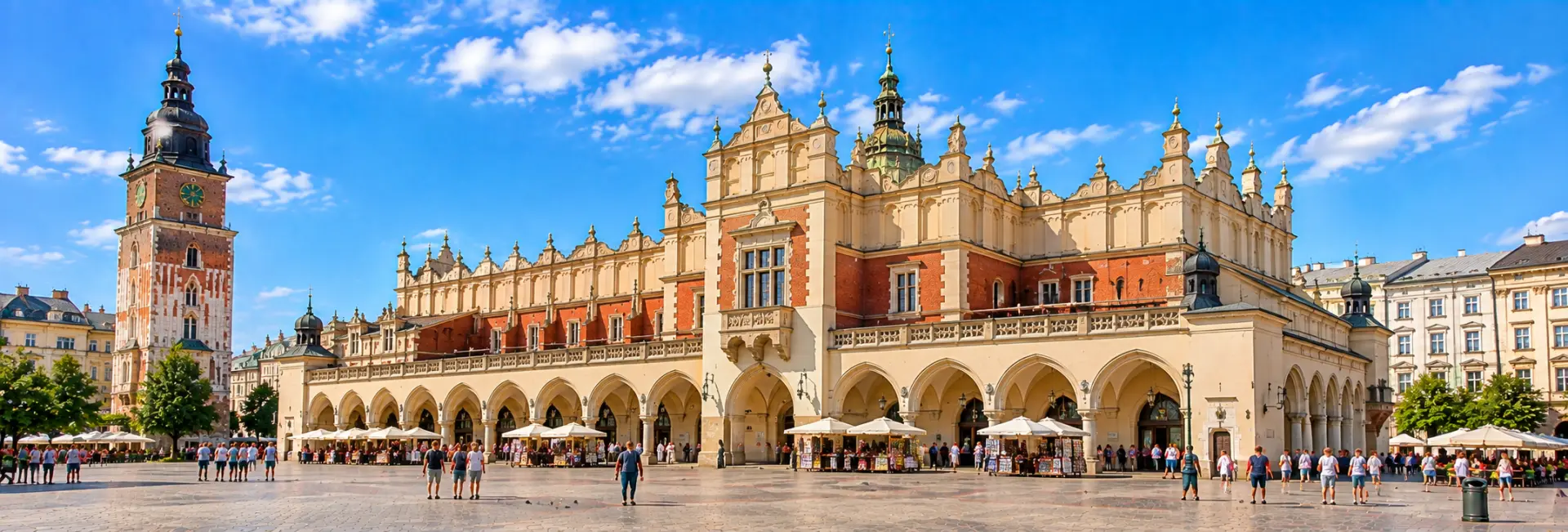
The Cloth Hall, known in Polish as Sukiennice, stretches across the center of Kraków's Main Market Square and has functioned as a marketplace for more than seven centuries. Its long Renaissance facade and covered central passageway make it one of the most recognizable buildings in the city, and it remains, remarkably, still in commercial use today.
Beyond its ground-floor stalls, the building's upper floor houses a major gallery of 19th-century Polish painting and sculpture, while an archaeological museum lies just beneath its foundations. Few buildings anywhere combine active commerce, fine art, and medieval archaeology so directly under one roof.
History
From Market Street to Covered Hall
The Cloth Hall's origins trace back to the mid-13th century, shortly after Kraków received its city charter under Magdeburg Law. King Bolesław V the Chaste established two rows of stalls at the center of the newly planned Main Market Square for the sale of cloth, one of the region's most valuable traded goods. By the 13th century, these stalls had been covered with a roof, forming the earliest version of the hall.
A Gothic Trading Hall
In 1358, King Casimir III the Great commissioned a far more substantial stone building on the site, a monumental Gothic hall roughly 108 meters long lined with stalls on either side. This structure served Kraków's merchants for nearly two centuries, cementing the Cloth Hall's role as the commercial heart of the city.
Rebuilding After Fire
A devastating fire in 1555 destroyed the Gothic hall, but the disaster gave Kraków the opportunity to rebuild in the fashionable style of the day. Italian architects associated with the royal court, including Giovanni Maria Padovano and Santi Gucci, led a Renaissance reconstruction between 1556 and 1559, adding the ornately decorated attic parapet and column loggias that still define the building's silhouette.
A 19th-Century Restoration
By the late 1800s the Cloth Hall had fallen into disrepair, prompting a major renovation between 1875 and 1879 led by architect Tomasz Pryliński. This project added the arcades running along both sides of the building, reorganized the ground-floor stalls, and created new exhibition rooms upstairs, which opened in 1879 as one of Poland's first public art galleries.
Architecture & Design
The Cloth Hall's overall form still reflects its Renaissance reconstruction, with a long rectangular footprint, a central passageway running the length of the building, and the distinctive attic parapet decorated with carved mascarons along the roofline. This blend of Italian Renaissance ornament applied to a fundamentally Gothic trading hall gives the building its unusual, layered character.
The arcades framing the building today date only to the 19th-century restoration, when Tomasz Pryliński added them along with new decorative details, including carved column capitals attributed to painter Jan Matejko, who contributed to the design work during the renovation.
Collections & Exhibits
The Trading Stalls
The ground floor continues its centuries-old commercial function, now filled with vendors selling amber jewelry, leather goods, wood carvings, and other traditional Polish crafts, arranged along wooden stalls decorated with the coats of arms of Polish cities and guild emblems.
Gallery of 19th-Century Polish Art
Occupying the building's upper floor, this branch of the National Museum in Kraków holds the largest permanent collection of 19th-century Polish painting and sculpture, displayed across several grand exhibition halls. Highlights include large-scale history paintings alongside portraiture and landscape work spanning the late Baroque period through the early 20th century.
Rynek Underground Museum
Beneath the Cloth Hall's foundations lies an archaeological museum built around excavated medieval market stalls, roads, and building foundations uncovered during extensive excavations carried out under the square.
Must-See Highlights
A first visit to the Cloth Hall typically combines a few key elements across its different levels.
- The Renaissance attic parapet and its carved mascarons, best appreciated from the square outside
- The ground-floor stalls, still selling traditional Polish crafts after centuries of continuous trade
- Large-scale 19th-century Polish history paintings on display in the upstairs gallery
- The 19th-century arcades added by Tomasz Pryliński, including column capitals linked to painter Jan Matejko
- The Rynek Underground Museum beneath the building, for those interested in the square's medieval archaeology
Ways to Experience It
Most visitors experience the Cloth Hall on several levels during a single stop at the Main Market Square.
- Walk the ground-floor passageway and browse the craft stalls, free to enter at any time during opening hours
- Visit the Gallery of 19th-Century Polish Art upstairs on a separate ticket for a deeper look at Polish painting and sculpture
- Descend into the Rynek Underground Museum beneath the building for its archaeological exhibits
- View the building's exterior from a café table on the Main Market Square to take in its full Renaissance facade
Best Time to Visit
Because the ground-floor stalls and much of the surrounding square are outdoors or semi-open, the Cloth Hall is pleasant to visit in most seasons, though the upstairs gallery and underground museum offer a reliable indoor option regardless of weather. Mornings tend to be quieter than midday, when tour groups crossing the Main Market Square are at their busiest.
The building's stalls and gallery keep their own separate hours from the rest of the square's attractions, so checking current times is worthwhile, particularly for the gallery, which is typically closed on Mondays.
Visitor Tips
A few practical notes make it easier to plan time around the Cloth Hall's several distinct sections.
- Walking through the ground-floor stalls is free, while the upstairs gallery and the Rynek Underground Museum each require separate paid tickets
- Prices for crafts and souvenirs inside the stalls can run higher than elsewhere in the city, so it is worth comparing options if shopping is a priority
- Confirm current opening hours for the gallery and underground museum before visiting, since they differ from each other and can vary seasonally
- The building sits at the busiest point of the Main Market Square, so visiting early in the day helps avoid the largest crowds
- Combine a visit with nearby St. Mary's Basilica and the Rynek Underground Museum for a fuller morning or afternoon on the square
Nearby Attractions
Standing at the center of the Main Market Square, the Cloth Hall sits within easy reach of Kraków's other major Old Town sights.
- St. Mary's Basilica, just across the square to the northeast
- The Adam Mickiewicz Monument, standing directly beside the Cloth Hall
- The Rynek Underground Museum, accessible beneath the Cloth Hall itself
- Wawel Royal Castle and Wawel Cathedral, a walk of about fifteen minutes south
- Floriańska Street and St. Florian's Gate, leading north from the square along the historic Royal Route
FAQs about visiting the Cloth Hall
What is the Cloth Hall known for? +
It is known as Kraków's historic Renaissance trading hall, still functioning as a marketplace for traditional crafts while also housing a major gallery of 19th-century Polish art on its upper floor.
Is it free to visit the Cloth Hall? +
Walking through the ground-floor stalls is free, while the upstairs Gallery of 19th-Century Polish Art and the Rynek Underground Museum beneath the building each require separate paid tickets.
How old is the Cloth Hall? +
Its origins date to the mid-13th century, with the current Renaissance appearance largely dating from a reconstruction completed between 1556 and 1559 after a major fire.
What can I buy at the Cloth Hall's stalls? +
The ground-floor stalls sell traditional Polish crafts, including amber jewelry, leather goods, and wood carvings, continuing a commercial tradition that stretches back centuries.
What is displayed in the upstairs gallery? +
The Gallery of 19th-Century Polish Art holds the largest permanent collection of Polish painting and sculpture from that period, including large-scale history paintings and portraiture.
How much time should I plan for a visit? +
A quick walk through the ground-floor stalls takes only minutes, while adding the upstairs gallery and the Rynek Underground Museum can extend a visit to an hour or more.
Is the Cloth Hall open every day? +
The ground-floor stalls are generally open daily, though the upstairs gallery typically closes on Mondays, so it is worth checking current hours before planning a visit.
What else is nearby if I want to keep exploring? +
St. Mary's Basilica, the Adam Mickiewicz Monument, and the Rynek Underground Museum are all within steps of the Cloth Hall, making it a natural anchor for exploring the rest of the Main Market Square.