Table of Contents
Overview
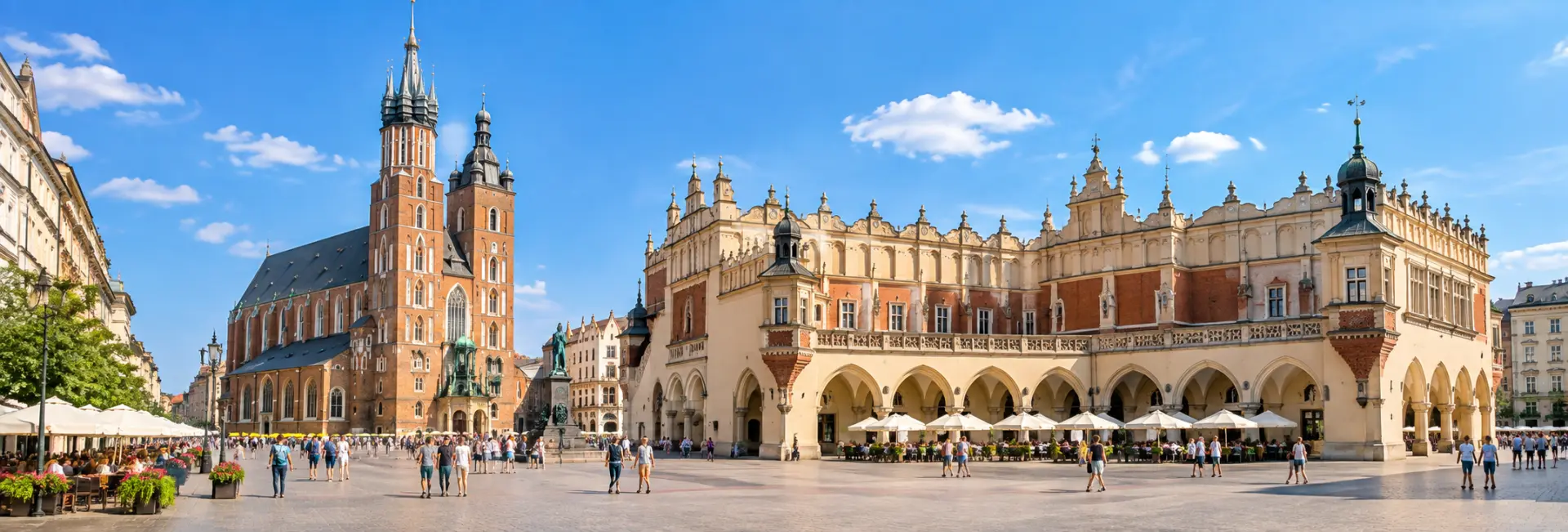
Kraków's Main Market Square, known in Polish as Rynek Główny, is the beating heart of the city's Old Town and one of the largest medieval town squares surviving anywhere in Europe. Ringed by pastel-colored townhouses, street cafés, and horse-drawn carriages, it has functioned as a marketplace and civic gathering point for more than seven centuries.
At its center stand two of Kraków's most photographed landmarks, the long Renaissance hall known as the Cloth Hall and the twin-towered St. Mary's Basilica, while beneath the cobblestones an entire underground museum preserves traces of the square's medieval past. Few places in the city pack this much history into a single, walkable open space.
History
A Square Born from Disaster
Kraków received its city charter in 1257, shortly after Mongol raids had devastated much of the earlier settlement. Rather than simply repairing what existed, the city was rebuilt on a new grid plan, with a vast central square measuring roughly 200 by 200 meters placed at its heart, a layout that has barely changed in the centuries since.
A Crossroads of Trade
The square quickly became a meeting point for merchants traveling between Western Europe and the East, trading in cloth, salt, spices, and countless other goods. This commercial importance led to the construction of a covered market hall at the square's center, the forerunner of the building known today as the Cloth Hall.
A Stage for Public Life
Over the centuries, the square served as the setting for royal ceremonies, public executions, and moments of national significance, including Tadeusz Kościuszko's 1794 call to arms against foreign occupation. During the Second World War, German occupying forces renamed the square after Adolf Hitler, a designation that vanished along with the occupation itself. Since 1978, the square has been protected as part of the Historic Centre of Kraków, one of the first sites ever inscribed on the UNESCO World Heritage list.
Key Landmarks on the Square
The Cloth Hall (Sukiennice)
Standing at the square's center, the Cloth Hall traces its origins to a medieval covered marketplace, rebuilt in Renaissance style after a fire in 1555 and later given its distinctive arcades in the 19th century. Its ground floor still functions as a market, now filled with stalls selling amber, leather, and traditional crafts, while its upper floor houses a gallery of 19th-century Polish painting.
St. Mary's Basilica
Rising at the square's northeast corner, this Gothic brick church is instantly recognizable by its two mismatched towers. Inside, it holds the monumental altarpiece carved by Veit Stoss between 1477 and 1489, widely considered the largest Gothic wooden altarpiece in the world. Every hour, a trumpeter plays a short melody from the taller tower that breaks off abruptly, commemorating a medieval bugler said to have been struck by an arrow while sounding a warning to the city.
Church of St. Adalbert
Tucked into a corner of the square, this small Romanesque church is one of the oldest stone buildings in Poland, offering a striking contrast in scale to the grander structures surrounding it.
Town Hall Tower and the Adam Mickiewicz Monument
A solitary Gothic tower is all that remains of the square's original town hall, demolished in the early 19th century, while a monument to the Polish national poet Adam Mickiewicz has served as a popular meeting point since it was unveiled in 1898.
Underground Kraków
Beneath the Cloth Hall lies the Rynek Underground Museum, an archaeological exhibition built around the foundations, market stalls, and cobbled roads uncovered during excavations that took place under the square between the 1970s and early 2000s. Walkways lead visitors past the remnants of medieval merchant stalls and street layouts, offering a physical sense of the square's earliest centuries that is easy to miss while walking across it at street level.
Ways to Experience It
Most visits combine simply walking the square with stops at its major landmarks and a look underground.
- Walk the square at a relaxed pace, taking in the surrounding townhouses and their varied architectural styles
- Time a visit to catch the hourly trumpet call from St. Mary's Basilica tower
- Browse the stalls inside the Cloth Hall for traditional Polish crafts and amber jewelry
- Visit the Rynek Underground Museum for a look at the archaeology beneath the square
- Take a horse-drawn carriage ride around the Old Town, departing from the square itself
Best Time to Visit
The square is at its liveliest, and most crowded, during the summer months and around the Christmas and Easter markets, when stalls, lights, and seasonal food fill much of the open space. Visitors seeking a quieter experience tend to prefer early mornings or the shoulder seasons of spring and autumn.
Because it is an open public space, the square itself is accessible at any hour, though the landmarks around it, including the Cloth Hall galleries, St. Mary's Basilica, and the underground museum, keep their own separate opening hours worth checking in advance.
Visitor Tips
A few practical notes make it easier to plan time around the square and its surrounding landmarks.
- Confirm current opening hours and ticket prices for St. Mary's Basilica, the Cloth Hall galleries, and the Rynek Underground Museum before visiting, since these vary by season
- Photography inside St. Mary's Basilica may be restricted during services, so check signage on arrival
- The square can get very crowded in peak summer and during seasonal markets, so early morning visits offer a calmer alternative
- Café and restaurant prices directly on the square tend to run higher than those on nearby side streets
- Wear comfortable shoes, since the square's cobblestones and surrounding Old Town streets involve a fair amount of walking
Nearby Attractions
The square's central position makes it the natural starting point for exploring the rest of Kraków's Old Town.
- Wawel Royal Castle and Wawel Cathedral, a short walk south along the Royal Route
- Kazimierz, Kraków's historic Jewish quarter, a walk of about fifteen minutes southeast
- The Barbican and St. Florian's Gate, remnants of the city's medieval fortifications north of the square
- Planty Park, the green ring of gardens tracing the line of Kraków's former city walls
- Collegium Maius, part of Jagiellonian University, a short walk west of the square
FAQs about visiting the Main Market Square
What is the Main Market Square known for? +
It is known as one of Europe's largest surviving medieval squares, home to the Renaissance Cloth Hall, the Gothic St. Mary's Basilica, and an hourly trumpet call played from the basilica's tower.
How old is the Main Market Square? +
The square dates back to 1257, when Kraków was rebuilt on a new grid plan following its city charter, and its layout has changed little since then.
Is it free to visit the square? +
Yes, the open square itself is free and always accessible, though individual landmarks around it, such as St. Mary's Basilica and the Rynek Underground Museum, charge separate admission.
What is the significance of the trumpet call played every hour? +
Known as the Hejnał, it commemorates a medieval trumpeter said to have been struck by an arrow while sounding a warning to the city, and the melody still breaks off abruptly in his memory.
What is the Rynek Underground Museum? +
It is an archaeological museum beneath the Cloth Hall showcasing medieval foundations, market stalls, and roads uncovered during excavations carried out under the square.
How much time should I plan for the square and its landmarks? +
A quick walk across the square takes only minutes, but visiting St. Mary's Basilica, the Cloth Hall, and the underground museum together can easily fill half a day.
When is the best time to visit? +
Early mornings and the shoulder seasons of spring and autumn tend to be quieter, while summer and the Christmas and Easter markets bring the largest crowds.
What else is nearby if I want to keep exploring? +
Wawel Royal Castle, the Kazimierz district, and the Barbican are all within walking distance, making the square an easy base for exploring the rest of Kraków's Old Town.