Table of Contents
Overview
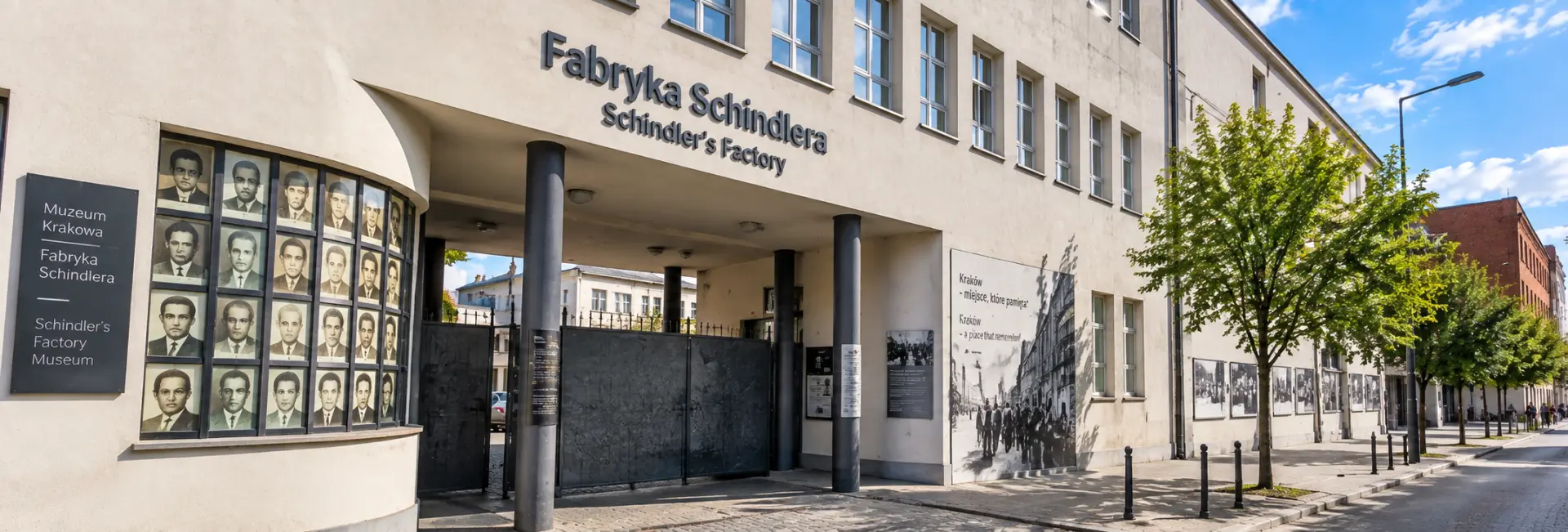
Schindler's Factory sits in the Zabłocie district of Kraków, across the Vistula River from the city's Old Town, in the former administrative building of a wartime enamelware plant. It was here that German businessman Oskar Schindler employed and ultimately protected more than a thousand Jewish workers during the Nazi occupation of Poland, a story later brought to global attention by Steven Spielberg's 1993 film Schindler's List.
Today the building houses a branch of the Historical Museum of Kraków, presenting a permanent exhibition that uses Schindler's story as one thread within a much broader account of what life was like in Kraków under Nazi occupation between 1939 and 1945.
History
A Prewar Factory Under New Ownership
The factory at 4 Lipowa Street was established in 1937 by a group of Jewish businessmen as an enamelware and metal goods plant. Following the German invasion of Poland in September 1939, Oskar Schindler, a German businessman and member of the Nazi party, took over the factory and renamed it the Deutsche Emailwarenfabrik, or DEF.
Protection Through Employment
As the war progressed and Kraków's Jewish population was confined first to a ghetto and later to the nearby Płaszów forced labor camp, Schindler employed increasing numbers of Jewish workers at his factory, arguing that their labor was essential to the German war effort. By 1944, as deportations to death camps accelerated, Schindler compiled a list of workers he insisted on keeping at a new factory location, an act that ultimately saved more than a thousand Jewish lives.
From Factory Floor to Museum
After the war, the building continued in industrial use for decades, manufacturing telecommunications components under Poland's state-run Telpod company until the early 2000s. The city of Kraków acquired the site in 2005, and in 2010 the administrative building reopened as a museum, with its permanent exhibition, Kraków under Nazi Occupation 1939-1945, telling the wider story of the city during the war alongside Schindler's own role within it.
The Museum Today
The museum occupies the factory's former administrative building, now run as a branch of the Historical Museum of Kraków, while the neighboring former workshop spaces house MOCAK, Kraków's Museum of Contemporary Art, allowing visitors to combine a wartime history museum with a contemporary art collection on the same industrial site.
Rather than focusing narrowly on Schindler, the museum situates his actions within a detailed account of daily life in occupied Kraków, drawing on survivor testimony, photographs, documents, and multimedia displays to reconstruct the experiences of both Polish and Jewish residents throughout the occupation.
Collections & Exhibits
The permanent exhibition moves chronologically through the German invasion, the establishment of Kraków as the administrative capital of the Nazi-occupied General Government, the creation and eventual liquidation of the Kraków Ghetto, the everyday hardships faced by the city's residents, the underground resistance movement, and finally the Soviet capture of the city in 1945.
Within this broader narrative, several rooms focus specifically on Schindler and the workers he employed, including his preserved office, complete with his original desk and a large map he once used to track the German military's advances across Europe.
Must-See Highlights
A handful of elements tend to leave the strongest impression on visitors.
- Oskar Schindler's preserved office, including his original desk
- A symbolic installation referencing the list of workers Schindler insisted on protecting
- Survivor testimony and personal artifacts documenting daily life under occupation
- Immersive, reconstructed spaces depicting wartime Kraków streets and interiors
- Extensive photographic and archival material tracing the fate of the city's Jewish community
Ways to Experience It
Most visitors move through the museum's permanent exhibition at their own pace, though several options can deepen the experience.
- Follow the self-guided permanent exhibition using the included route through the building's chronological displays
- Rent an audio guide for additional context on the exhibits and Schindler's own story
- Join a guided tour, often combined with a wider walk through Podgórze and the site of the former Kraków Ghetto
- Visit MOCAK next door afterward for a contrasting look at contemporary art within the same former industrial complex
Best Time to Visit
Because the museum is almost entirely indoors, it can be visited comfortably in any season, making it a solid option on days when outdoor sightseeing is less appealing. The museum is popular enough that queues can form during peak season and weekends, particularly in the early afternoon.
Booking tickets online in advance or arriving close to opening time tends to reduce waiting, especially during the busy summer months.
Visitor Tips
A little planning helps visitors get the most from a visit to this emotionally weighty site.
- Book tickets online in advance where possible, since queues can be long, particularly on weekends and in summer
- Allow at least two to three hours to see the exhibition thoroughly, since it covers substantial ground beyond Schindler's own story
- Consider an audio guide or guided tour for deeper context, since much of the exhibition relies on documents and testimony that benefit from added explanation
- The subject matter is serious and may not be suitable for very young children
- Combine the visit with a walk through nearby Podgórze to see the site of the former Kraków Ghetto for a fuller picture of the city's wartime history
Nearby Attractions
The museum's location in Zabłocie, just across the river from Kraków's historic core, puts it close to several other sites connected to the city's wartime history.
- MOCAK, the Museum of Contemporary Art in Kraków, housed in the same former factory complex
- Podgórze and the site of the former Kraków Ghetto, a short walk away
- Ghetto Heroes' Square, marked by its memorial installation of empty chairs
- Kazimierz, Kraków's historic Jewish quarter, across the Vistula River
- The Vistula Boulevards, offering a riverside walking route back toward the Old Town
FAQs about visiting Schindler's Factory
What is Schindler's Factory known for? +
It is known as the site where Oskar Schindler employed and ultimately protected more than a thousand Jewish workers during the Nazi occupation of Poland, a story later depicted in the film Schindler's List.
Is the museum only about Oskar Schindler? +
No, while Schindler's story features prominently, the permanent exhibition covers the broader experience of Kraków and its residents, both Polish and Jewish, throughout the Nazi occupation.
How much time should I plan for a visit? +
Most visitors need at least two to three hours to see the exhibition thoroughly, given how much ground it covers beyond the Schindler story itself.
Do I need to book tickets in advance? +
It is strongly recommended, since queues can be long, particularly on weekends and during the busy summer season.
Is Schindler's Factory the same as the Kraków Ghetto? +
No, the factory sits in the Zabłocie district, while the historical Kraków Ghetto was located nearby in Podgórze, an area that can be visited separately or combined with the museum.
Is the museum suitable for children? +
The subject matter is serious and covers difficult wartime history, so it may not be suitable for very young children.
What else is on the same site as the museum? +
MOCAK, Kraków's Museum of Contemporary Art, occupies the former workshop buildings of the same factory complex and can easily be visited afterward.
What else is nearby if I want to keep exploring? +
Podgórze, the site of the former Kraków Ghetto, and Ghetto Heroes' Square are all within walking distance, along with Kazimierz across the river.