Table of Contents
Overview
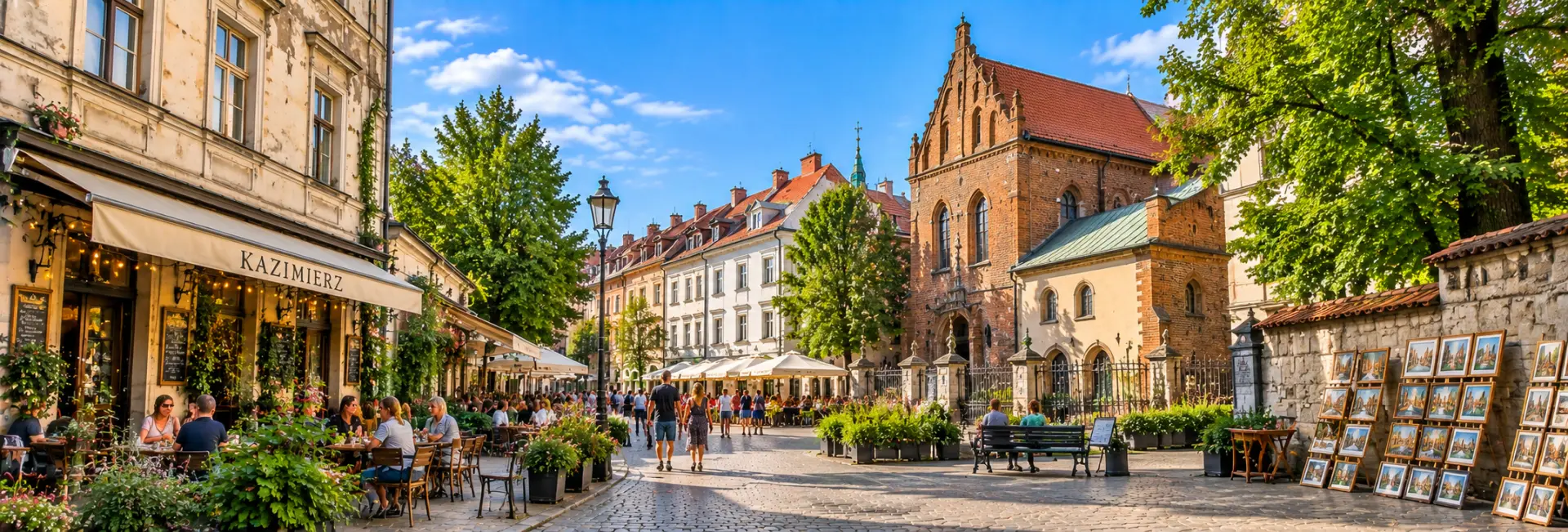
Kazimierz is Kraków's historic Jewish quarter, a district of narrow streets, courtyards, and centuries-old synagogues just southeast of the city's Old Town. For more than four hundred years it served as one of the most significant centers of Jewish life in Europe, and its layered history is still visible in its architecture, its cemeteries, and the daily rhythms of a neighborhood that continues to reinvent itself.
Once neglected for decades after the Second World War, Kazimierz has since become one of Kraków's most vibrant districts, drawing visitors for its Jewish heritage sites as much as for its galleries, bars, and street food. Few places in the city hold this much history alongside this much everyday energy.
History
An Independent Town
Kazimierz began as its own separate town, founded in 1335 by King Casimir III the Great on an island in the Vistula River, complete with its own charter, market square, and defensive walls. For more than a century it developed as a mixed Christian and Jewish settlement in its own right, distinct from the city of Kraków across the water.
The Formation of the Jewish Town
In 1495, following a fire in Kraków and rising tension between Jewish and Christian merchants, King John I Albert ordered the city's Jewish residents relocated to the northeastern part of Kazimierz. This area, centered on what is now Szeroka Street, became a walled Jewish town, and over the following centuries it grew into one of the largest and most influential Jewish communities in Poland and Europe.
Centuries of Jewish Life
Through the 16th and 17th centuries, Kazimierz's Jewish community built synagogues, schools, and cemeteries, and became a significant center of religious scholarship and communal life. By the eve of the Second World War, Kazimierz remained home to a substantial Jewish population and a dense concentration of synagogues, several of which still stand today.
War, Neglect, and Revival
Under German occupation, Kraków's Jewish community was forcibly relocated across the Vistula River into the Kraków Ghetto in the Podgórze district in 1941, and the vast majority of the city's Jews were later murdered in the Holocaust. Kazimierz itself fell into decades of neglect during the postwar communist era. Its revival began in earnest in the 1990s, spurred in part by renewed interest in Jewish heritage and by the international attention brought by Steven Spielberg's film Schindler's List, much of which was filmed on Kazimierz's streets.
The Synagogues of Kazimierz
Kazimierz was historically home to seven synagogues, several of which remain standing and open to visitors today.
- The Old Synagogue, the oldest surviving synagogue building in Poland, now housing a museum on the history of Kraków's Jewish community
- The Remuh Synagogue, still an active place of worship, standing beside the Old Jewish Cemetery where the revered Rabbi Moses Isserles is buried
- The Tempel Synagogue, a Reform congregation known for its richly decorated interior
- The Wolf Popper Synagogue, a 17th-century Baroque building now used as a cultural venue
- The Kupa and Isaac's Synagogues, both historic houses of worship that have been restored in recent decades
Key Areas & Streets
Szeroka Street
Despite its name, Szeroka functions more as a long rectangular square than a conventional street, and it has served as the heart of Jewish Kazimierz since the district's earliest days, ringed by synagogues, the Old Jewish Cemetery, and historic townhouses.
Plac Nowy
Centered on a distinctive round former poultry market known as the Okrąglak, Plac Nowy has become Kazimierz's liveliest square, home to a daily food market, a weekend flea market, and the neighborhood's famous zapiekanki, a Kraków street food specialty of open-faced toasted baguettes.
Józefa and Meiselsa Streets
These narrower streets running through the district's core preserve much of Kazimierz's pre-war character, with weathered courtyards, small galleries, and cafés tucked behind historic facades.
Kazimierz and Schindler's List
Kazimierz's largely intact pre-war streetscape made it the primary filming location for Steven Spielberg's 1993 film Schindler's List, even though the historical Kraków Ghetto it depicts actually stood across the river in Podgórze. Because the real ghetto area had been significantly altered after the war, the production used Szeroka Street, Józefa Street, and other corners of Kazimierz to recreate scenes of prewar Jewish life and the ghetto's liquidation.
Visitors interested in this history can walk several recognizable filming locations within Kazimierz itself, then cross the Vistula to Podgórze to see the site of the actual ghetto and the nearby Schindler's Factory Museum.
Ways to Experience It
Kazimierz rewards both a historically focused visit and simply wandering its streets and cafés.
- Walk Szeroka Street and visit the Old Synagogue and Remuh Synagogue and cemetery to trace the district's Jewish heritage
- Join a guided walking tour focused on Kazimierz's Jewish history, often combined with a visit to Podgórze and the former ghetto area
- Visit the Galicia Jewish Museum for a broader look at Jewish life and culture across the wider region
- Browse Plac Nowy's markets and sample a zapiekanka from one of the stalls in the Okrąglak
- Explore the district's galleries, vintage shops, and bars, many tucked into converted historic buildings
Best Time to Visit
Kazimierz can be visited comfortably throughout the year, with its bars and cafés giving it an active atmosphere well into the evening regardless of season. The district is especially lively each summer during the Jewish Culture Festival, held annually since 1988 and drawing visitors from around the world for concerts, lectures, and performances centered on Szeroka Street.
Weekday mornings offer the quietest time to visit the synagogues and walk the district's main streets, while weekends bring larger crowds to Plac Nowy's flea market and the neighborhood's restaurants.
Visitor Tips
A few practical notes make it easier to plan a visit to Kazimierz and its heritage sites.
- Several synagogues charge separate admission and follow their own opening hours, including closures on the Jewish Sabbath, so checking in advance is worthwhile
- Modest dress is appropriate when visiting active synagogues such as the Remuh
- It is worth clarifying before a visit that Kazimierz itself was never the site of the wartime ghetto, which stood across the river in Podgórze, to avoid a common point of confusion
- The district is walkable from Kraków's Main Market Square, roughly fifteen to twenty minutes on foot
- Evenings bring a busy bar and restaurant scene, particularly around Plac Nowy, which may not suit visitors seeking a quieter atmosphere
Nearby Attractions
Kazimierz's location just southeast of the Old Town makes it easy to combine with several other significant sights.
- Kraków's Old Town and Main Market Square, a walk of about fifteen to twenty minutes northwest
- Wawel Royal Castle and Wawel Cathedral, along the riverbank between Kazimierz and the Old Town
- Podgórze, across the Vistula River, home to the former Kraków Ghetto area and Schindler's Factory Museum
- The Vistula Boulevards, running along the riverbank near Kazimierz's edge
- The Galicia Jewish Museum, within Kazimierz itself, offering further context on regional Jewish history
FAQs about visiting Kazimierz
What is Kazimierz known for? +
It is known as Kraków's historic Jewish quarter, home to several centuries-old synagogues, Szeroka Street, and a lively modern scene of cafés, galleries, and markets.
Was Kazimierz the site of the Kraków Ghetto? +
No, the historical Kraków Ghetto was located across the Vistula River in the Podgórze district; Kazimierz was the city's Jewish quarter before the war but was not itself walled off as the ghetto.
Why was Schindler's List filmed in Kazimierz? +
Kazimierz retained much of its pre-war architecture and street layout, making it a convincing stand-in for scenes of prewar Jewish life, even though the actual ghetto it depicts stood in nearby Podgórze.
Can I visit the synagogues in Kazimierz? +
Yes, several synagogues, including the Old Synagogue and the Remuh Synagogue, are open to visitors, though most charge admission and keep their own opening hours, including closures on the Jewish Sabbath.
What is Plac Nowy? +
It is Kazimierz's liveliest square, centered on a historic round building called the Okrąglak and known for its daily market, weekend flea market, and the local street food specialty, zapiekanki.
When is the best time to visit Kazimierz? +
The district is lively year-round, but it is especially busy each summer during the Jewish Culture Festival, one of the largest events of its kind in the world.
How much time should I plan for a visit? +
Half a day covers the main synagogues, Szeroka Street, and Plac Nowy, while a full day allows time to also visit the Galicia Jewish Museum and cross into Podgórze for the former ghetto area and Schindler's Factory Museum.
How do I get to Kazimierz? +
It sits a short walk southeast of Kraków's Old Town, roughly fifteen to twenty minutes on foot from the Main Market Square.