Table of Contents
Overview
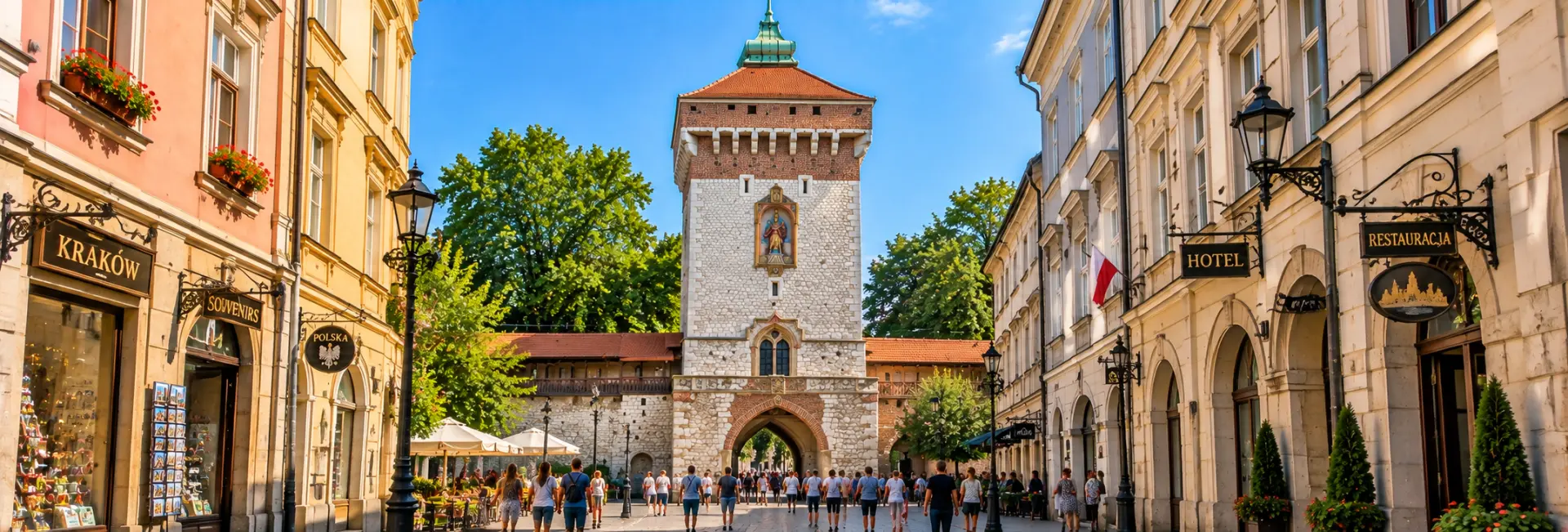
St. Florian's Gate stands at the northern edge of Kraków's Old Town, marking the point where the historic Royal Route begins its path down Floriańska Street toward the Main Market Square and, beyond it, Wawel Hill. Built in the 14th century as one of eight gates in the city's medieval fortifications, it is the only one of the original gates to survive intact.
Together with the neighboring Barbican and a short stretch of surviving city wall, the gate offers one of the clearest physical links to Kraków's medieval defenses, standing today as both a historic monument and a lively backdrop for the open-air art market that lines the adjoining walls.
History
Fortifying a Rebuilt City
Following the devastating Mongol attack of 1241, which destroyed much of Kraków, Prince Leszek II the Black issued a permit in 1285 for the construction of a new system of city defenses, including stone watchtowers, fortified gates, and a moat. St. Florian's Gate, first mentioned in historical records in 1307, was built as part of this effort and named for the saint venerated as a protector against fire.
The City's Main Entrance
As Kraków's fortifications expanded over the following centuries, eventually including 47 watchtowers and eight gates at their peak, St. Florian's Gate became the city's principal entryway, connected by a long bridge across the moat to the circular Barbican on its northern side. The gate was traditionally maintained and defended by the Kraków Furriers Guild, one of the city's medieval craft guilds.
Surviving Demolition
By the early 19th century, Kraków's aging fortifications had fallen into disrepair and were ordered dismantled by Austrian authorities. A campaign led by Jagiellonian University professor Feliks Radwański succeeded in preserving St. Florian's Gate along with the Barbican and a short adjoining stretch of wall, making it the only one of the city's original eight gates to survive the 19th-century clearance that created Planty Park.
Architecture & Design
Built from rough-cut stone and brick in the Gothic style, St. Florian's Gate takes the form of a tall, rectangular tower rising roughly 33.5 meters, with a Baroque metal cupola added in 1660 and renovated in 1694 bringing its total height to around 34.5 meters. This combination of a sturdy medieval base topped by a later ornamental spire gives the gate its distinctive silhouette.
The tower's south-facing side, looking into the Old Town, carries an 18th-century bas-relief of St. Florian, while the northern face, looking outward, bears a carved stone eagle, a national symbol of Poland. A small chapel is also built into the gate itself.
Recognition & Status
As the sole survivor among Kraków's original eight medieval gates, St. Florian's Gate holds a distinct place among the city's historic monuments, standing alongside the Barbican as the most tangible remnant of the fortifications that once encircled the Old Town. It forms part of the Historic Centre of Kraków, inscribed on the UNESCO World Heritage list in 1978, and is separately recognized as a Historic Monument of Poland.
What to See There
A handful of details are worth looking for around the gate and its surrounding walls.
- The bas-relief of St. Florian on the gate's Old Town-facing side
- The carved stone eagle on the gate's outward-facing side, added in the 18th century
- The Baroque metal cupola crowning the medieval stone tower
- The adjoining stretch of surviving city wall, connecting the gate to the Barbican
- The open-air art market lining the inner side of the walls, where local artists have displayed and sold paintings for decades
Ways to Experience It
Most visitors encounter St. Florian's Gate simply by passing through it on the way into or out of the Old Town, though it rewards a closer look as well.
- Walk through the gate itself as part of a stroll along the Royal Route toward the Main Market Square
- Browse the open-air art market along the adjoining walls, a long-running feature of this stretch of the fortifications
- Continue on to the nearby Barbican to see the two structures together as a single defensive complex
- View the gate from within Planty Park, which traces the line of the vanished walls just outside
Best Time to Visit
St. Florian's Gate can be appreciated at any time of year, since it sits along an outdoor thoroughfare rather than requiring separate opening hours. The surrounding art market and street life tend to be liveliest in the warmer months and quieter during winter mornings.
Early in the day generally offers the calmest views of the gate itself, before the crowds moving along Floriańska Street and through the Royal Route build up later in the morning.
Visitor Tips
A few practical notes make it easy to fit St. Florian's Gate into a walk through the Old Town.
- The gate is a public street monument with no admission fee or set opening hours
- Pair a visit with the neighboring Barbican, just a short walk across Planty Park
- If interested in the art market along the walls, allow a few extra minutes to browse, since it can draw a crowd during peak tourist season
- The gate marks a natural starting point for walking the Royal Route toward the Main Market Square and Wawel Hill
- Photographs of the gate's full height are easiest from within Planty Park, just outside the old wall line
Nearby Attractions
Sitting at the edge of the Old Town, St. Florian's Gate is within easy reach of several other major sights.
- The Barbican, connected historically to the gate and just a short walk across Planty Park
- Planty Park, tracing the outline of the vanished city walls around the gate
- Floriańska Street, leading directly from the gate to the Main Market Square
- Kraków's Main Market Square, a short walk south along the Royal Route
- The Czartoryski Museum, located just off Floriańska Street near the gate
FAQs about visiting St. Florian's Gate
What is St. Florian's Gate known for? +
It is known as the only one of Kraków's original eight medieval city gates to survive intact, marking the start of the historic Royal Route into the Old Town.
How old is St. Florian's Gate? +
It was first recorded in 1307, built as part of a fortification system authorized in 1285 following the Mongol attack that had devastated Kraków decades earlier.
Is it free to visit St. Florian's Gate? +
Yes, it is an open street monument with no admission fee, and visitors pass through it freely as part of walking through the Old Town.
How tall is St. Florian's Gate? +
The gate's stone tower rises about 33.5 meters, with its Baroque metal cupola adding roughly another meter for a total height of around 34.5 meters.
Why did this gate survive when the others were demolished? +
A campaign led by a Jagiellonian University professor in the early 19th century successfully preserved St. Florian's Gate, the Barbican, and a short stretch of wall when the rest of Kraków's fortifications were dismantled.
What is the art market near the gate? +
It is a long-running open-air display of paintings by local artists, set up along the inner side of the surviving city walls next to the gate.
How does the gate connect to the Barbican? +
The two structures were historically linked by a bridge across the old moat and today sit close together across a short stretch of Planty Park, often visited as a pair.
What else is nearby if I want to keep exploring? +
Planty Park, Floriańska Street, and the Main Market Square are all directly connected to the gate, making it a natural starting point for exploring the rest of Kraków's Old Town.