Table of Contents
Overview
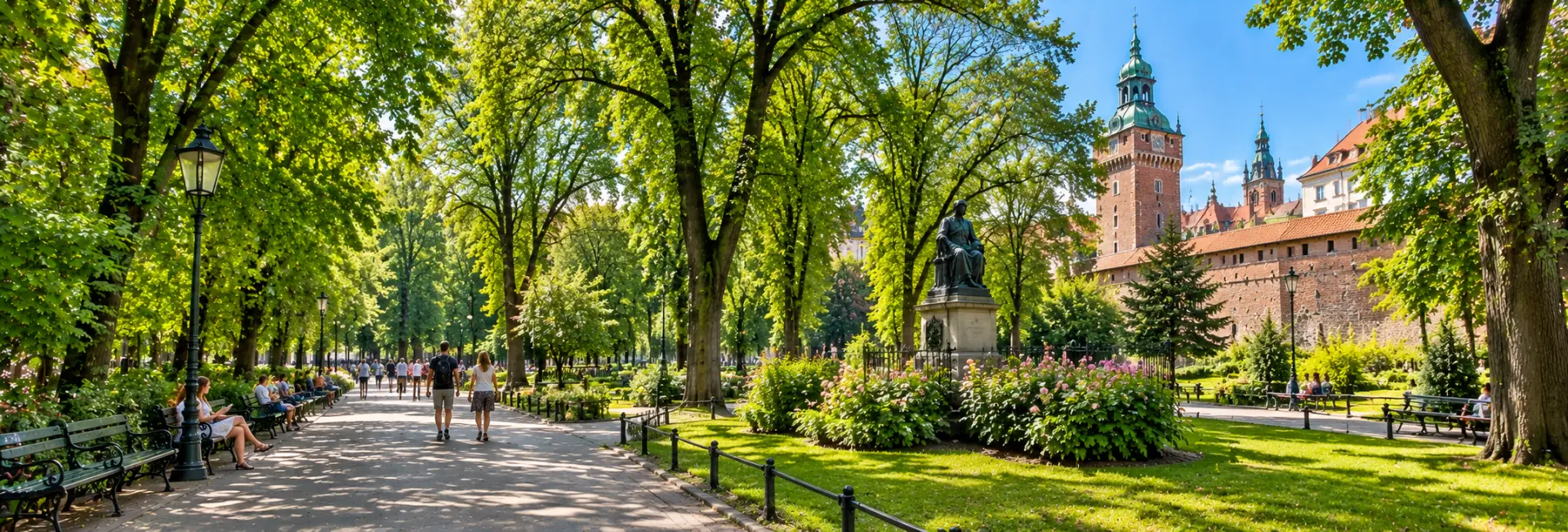
Planty Park is the green ring that wraps around Kraków's Old Town, tracing the exact line where the city's medieval defensive walls, moats, and towers once stood. Roughly four kilometers long, it forms a horseshoe of tree-lined paths, flower beds, and quiet green space separating the historic core from the busier streets beyond.
More than just a scenic buffer, Planty is dotted with monuments, fountains, and small gardens of varying design, making it as much an outdoor museum of Polish history as it is a place to relax. For visitors moving between the Old Town's major sights, it also offers a calmer, greener alternative to the cobblestone streets just inside its border.
History
From Fortifications to Neglect
Kraków's medieval defenses once consisted of a double ring of walls with dozens of towers and several gates, considered formidable well into the 17th century. By the 18th century, prolonged neglect, worsened by the political upheavals of the era, left the fortifications deteriorating, and the stagnant moat surrounding them had become an informal dumping ground posing health concerns for the city.
Demolition and a Fight to Preserve a Fragment
Between 1810 and 1814, on the orders of the Austrian emperor, the moat was filled in and most of the walls and towers dismantled. Jagiellonian University professor Feliks Radwański successfully argued in 1817 for preserving a small remaining section of the fortifications, including St. Florian's Gate and the adjoining Barbican, which survive today as the most visible reminders of the old defenses.
Creating a Green Ring
Beginning around 1822, the cleared land where the walls and moat had stood was gradually transformed into a landscaped public park, a project carried on after Radwański's death by civic figure Florian Straszewski, who oversaw much of the planting and design work across the following years. Over time, chestnut, lime, poplar, and maple trees were planted throughout, along with a growing collection of monuments and fountains.
Layout & Design
Planty follows a horseshoe shape rather than a complete circle, since Wawel Hill interrupts the ring at the Old Town's southern edge. Rather than one continuous, uniformly designed garden, it is made up of a chain of roughly thirty smaller connected gardens, each landscaped in its own style, giving different stretches of the park distinct character as visitors walk from one section to the next.
Covering around 21 hectares in total, the park's paths follow the same footprint as the vanished city walls, meaning a walk around Planty effectively retraces the outline of medieval Kraków.
Monuments & Notable Features
More than twenty statues and monuments are scattered throughout Planty, most honoring notable figures from Polish history and culture.
- A monument to astronomer Nicolaus Copernicus
- A statue honoring painter Jan Matejko
- Monuments to Queen Jadwiga and King Władysław II Jagiełło, commemorating the medieval Jagiellonian dynasty
- Plaques and statues dedicated to figures including chronicler Jan Długosz and playwright Stanisław Wyspiański
- The Barbican and St. Florian's Gate, the surviving fragments of the medieval fortifications the park replaced
Ways to Experience It
Planty works equally well as a quick shortcut between Old Town sights and as a destination for a longer, unhurried walk.
- Walk a full loop of the park to trace the outline of Kraków's vanished city walls
- Use Planty's paths as a quieter alternative route between major Old Town landmarks
- Look for individual monuments and gardens along the way, since each section of the park has its own character
- Combine a walk through Planty with a stop at the Barbican and St. Florian's Gate, where the park meets the surviving fortifications
- Cycle or jog the park's perimeter, a popular option among local residents
Best Time to Visit
Planty is at its most colorful in spring and early summer, when flower beds are in bloom, and in autumn, when its chestnut and maple trees turn color. Being an open, outdoor space, it is naturally busiest on warm weekend afternoons and quieter during weekday mornings.
Because it borders the Old Town rather than sitting inside it, Planty also makes a pleasant early morning or evening walk when the streets within the historic core are at their most crowded.
Visitor Tips
A few practical notes help visitors make the most of a walk through Planty.
- The park is free and open at all times, with no set opening hours
- Wear comfortable shoes, since a full loop covers roughly four kilometers
- Benches are placed throughout, making it easy to break up a longer walk with a rest
- Because the park borders many of Kraków's main streets, it is easy to step in and out of Planty as a shortcut rather than committing to the full loop
- Combine a visit with the Barbican and St. Florian's Gate, where several of the park's historical information points are concentrated
Nearby Attractions
Because it encircles the Old Town, Planty sits within easy reach of nearly all of Kraków's major historic sights.
- The Barbican and St. Florian's Gate, marking the park's most historically significant stretch
- Kraków's Main Market Square, just inside the ring at the Old Town's center
- Wawel Royal Castle and Wawel Cathedral, at the southern point where the park's ring is interrupted
- Jagiellonian University's Collegium Maius, near the park's western edge
- Kraków Główny railway station, close to the park's northeastern stretch
FAQs about visiting Planty Park
What is Planty Park known for? +
It is known as the green ring encircling Kraków's Old Town, built in the early 19th century on the site of the city's demolished medieval walls and moat.
How long is Planty Park? +
It stretches roughly four kilometers around the Old Town and covers about 21 hectares in total.
Is Planty Park free to visit? +
Yes, it is a public park that is free and open at all times.
Why isn't Planty a complete circle? +
The park forms a horseshoe shape rather than a full ring because Wawel Hill interrupts its path at the Old Town's southern edge.
What can I see in the park? +
Planty holds more than twenty monuments and statues honoring figures from Polish history, along with the Barbican and St. Florian's Gate, the surviving remnants of the medieval city walls.
How much time should I plan for a visit? +
A full loop takes a couple of hours at a relaxed walking pace, though many visitors simply use short stretches of the park as a route between Old Town sights.
When is the best time to visit Planty? +
Spring and early summer bring flowering gardens, while autumn offers colorful foliage; early mornings and weekday visits tend to be quieter than weekend afternoons.
What else is nearby if I want to keep exploring? +
Kraków's Main Market Square, Wawel Royal Castle, and Jagiellonian University's Collegium Maius are all directly adjacent to or just inside the park's ring.