Table of Contents
Overview
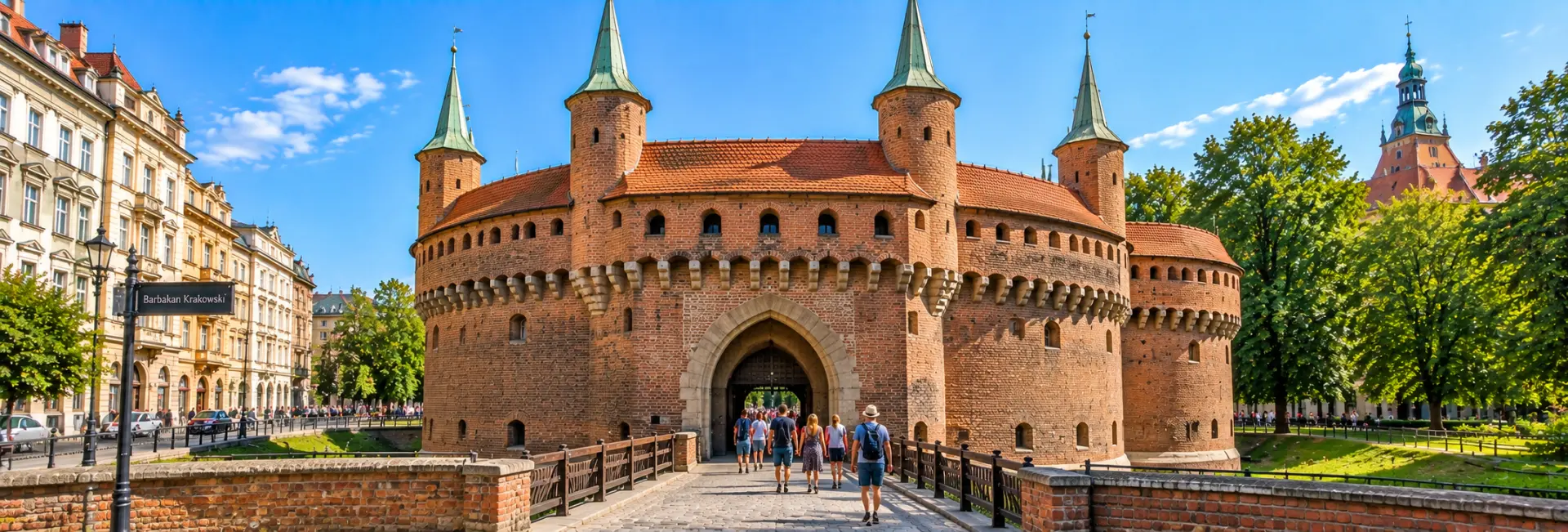
The Kraków Barbican is a circular brick fortress standing just outside St. Florian's Gate, at the point where Planty Park now traces the outline of the city's vanished medieval walls. Built at the very end of the 15th century, it once formed the outermost line of defense guarding the main approach into Kraków's Old Town.
Today it is recognized as one of only a handful of barbicans of its kind surviving anywhere in Europe, and widely regarded as the best preserved among them. Its imposing circular walls and turrets remain a striking sight for anyone walking the northern edge of the Old Town.
History
Built in Response to Military Setbacks
The Barbican was constructed in 1498 and 1499 on the orders of King John I Albert, following a series of military defeats, including the disastrous Battle of the Cosmin Forest against Moldavian forces in 1497. Concerned about the threat of further attacks from the south and east, the crown ordered a strengthened outer defense to protect the city's most vulnerable approach.
Guarding the City's Main Gate
Positioned just beyond St. Florian's Gate, the Barbican was originally connected to it by a long covered passageway, sometimes referred to as the neck, that crossed the surrounding moat. This arrangement allowed the fortress to function as a checkpoint controlling all traffic entering the city from the north, while also providing an additional line of defense the city walls alone could not offer.
Surviving Sieges and Demolition
Over the following centuries, the Barbican played a role in defending Kraków during several conflicts, including clashes with Austrian forces in the late 16th century and sieges during the wars of the mid-17th century. When Austrian authorities ordered most of Kraków's fortifications dismantled in the early 19th century, a campaign led by Jagiellonian University professor Feliks Radwański succeeded in preserving the Barbican along with St. Florian's Gate, even as the connecting passageway between them was ultimately lost.
Architecture & Design
The Barbican takes the form of a cylindrical brick structure roughly 24.4 meters in diameter, ringed by walls up to 3 meters thick and originally surrounded by its own moat. Seven turrets, alternating between round and hexagonal forms, project from the main structure, historically reachable only by ladder to keep them defensible even if the main level was breached.
The walls are pierced by around 130 embrasures, narrow openings that allowed defenders to fire on attackers while remaining protected. This dense concentration of defensive features, combined with the fortress's thick walls and moat, made the Barbican a formidable obstacle for any force attempting to approach St. Florian's Gate directly.
Recognition & Status
The Kraków Barbican is considered one of only three fortified outposts of its type still standing in Europe, and the best preserved among them, giving it particular significance among Poland's surviving medieval military architecture. It forms part of the Historic Centre of Kraków, inscribed on the UNESCO World Heritage list in 1978, and is separately designated a Historic Monument of Poland.
What to See There
A visit to the Barbican offers a close look at several features of late medieval military design.
- The fortress's seven turrets, alternating between round and hexagonal shapes
- The dense rows of embrasures lining the brick walls
- The interior courtyard and passageways, open to visitors as part of the Historical Museum of Kraków
- Exhibits inside the structure covering the development of Kraków's fortifications over the centuries
- A commemorative tablet on the eastern wall honoring a Kraków burgher who defended the city during an 18th-century conflict
Ways to Experience It
The Barbican can be appreciated both from the outside, as a striking piece of the city's skyline, and from within, as a small museum.
- Walk around the exterior from Planty Park to appreciate the full circular structure and its turrets
- Enter the interior, managed by the Historical Museum of Kraków, to see exhibits on the city's fortifications
- Combine a visit with the adjoining St. Florian's Gate to understand how the two structures worked together
- Check for seasonal events, since the Barbican occasionally hosts historical reenactments and exhibitions tied to its medieval role
Best Time to Visit
The Barbican's exterior can be appreciated at any time of year from Planty Park, while entry to the interior follows the Historical Museum of Kraków's seasonal opening hours, which are typically more limited in winter. Warmer months bring the best chance of catching any special exhibitions or historical events held on site.
Mornings tend to offer a quieter look at the structure before the surrounding area, including nearby Floriańska Street, fills with visitors later in the day.
Visitor Tips
A few practical notes help visitors plan a stop at the Barbican.
- Entry to the interior requires a paid ticket, while the exterior can be viewed freely from Planty Park at any time
- Check current opening hours in advance, since the interior's schedule can vary by season and is often more limited in winter
- Combine a visit with the neighboring St. Florian's Gate, since the two sit only a short walk apart
- The surrounding area includes the open-air art market along the nearby city walls, worth a look before or after visiting the Barbican itself
- Photographs of the full circular structure are easiest from within Planty Park, where there is enough distance to capture the whole building
Nearby Attractions
Sitting at the edge of the Old Town, the Barbican is close to several other significant sights.
- St. Florian's Gate, historically connected to the Barbican and just steps away
- Planty Park, encircling the Old Town and bordering the Barbican directly
- Floriańska Street, leading from St. Florian's Gate toward the Main Market Square
- Kraków's Main Market Square, a short walk south along the Royal Route
- The Czartoryski Museum, located just off Floriańska Street near the Barbican
FAQs about visiting the Kraków Barbican
What is the Kraków Barbican known for? +
It is known as one of only a handful of surviving medieval barbicans in Europe, and widely regarded as the best preserved, built in 1498 to defend the approach to St. Florian's Gate.
Why was the Barbican built? +
It was constructed on the orders of King John I Albert following military setbacks against Moldavian forces, as part of an effort to strengthen Kraków's northern defenses against further attack.
How was the Barbican connected to the city? +
It was originally linked to St. Florian's Gate by a covered passageway across the surrounding moat, allowing it to function as a checkpoint controlling access to the city, though this passageway no longer survives.
Is it possible to go inside the Barbican? +
Yes, the interior is managed by the Historical Museum of Kraków and open to visitors on a paid ticket, with exhibits covering the history of the city's fortifications.
How big is the Barbican? +
It measures roughly 24.4 meters in diameter, with walls up to 3 meters thick and around 130 embrasures for defense.
Why did the Barbican survive when most of Kraków's walls were demolished? +
A campaign led by a Jagiellonian University professor in the early 19th century preserved the Barbican along with St. Florian's Gate when the rest of the city's fortifications were dismantled.
How much time should I plan for a visit? +
Viewing the exterior takes only a few minutes, while a visit inside the museum exhibits typically takes twenty to thirty minutes.
What else is nearby if I want to keep exploring? +
St. Florian's Gate, Planty Park, and Floriańska Street are all directly adjacent, making it easy to combine the Barbican with a walk into the rest of the Old Town.