Table of Contents
Overview
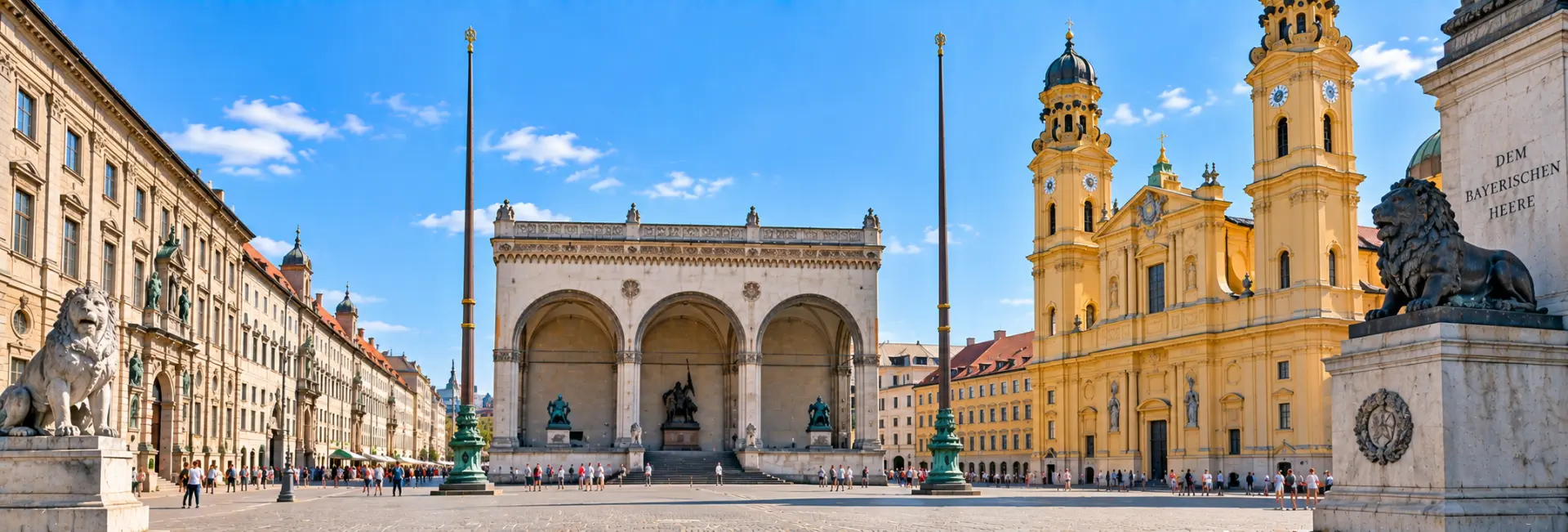
At the point where Munich's old town gives way to the grand nineteenth-century boulevard of Ludwigstrasse, Odeonsplatz brings together some of the city's most striking architecture in a single, open square. Framed by the yellow facade of the Theatinerkirche, the columned Feldherrnhalle, and the Residenz, the former royal palace, it has served for two centuries as a stage for both celebration and, at one pivotal moment, political violence.
Today the square functions as a natural crossroads for sightseeing, a place where visitors moving between the old town and Munich's museum district almost inevitably pass through, pausing to take in the buildings, catch a concert, or simply sit at one of the cafes along its edges.
History
From City Gate to Royal Square
Until the late eighteenth century, this area sat just outside Munich's fortifications, marked by a large medieval gate leading toward the nearby village of Schwabing. When the old city walls were torn down, King Ludwig I commissioned architect Leo von Klenze in 1816 to lay out a new square on the site, clearing the way for the grand approach to Ludwigstrasse that Klenze was designing at the same time. The Feldherrnhalle, added several decades later under architect Friedrich von Gartner, completed the square's monumental character by the mid-1840s.
The 1923 Beer Hall Putsch
Odeonsplatz is also permanently tied to one of the most consequential failures in twentieth-century German history. On 9 November 1923, a column of armed marchers led by Adolf Hitler attempted to seize power in Munich, marching toward the Feldherrnhalle where police blocked their path. A brief but deadly exchange of gunfire killed sixteen marchers and four police officers, ending the attempted coup and leading to Hitler's arrest and imprisonment. Under Nazi rule after 1933, the site was turned into an annual ceremonial gathering point, and a small side street nearby, still marked today, became known for the route some Munich residents quietly used to avoid saluting a memorial plaque placed at the scene.
Key Landmarks
Several major buildings define the square and give it its layered character.
- The Theatinerkirche, a bright yellow Baroque church built in the seventeenth century and topped with twin towers and a dome
- The Feldherrnhalle, a columned hall modeled on a Renaissance loggia in Florence, built as a tribute to the Bavarian army
- The Residenz, the former royal palace of the Wittelsbach family and the largest city palace in Germany, bordering the square's eastern side
- The Hofgarten, a formal court garden just north of the Residenz, with a domed pavilion at its center
- The former Odeon concert hall building, now home to a Bavarian state ministry, on the square's western side
Together these buildings span more than two centuries of construction, yet they read as a single, coordinated backdrop thanks to the careful nineteenth-century planning that shaped the square.
Architecture & Design
Odeonsplatz reflects the deliberate, planned classicism that Ludwig I favored for much of nineteenth-century Munich, with buildings modeled closely on Italian originals rather than developed organically over time. The Feldherrnhalle's design borrows directly from the Loggia dei Lanzi in Florence, while the matching buildings on the square's western side echo the Palazzo Farnese in Rome, giving the square a coherent, almost stage-set quality despite the different eras in which its buildings were actually constructed.
The Theatinerkirche stands apart from this later classicism, having been built decades earlier in an Italian High Baroque style, its ornate yellow facade added still later in the eighteenth century. The contrast between the church's curving Baroque lines and the surrounding square's more restrained neoclassical buildings is part of what gives Odeonsplatz its distinctive visual character.
Ways to Experience It
Most visitors experience Odeonsplatz simply by walking through it, since it functions as a natural connecting point between the old town, the Residenz, and the wider Kunstareal museum district to the north.
- Step inside the Theatinerkirche to see its Baroque interior and the Wittelsbach family crypt beneath it
- Climb the steps of the Feldherrnhalle for a slightly elevated view back across the square, when the monument is not closed for renovation
- Walk into the neighboring Hofgarten for a quieter, greener contrast to the square's grand architecture
- Look for the line of cobblestones in the small side street just west of the Feldherrnhalle, a quiet marker of the square's more difficult history
The square also regularly hosts concerts, markets, and public gatherings, so it is worth checking the local events calendar if timing a visit around a specific occasion.
Best Time to Visit
Odeonsplatz can be visited at any time of year, and because most of the experience takes place outdoors among the surrounding buildings, clear weather makes for the most rewarding visit. Early mornings tend to be quiet before tour groups and foot traffic build up later in the day.
Because the square sits directly on the route between the old town and the museum district, many visitors pass through it naturally as part of a longer walk rather than visiting it as a single destination, so timing often comes down to when that broader walk takes place.
Visitor Tips
A few practical points help visitors get the most from a stop at Odeonsplatz.
- The square itself is freely accessible at all times, with no admission charge
- The Feldherrnhalle is currently undergoing renovation, expected to continue for several years, so parts of it may be covered by scaffolding
- The square is largely step-free, though the Feldherrnhalle itself is reached by stairs
- Check ahead for road closures or rerouted access during major events, concerts, or demonstrations
- The nearest public transport stop is the Odeonsplatz U-Bahn station, served by several lines
Nearby Attractions
Odeonsplatz connects naturally to several of Munich's other major sights, making it an easy stop on a longer walk through the city center.
- The Munich Residenz, with its museum, treasury, and Cuvillies Theatre, directly on the square
- Ludwigstrasse, the grand boulevard leading north toward the Siegestor triumphal arch
- Marienplatz and the Old Town, a short walk south through the pedestrian zone
- The Alte Pinakothek and the wider Kunstareal museum district, a short walk northwest
FAQs about visiting Odeonsplatz
What is Odeonsplatz known for? +
It is a landmark Munich square known for the Theatinerkirche, the Feldherrnhalle, and the Residenz, as well as its connection to the failed 1923 Beer Hall Putsch.
Is there an admission fee to visit Odeonsplatz? +
No, the square itself is freely accessible at all times; only certain buildings around it, such as parts of the Residenz, charge separate admission.
What happened at the Feldherrnhalle in 1923? +
It was the site where police stopped a column of armed marchers led by Adolf Hitler during an attempted coup, in a gun battle that killed sixteen marchers and four police officers.
Why is the Feldherrnhalle covered in scaffolding? +
It is currently undergoing a major renovation that is expected to continue for several years, so it can only be seen in a limited way during that time.
Can I go inside the Theatinerkirche? +
Yes, the church is open to visitors and features a Baroque interior along with the crypt of the Wittelsbach family.
How much time should I plan for a visit? +
Odeonsplatz itself can be seen in 15 to 30 minutes, though many visitors linger longer to also see the Theatinerkirche interior or walk through the neighboring Hofgarten.
What is the cobblestone line near the Feldherrnhalle? +
It marks a small side street that some Munich residents historically used to avoid a nearby memorial plaque during the Nazi era, and it remains a quiet marker of that history today.
How do I get to Odeonsplatz? +
The square has its own U-Bahn station, Odeonsplatz, served by several subway lines, making it easy to reach from most parts of the city.