
Table of Contents
Overview
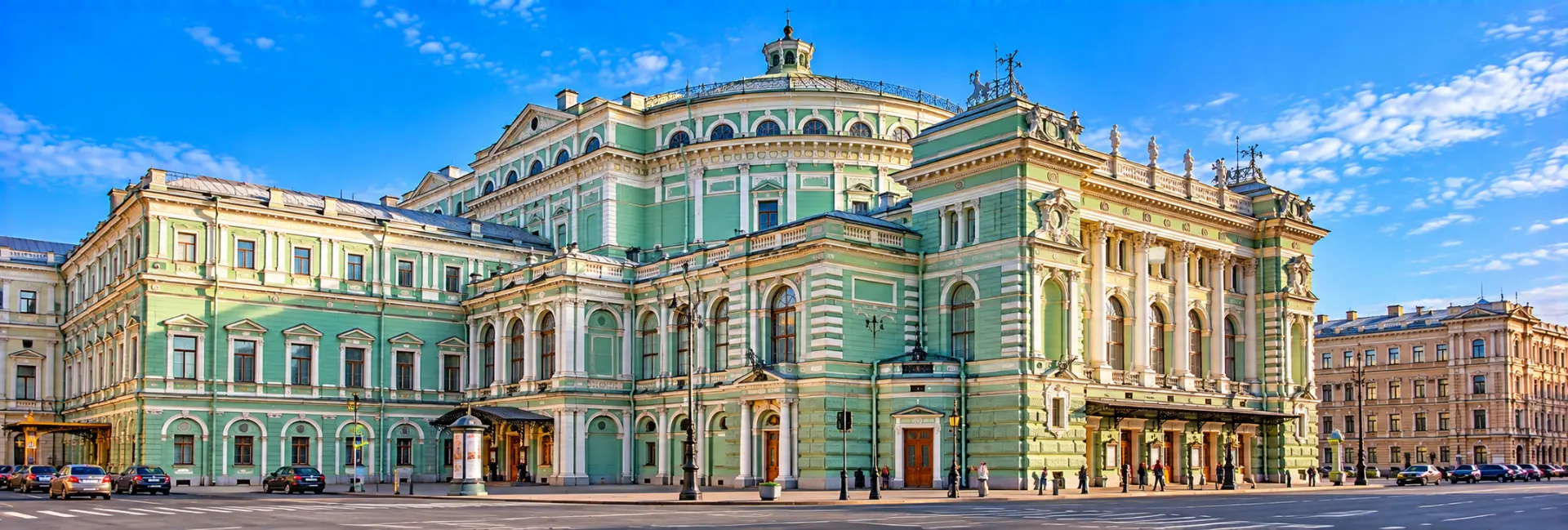
The Mariinsky Theatre is the grand opera and ballet house of Saint Petersburg and one of the best-known performing arts institutions in the world. Its historic home, a green-and-white building on Theatre Square, opened in 1860 and quickly became the stage on which some of the great works of Russian music and dance were first seen.
Today the name covers far more than one building. The Mariinsky is a company of three artistic ensembles, the Mariinsky Ballet, the Mariinsky Opera and the Mariinsky Orchestra, and it performs across a small complex of venues around Theatre Square and nearby Dekabristov Street. For many travelers, a night here is the highlight of a trip to the city.
Whether you want to hear a Tchaikovsky or Mussorgsky opera in the setting where it first reached the public, or watch classical ballet in the tradition that produced Pavlova, Nijinsky and Nureyev, the Mariinsky offers an experience that goes well beyond an ordinary night at the theatre.
History
The Stone Theatre on Carousel Square
The story begins in 1783, when Catherine the Great's government created an imperial theatre organization and a grand stone theatre, designed by Antonio Rinaldi, opened on what was then Carousel Square. The building was so large and so admired that the square itself took the name Theatre Square, which it still carries. Alexander Pushkin was among its regular visitors in the early nineteenth century.
From Circus to Mariinsky
In 1849 the architect Albert Cavos built a circus theatre on the square. After it was destroyed by fire in 1859, Cavos rebuilt it as a full opera and ballet theatre. It opened on 2 October 1860 and was named in honor of Empress Maria Alexandrovna, wife of Alexander II, whose bust still stands in the entrance foyer.
The Imperial Golden Age
The ballet company arrived at the new theatre in 1870, and in 1886 both the Imperial Ballet and the Imperial Opera moved in for good once the older Bolshoi Kamenny Theatre was judged unsafe. The conductor Eduard Nápravník led the opera for around half a century from 1863, while the choreographer Marius Petipa shaped the ballet repertoire that is still danced around the world.
Soviet Years and the Return of the Name
After the Revolution the theatre was renamed several times. From 1935 until 1992 it was known as the Kirov Theatre, after the Leningrad Communist Party leader Sergey Kirov, and many of its companies kept the Kirov name abroad for years afterward. The building was badly damaged during the Siege of Leningrad but was fully restored by autumn 1944, and the historic Mariinsky name was officially returned in 1992.
Architecture & Design
A Landmark on Theatre Square
The historic building is instantly recognizable from the outside. Its pale green exterior, white columns and ornate detailing give it the look of a classic imperial theatre, and it faces a wide square that was designed as a performance district long before the modern complex was built. The Rimsky-Korsakov Conservatory stands on the opposite side, on the site once occupied by the older Bolshoi Kamenny Theatre.
The Auditorium
Inside, the horseshoe-shaped auditorium is famed for its blue and gold decoration, tiered boxes and richly sculpted ornament. The house is intimate by modern opera-house standards, which means that even seats high up often feel close to the stage. A box in the middle of the hall was traditionally associated with the imperial family, and while it was never officially called the Tsar's Box, it is where the emperor and his family usually sat.
Rebuilt and Renewed
The theatre has been reconstructed more than once, including repairs after wartime bombing. Each renovation has aimed to keep the look of the nineteenth-century interior while improving the stage machinery, acoustics and comfort for modern performances.
The Mariinsky Complex
For visitors, the Mariinsky is best understood as a family of venues. Tickets show which building the performance takes place in, and it is easy to head to the wrong one if you are not careful, so always check before you set out.
The Historic Stage
The original theatre at 1 Theatre Square is the one most travelers picture: the gilded, nineteenth-century house with its traditional atmosphere. Choose this venue if you want to experience opera or ballet in the classic setting.
Mariinsky II
Opened in May 2013 at 34 Dekabristov Street, next to the historic building, the new stage is a large, modern theatre of about 1,830 seats designed by the Canadian firm Diamond and Schmitt with a local partner. After an earlier design by Jean Nouvel was halted, the new plan was completed at a reported cost of around 500 million euros. Its sightlines, technology and step-free access make it a comfortable alternative to the older hall.
The Concert Hall
The Mariinsky Concert Hall, designed by the French architect Xavier Fabre, opened in 2007 and hosts symphonic concerts and recitals. Its main address is 20 Pisareva Street, with an entrance from 37 Dekabristov Street.
Beyond Saint Petersburg
The theatre has also set up regional stages in Vladivostok and Vladikavkaz, extending its reach across Russia.
Performances & Famous Premieres
A House of World Premieres
The Mariinsky and its predecessor staged the first performances of a remarkable number of masterpieces, which is a large part of its prestige. Mikhail Glinka, Modest Mussorgsky and Pyotr Tchaikovsky all saw operas premiered here.
- Mussorgsky's Boris Godunov (1874)
- Tchaikovsky's The Queen of Spades (1890) and Iolanta (1892)
- Rimsky-Korsakov's The Golden Cockerel (1909)
- The revised version of Prokofiev's ballet Romeo and Juliet (1940)
- Prokofiev's Cinderella (1946)
- Khachaturian's Spartacus (1956)
The Ballet Tradition
The company's school, now known as the Vaganova Academy of Russian Ballet, has trained many of the most famous dancers in history, including Anna Pavlova, Vaslav Nijinsky, George Balanchine, Galina Ulanova, Rudolf Nureyev and Mikhail Baryshnikov. Their legacy gives the Mariinsky ballet its reputation for pure classical line and refined technique.
Opera and Orchestra
The opera company is especially associated with the Russian repertoire, though it also performs works by Verdi, Wagner and other composers. The conductor Valery Gergiev has led the theatre as general director since 1988, and the orchestra has toured widely and recorded under its own label.
Ways to Experience It
Attending a Performance
The most rewarding way to see the Mariinsky is simply to attend a show. Opera and ballet are both staged regularly during the season, and many travelers choose a ballet evening for its visual appeal, since no language knowledge is required.
Choosing a Venue and a Seat
- Pick the historic stage for atmosphere and tradition
- Pick Mariinsky II for modern comfort, views and accessibility
- Pick the Concert Hall for orchestral music and recitals
- Look at the seating plan before buying, since views from the sides of some tiers can be restricted
Learning More
The theatre runs a souvenir stand in each building, where you can find recordings on the Mariinsky label, books, postcards and items made in the theatre's own workshops. Guided visits to the historic building are sometimes offered through the theatre or licensed operators, but availability varies, so verify before you plan around one.
Best Time to Visit
The Performance Season
The theatre follows a season that runs from early autumn to late summer, with the opening around the start of September and the closing performances in August. During part of the summer the troupes often travel on tour, so the programme at home can be lighter. If you want the fullest choice of operas and ballets, plan your trip between autumn and spring.
Festival Moments
The theatre is also known for festivals that bring special programmes to the stage. If your dates are flexible, check the official schedule for any festival periods in the months you are considering.
Time of Day
Most performances take place in the evening, with some matinees on selected days. Arriving at least 30 to 45 minutes early gives you time to collect tickets, check your coat and take in the foyers before the lights go down.
Visitor Tips
- Buy tickets through the theatre's official website or box offices, since it sells tickets online around the clock and unofficial resellers may charge much more
- Check the venue printed on your ticket: the historic theatre, Mariinsky II and the Concert Hall are separate buildings with different entrances
- Check the current programme, cast and schedule on the official site, as these change and are not fixed here
- Many guests dress smartly for an evening at the theatre, although there is no strict rule
- Arrive early, as bag and coat checks and the foyers can be busy just before curtain time
- Plan your journey in advance, since the theatre is a fair walk from the nearest metro stations and public transport or a taxi is often the easiest choice
- Confirm current travel advisories from your own government and how payments and ticket purchases work for foreign visitors, as arrangements for international travelers to Russia can change
Mariinsky II has the easiest step-free access of the three main venues, so visitors with mobility needs may wish to choose a performance there and contact the theatre ahead of time to confirm arrangements.
Nearby Attractions
Theatre Square sits slightly away from the busiest tourist streets, in a quieter, more local part of the city that rewards a short stroll before or after a performance.
- Saint Nicholas Naval Cathedral: a blue-and-white Baroque church close to the theatre, beside the Kryukov Canal
- Kryukov Canal: a peaceful waterway ideal for a pre-show walk
- Rimsky-Korsakov Conservatory: the famous music school on the opposite side of Theatre Square
- Mariinsky Concert Hall and Mariinsky II: neighboring venues in the same complex, worth admiring from outside even if you are not attending
- Yusupov Palace: a historic mansion on the Moika River within walking distance
- New Holland Island: a revitalized former naval site with green spaces and cafes
FAQs about visiting the Mariinsky Theatre
What is the Mariinsky Theatre known for? +
It is one of Russia's leading opera and ballet houses, famous for its historic building on Theatre Square, its world-class ballet tradition and the many operas by Tchaikovsky, Mussorgsky and Rimsky-Korsakov that premiered there.
Where is the Mariinsky Theatre located? +
The historic theatre is at 1 Theatre Square in Saint Petersburg. Mariinsky II is at 34 Dekabristov Street, and the Concert Hall is at 20 Pisareva Street with an entrance from Dekabristov Street.
What is the difference between the historic theatre and Mariinsky II? +
The historic theatre opened in 1860 and offers a classic, ornate nineteenth-century interior. Mariinsky II opened in 2013 and is a larger, modern building with up-to-date technology and easier access.
Why is the Mariinsky sometimes called the Kirov? +
From 1935 until 1992 the theatre was named after the Leningrad leader Sergey Kirov. The Mariinsky name returned in 1992, though the Kirov name is still used in some international contexts for the companies.
How do I buy tickets? +
Tickets are available through the theatre's official website and box offices. Buying from official sources is the safest route, and checking which building the performance takes place in is essential.
Do I need to know Russian to enjoy a performance? +
Not for ballet, which is told through dance and music. For opera, performances are usually sung in the original language, and the theatre may offer translated titles, so check the details for your chosen show.
Is there a dress code? +
There is no strict official rule, but many visitors dress smartly for an evening at the theatre, which helps you feel part of the occasion.
When does the season run? +
The season runs from early autumn until summer, with the companies often touring during part of the summer. Check the official calendar for exact dates.
What else can I see nearby? +
Saint Nicholas Naval Cathedral, the Kryukov Canal, the Rimsky-Korsakov Conservatory and Yusupov Palace are all within a short walk.
