
Table of Contents
Overview
Nevsky Prospekt is the street that every visitor to Saint Petersburg ends up walking, sooner or later. It runs for about 4.5 kilometers from the Admiralty, near the Neva River, to Alexander Nevsky Lavra in the east, and along the way it passes cathedrals, palaces, bridges, department stores, theaters and cafes. It is the city's main thoroughfare and its liveliest social space.
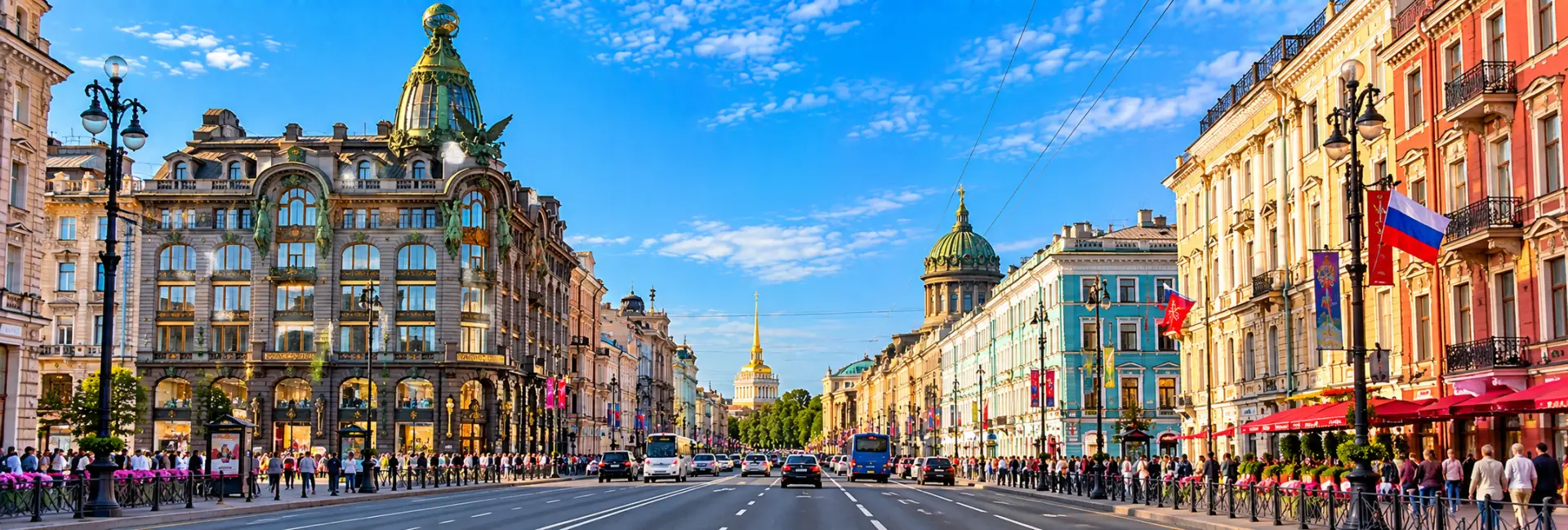
The avenue is very wide, and its long, straight view toward the golden spire of the Admiralty is one of the defining images of the city. Buildings on both sides range from Baroque palaces to Neoclassical churches and early twentieth-century Art Nouveau landmarks, and each block seems to belong to a different period of Russian history.
Part of the Historic Centre of Saint Petersburg, a UNESCO World Heritage Site, Nevsky Prospekt is not a single attraction in the usual sense. It is a place to wander, shop, eat and people-watch, with a world-class sight at nearly every few hundred meters.
History
Two Roads Across the Marsh
The avenue began in the early 1710s, when Peter the Great's builders laid roads through swampy ground to link the Admiralty with the site of the Alexander Nevsky Monastery and the ancient trade route toward Novgorod. At first it was a rough track, but as the new capital grew, the road became the main axis of its development.
A Street Named for a Hero
The name comes from Alexander Nevsky, the medieval prince who defeated Swedish forces on the banks of the Neva in the thirteenth century. The monastery founded in his honor gave the road its identity, and the section nearest to it, east of Vosstaniya Square, is still sometimes called Old Nevsky.
Growth and Transformation
Through the eighteenth and nineteenth centuries, churches of several faiths, grand private mansions, merchant houses and shopping arcades filled in the avenue. Kazan Cathedral and the surrounding square took shape in the early 1800s, and at the turn of the twentieth century new commercial buildings, including the Singer House, gave the street a modern face.
After the 1917 revolution the avenue was renamed in honor of the October uprising, and it regained its historic name in 1944. The metro stations that opened in the 1960s further cemented its role as the center of daily life in the city.
Architecture & Streetscape
The great charm of Nevsky Prospekt lies in the variety of its buildings. Rather than a single style, the avenue offers a continuous parade of facades, with colors ranging from pastel yellows and pinks to deep reds and whites. Rooftop statues, ornate balconies and arched entrances reward anyone who looks up.
Baroque and Neoclassical
Baroque survives in the Stroganov Palace, a graceful pink-and-white building by Bartolomeo Rastrelli completed around 1760. Neoclassical architecture dominates in the great arcaded halls of Gostiny Dvor and in the sweeping colonnade of Kazan Cathedral, which reaches out to embrace the square in front of it.
Art Nouveau and Modern Touches
By the early 1900s, architects were designing in a new, more fluid style. The Singer House, with its glass tower topped by a globe, is the best-known example. Many of the passages and department stores that replaced older buildings share the same bright, commercial confidence.
Canals and Bridges
The avenue crosses several waterways, including the Moika, the Griboedov Canal and the Fontanka. The bridges give you pleasing views along the water, and each crossing brings a change of atmosphere. The Anichkov Bridge, with its sculptured horses, is especially celebrated.
Key Stretches of the Avenue
Admiralty to Kazan Cathedral
The western end is the most formal. Near the Admiralty you find grand mansions, bookshops and the Stroganov Palace. The view back toward the golden spire is memorable at any time of day, and the area leads naturally to Palace Square.
Kazan Cathedral to the Fontanka
This is the busiest and most commercial part of the avenue. Here are the Singer House, the Gostiny Dvor shopping arcade, the National Library and a cluster of historic churches. Side streets branch off toward the Church of the Savior on Spilled Blood and the Arts Square.
The Fontanka to Vosstaniya Square
Beyond the Anichkov Bridge the atmosphere changes. The street feels a little calmer and more residential, with the Anichkov Palace and the Beloselsky-Belozersky Palace close to the river. The Moscow Railway Station and Vosstaniya Square mark the end of the most popular walking route.
Old Nevsky to the Lavra
The final stretch is narrower and quieter, leading past shops and local cafes to Alexander Nevsky Square and the entrance to Alexander Nevsky Lavra, a monastery complex known for its historic cemeteries.
Notable Landmarks
- The Admiralty, with its golden spire marking the western end of the avenue
- The Stroganov Palace, a Baroque mansion now linked with the Russian Museum
- Kazan Cathedral, a Neoclassical church built in the early 1800s with a vast curved colonnade
- The Singer House, an Art Nouveau landmark with a glass dome and globe, known today for its bookshop
- Gostiny Dvor, one of the oldest and largest shopping arcades in the world, stretching for roughly a kilometer
- The National Library of Russia, one of the largest libraries in the country
- Churches of different faiths, including Orthodox, Catholic, Lutheran, Dutch Reformed and Armenian congregations
- The Anichkov Bridge and its four bronze Horse Tamer sculptures by Peter Klodt
- The Anichkov Palace and the Beloselsky-Belozersky Palace beside the Fontanka
- Alexander Nevsky Lavra, a monastery with a famous necropolis for composers, writers and artists
Literary & Cultural Legacy
Nevsky Prospekt has been a literary subject for almost two centuries. Nikolai Gogol set one of his best-known stories here, portraying the avenue as a stage where appearances can be deceiving, and writers such as Dostoevsky and Tolstoy also used it as a backdrop. For many of them it stood for the energy, ambition and loneliness of the modern city.
The avenue also carries memories of the Second World War. During the siege of Leningrad, artillery fire struck the street regularly, and a warning sign recreated on the building at number 14 still reminds passers-by that one side was more dangerous than the other. The Horse Tamers on the Anichkov Bridge were buried in a garden during the war to protect them, and a damaged pedestal has been left as it was as a quiet memorial.
Today the avenue remains a social meeting place. Residents arrange to meet at its metro stations, couples stroll along it in the evening, and festivals and street performers still appear on the pavement and in the nearby squares.
Ways to Experience It
The best way to experience Nevsky Prospekt is slowly, on foot, with enough time to step into side streets and courtyards. Different visitors will want to emphasize different things.
- Walk the central section from Palace Square or the Admiralty to Vosstaniya Square, which covers most of the best-known sights
- Stop at Kazan Cathedral and the Singer House for architecture and a good view of the avenue
- Browse Gostiny Dvor and the older shopping passages for souvenirs and local products
- Pause at a cafe or a historic confectioner for a break and a view of the crowd
- Pick a canal bridge and look along the water for photographs
- Take a guided walking tour to learn the stories behind the facades
- Use the metro to skip long stretches, since several stations lie directly under the avenue
Best Time to Visit
The avenue is busy all year, but the mood changes with the season. Summer is the liveliest period, with outdoor terraces, long daylight and the famous White Nights, when people stroll late into the evening beneath a pale sky. It is also the most crowded time.
Spring and early autumn are comfortable for walking and offer softer light for photography. Winter is cold and dark early in the day, but the facades are decorated for the holiday season, and the lit shop windows and snowy bridges have a particular charm.
Morning is a quieter time to take photographs without large crowds. Late afternoon and evening bring the most energy, and the street is lit attractively after dark. The even-numbered side of the avenue gets more sun and is traditionally the more popular side for strolling.
Visitor Tips
Because Nevsky Prospekt is an ordinary city street rather than a ticketed attraction, practical planning matters more than booking. Opening hours for individual shops, museums and churches vary, so check each one before you go.
- Wear comfortable shoes, because the walk from end to end is several kilometers.
- Remember that crossings can be far apart, so use underpasses or marked crossings rather than crossing in the middle of the road.
- Keep your valuables secure in crowded sections, especially near Gostiny Dvor and the metro stations.
- Look for church entrances along the way, and dress modestly if you plan to go inside.
- Check the opening hours of museums, shops and cathedrals in advance, since they differ widely.
- Be cautious about restaurants with aggressive street touts, and compare menus and prices before sitting down.
- Check the city's events calendar, since festivals and holidays may close parts of the avenue to traffic.
Nearby Attractions
The avenue is surrounded by some of the best-known sights in Saint Petersburg, many of them only a few minutes from its main crossings.
- Palace Square and the Hermitage, at the western end of the avenue
- The Church of the Savior on Spilled Blood, a short walk from Nevsky Prospekt along the Griboedov Canal
- Saint Isaac's Cathedral and the Bronze Horseman, a little beyond the Admiralty
- The Russian Museum and Mikhailovsky Garden, near the Arts Square
- The Summer Garden and the Field of Mars, a pleasant walk from the Fontanka
- The Fabergé Museum on the Fontanka Embankment
- Alexander Nevsky Lavra, at the far eastern end of the avenue
FAQs about visiting Nevsky Prospekt
How long is Nevsky Prospekt? +
It runs for about 4.5 kilometers, from the Admiralty in the west to Alexander Nevsky Lavra in the east. Most visitors walk only the central section between Palace Square and Vosstaniya Square, which is a little over half the full distance.
How long does it take to walk? +
A steady walk of the central section takes about an hour, but most people spend several hours with stops at churches, shops and cafes. A full end-to-end walk with sightseeing can fill a whole day.
Is it free to visit? +
Yes, the avenue itself is a public street and costs nothing to walk. Museums, palaces and some church interiors charge their own admission, and prices change, so check each one in advance.
Which metro stations are on the avenue? +
Several stations lie along or under it, including Admiralteyskaya, Nevsky Prospekt, Gostiny Dvor, Mayakovskaya, Vosstaniya Square and Alexander Nevsky Square. Some of these are linked by transfer corridors, so you can hop between stretches easily.
What are the must-see stops? +
Most first-time visitors prioritize Kazan Cathedral, the Singer House, Gostiny Dvor and the Anichkov Bridge, with the Admiralty and Palace Square at one end. The Stroganov Palace and Alexander Nevsky Lavra are worth adding if you have time.
What is the best time of day to walk it? +
Early morning is quiet and good for photographs, while late afternoon and evening bring the most atmosphere. In summer the long light makes a later walk especially pleasant.
Is it safe to walk at night? +
The central section is busy and well lit in the evening, and many people stroll there after dark. As in any large city, keep an eye on your belongings and stay on the main, populated parts of the avenue.
Is Nevsky Prospekt suitable for children and visitors with limited mobility? +
The pavements are wide and mostly level, which makes the avenue manageable with a stroller or wheelchair, though crossings and some historic buildings can be awkward. Plan shorter stages and use the metro to cover longer distances.
