
Table of Contents
Overview
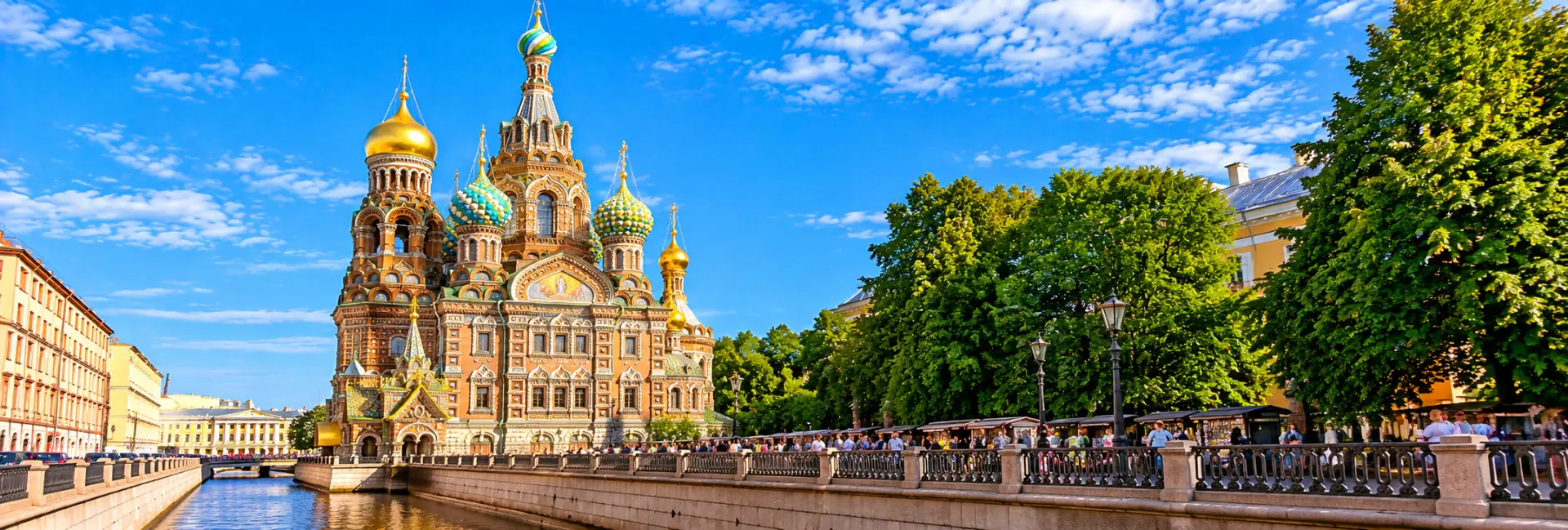
Few buildings in Saint Petersburg look as unexpected as the Church of the Savior on Spilled Blood. In a city known for pale Baroque palaces and strict Neoclassical facades, this church rises beside the Griboedov Canal with a crowd of glazed domes, patterned brickwork and bright decorative panels that recall medieval Moscow far more than the imperial capital around it.
The church was raised as a memorial to Emperor Alexander II, who was mortally wounded by a bomb on this exact stretch of the embankment in March 1881. Its official name is the Cathedral of the Resurrection of Christ, but the nickname that refers to the blood spilled on the spot is the one everyone uses, in Russian and in English alike.
Today the building works as a museum rather than a parish church, and its real fame lies inside. Nearly every surface of the interior is covered in mosaic, a scale of decoration that makes it one of the most striking religious interiors in Europe. Whether you come for the history, the photography or the sheer color, it is one of the essential stops in the historic center of the city.
History
A Murder on the Embankment
On 13 March 1881 (1 March in the Julian calendar then used in Russia), a member of the revolutionary group Narodnaya Volya threw a bomb at the carriage of Alexander II as it traveled along the Catherine Canal, which is now called the Griboedov Canal. The emperor, remembered for freeing the serfs, was carried to the Winter Palace and died there a few hours later.
Planning and Construction
His son and successor, Alexander III, decided that a memorial church should stand on the site of the attack. A design competition followed, and the chosen concept called for a church in the style of seventeenth-century Russian architecture. Architect Alfred Parland, working with ideas from Archimandrite Ignaty (Ivan Malyshev), shaped the final design. A ceremonial groundbreaking took place in 1883, although full-scale building only began after the definitive plans were approved in 1887.
To enclose the precise spot of the assassination within the church walls, part of the canal was narrowed and the building was pushed out over the old roadway. Funding came largely from the imperial family, supported by many private donors, and the project was finished and consecrated in 1907 under Nicholas II. The total cost is usually estimated at several million rubles.
Decline and Restoration
The church never served an ordinary congregation. It was intended for memorial services for the murdered emperor, and its life as a place of worship was short. After the 1917 revolution the interior was looted and damaged, and in 1932 the Soviet authorities closed it. In the following decades it was used for storage, and for a time as a morgue during the wartime siege, earning the grim local nickname "Saviour on Potatoes" because of the vegetables kept inside.
War damage and neglect left the structure in poor condition. In 1970 the building was placed under the administration of the museum at Saint Isaac's Cathedral, and a long restoration followed. The church reopened to visitors in 1997 as a museum, restored to a standard that brought back the original mosaic scheme.
Architecture & Design
The church is a prime example of the Russian Revival, or Neo-Russian, movement that flourished in the late nineteenth century. Its designers deliberately turned away from the Western-influenced style that dominated Saint Petersburg and looked to the churches of old Moscow and Yaroslavl for inspiration. The result is often compared with Saint Basil's Cathedral, though the two buildings differ considerably in plan and proportion.
The Silhouette
The building reaches about 81 meters in height and is crowned by a cluster of domes. A tall tent-roofed bell tower stands at the west end, directly above the place where the emperor fell. The domes are finished in colorful enamel and gilding, with patterns that catch the light differently from hour to hour, and the central dome rises above a ring of smaller ones.
Materials and Facades
The exterior is a lively mix of brick, granite, glazed tile and decorative stone. Colorful mosaic panels run along the upper walls, including panels bearing the coats of arms of Russian cities and provinces, while granite plaques with gilded lettering recount the main events of Alexander II's reign. Parland also designed an ornate gate for the church courtyard in a more modern Art Nouveau style, a reminder that the building belongs to its own era as much as to the medieval past it imitates.
Inside the Plan
Inside, the space is divided into a main body topped by the central dome and a smaller bay that holds the memorial to the emperor. The church could hold well over a thousand people when it was built, but it was designed to impress through surface decoration rather than through grand structural gestures, and that decision shapes everything a visitor sees.
Mosaics & Notable Features
The interior is why the church draws visitors from all over the world. There are no painted murals here. Walls, vaults, pillars and domes are covered with mosaic work that spreads across more than 7,000 square meters, among the largest displays of its kind anywhere. The images were produced from designs by some of the leading Russian artists of the period, including Viktor Vasnetsov and Mikhail Nesterov, with Parland himself contributing to the scheme.
The Memorial Canopy
The emotional center of the building is the small shrine on the very spot where Alexander II was wounded. A canopy of polished jasper and other fine stones, made by Russian stone-cutting workshops, rises over a section of the original embankment. Visitors can see the actual cobbles and a fragment of the canal railing that were preserved inside the church, which gives the site a physical link to the 1881 attack that few memorials can match.
Iconostasis and Biblical Scenes
The iconostasis, the screen that separates the altar area from the nave, is also executed in mosaic rather than painted panels. Scenes from the life of Christ unfold overhead, with the Passion shown toward the west and the post-Resurrection appearances toward the east. Many of the images are rendered in tiny pieces of glass, smalt and semiprecious stone, which gives them a glow that photographs only partly capture.
Details Worth Looking For
- The huge central dome, with its mosaic figure of Christ looking down over the nave
- Floors and lower walls inlaid with colored stone in intricate patterns
- Small mosaic portraits of saints and patron figures hidden in side arches
- The open chapel on the west facade with its mosaic crucifixion
Cultural & Religious Significance
For many Russians the church stands for a particular moment in history. It was commissioned in a period of rising national feeling, when architects, artists and patrons were rediscovering the visual language of medieval Russia. The building is as much a statement about identity as a monument to a single man.
Its unusual story, from imperial memorial to Soviet storeroom to restored museum, also mirrors the larger turns of twentieth-century Russian history. Few other buildings in the city carry so many layers of meaning within a single set of walls, and that is part of why guides tend to return to it again and again.
The church stands within the Historic Centre of Saint Petersburg, which is inscribed as a UNESCO World Heritage Site, and it is one of the best-known images of the city. Although it is a museum today and does not operate as a regular parish, it remains a consecrated-style space designed for Orthodox ritual, and many visitors approach it with the quiet respect they would show any active church.
Visiting Etiquette & Tips
The church is among the most visited sights in the city, so a bit of preparation goes a long way. Hours, ticket rules and entry procedures can change, so confirm them on the official site of the Saint Isaac's Cathedral museum, which manages the building, before you travel.
- Dress modestly, with shoulders covered, since the building keeps the atmosphere of a church even as a museum.
- Keep your voice low inside, and follow any posted rules on photography, flash and tripods.
- Arrive soon after opening or later in the evening to avoid the heaviest tour-group crowds.
- Allow time for the memorial shrine, which many people rush past on the way to the main hall.
- Check ahead whether tickets must be bought in advance or can be bought at the door, and how payment is accepted.
- Large bags may not be allowed inside, so travel light.
- Look up while you walk, because the best mosaic details sit in the vaults and domes.
Best Time to Visit
The exterior is beautiful in every season, but the experience changes with the light and the crowds. In summer the days are very long, especially during the White Nights period from roughly late May to mid-July, and the museum has historically stayed open later in the evening during the warm months, which makes a late visit a rewarding alternative to the busy daytime hours.
Winter brings thinner crowds, snow on the domes and a more contemplative mood, although the days are short and cold. Spring and early autumn offer a comfortable balance, with mild weather and a softer rhythm than the peak summer weeks.
Within a single day, the early morning is calmest for the interior, while late afternoon light gives the domes their warmest glow for photographs from the canal bridges. Remember that the museum has traditionally closed one day a week, often Wednesday, so check the current schedule before you plan the day around it.
Nearby Attractions
The church sits in the heart of Saint Petersburg's historic center, so it pairs easily with several other major sights on foot.
- Mikhailovsky Garden, right behind the church, a pleasant green space for a break
- The Russian Museum in the Mikhailovsky Palace, the largest collection of Russian art in the city
- The Field of Mars, a broad memorial park a short stroll to the north
- Nevsky Prospect, the main avenue, with its shops, cafes and Kazan Cathedral
- The Singer House, a landmark Art Nouveau building and bookshop on Nevsky Prospect
- Palace Square and the Hermitage Museum, a walk of about twenty minutes
- Canal boat tours, which depart nearby and give a different view of the church from the water
FAQs about visiting the Church of the Savior on Spilled Blood
Why is it called the Church of the Savior on Spilled Blood? +
The name refers to Emperor Alexander II, who was fatally wounded by a bomb on this spot in March 1881. The church was built as a memorial on the exact place where his blood was shed, and its official name is the Cathedral of the Resurrection of Christ.
Is it an active church or a museum? +
It functions mainly as a museum today, run by the team that manages Saint Isaac's Cathedral. It is not a regular parish church, though it is still a sacred space and visitors are expected to behave respectfully.
How long should I spend inside? +
Most visitors need about 45 minutes to an hour to see the interior comfortably, longer if you enjoy studying the mosaics in detail or taking an audio guide. Add extra time if you want to walk around the exterior and the canal side.
Do I need to buy tickets in advance? +
The interior requires an entry ticket, and lines can build up in busy periods. Booking ahead through the official channels is the safest approach, but check the current rules and payment options on the museum's official site before you go.
What is the best time of day to visit? +
Early morning and the final hours before closing are generally the quietest. In summer, evening visits are a popular choice because of the long daylight and the glow on the domes.
How do I get to the church? +
It stands on the Griboedov Canal embankment, a short walk from the Nevsky Prospect and Gostiny Dvor metro stations. Many people reach it on foot as part of a stroll along Nevsky Prospect.
Is it suitable for children and older visitors? +
Yes, the visit is mostly a walk at a gentle pace, and children often enjoy the bright domes and the sheer amount of color. Check current accessibility arrangements with the museum if you need step-free access, since older historic buildings can have limitations.
What should I combine it with? +
The church pairs naturally with the Mikhailovsky Garden and the Russian Museum next door. You can also continue to the Field of Mars, Nevsky Prospect or Palace Square for a full day in the historic center.
