
Table of Contents
Overview
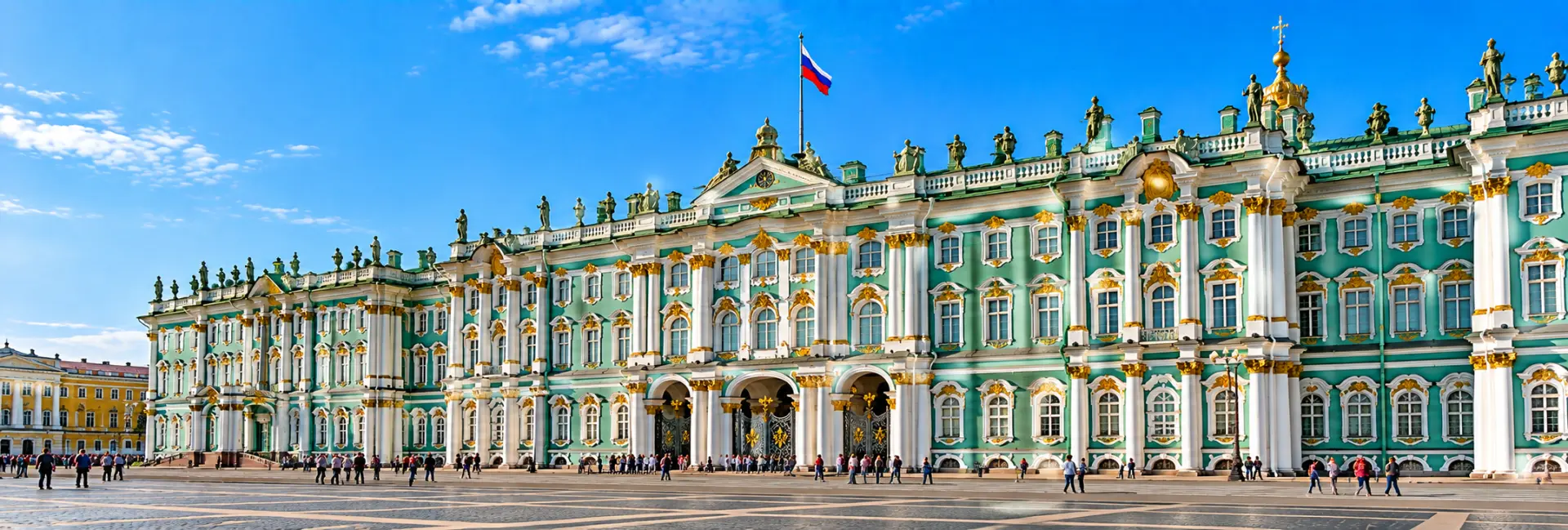
The State Hermitage Museum is one of the largest and most celebrated art museums on Earth, and its grandest building is the Winter Palace, the green-and-white Baroque residence of Russia's emperors on the bank of the Neva River. Together with several neighbouring buildings, it forms a vast ensemble in the heart of St Petersburg's historic centre.
The collections hold roughly three million items, stretching from the Stone Age to the twentieth century. Visitors can see Western European paintings, classical antiquities, Russian imperial treasures, ancient gold from the steppes, Oriental art and some of the world's finest Impressionist and modern works.
Part of the appeal is that the setting is as remarkable as the art. Gilded halls, marble staircases and richly decorated state rooms make the building itself an exhibit, so a visit blends fine art, imperial history and architecture in one unforgettable day.
History of the Museum
Catherine the Great's Private Collection
The museum traces its founding to 1764, when Empress Catherine the Great bought a collection of paintings from the Berlin merchant Johann Ernst Gotzkowsky. She and her successors kept adding to it, often by purchasing entire private collections from European aristocrats. The Hermitage was originally a private retreat for the court, and few outsiders were admitted.
From Palace to Public Museum
The New Hermitage, built in the mid-nineteenth century, opened to the public in 1852 and became Russia's first public museum. The imperial treasures, along with the palaces themselves, passed into state ownership after the 1917 revolution, an event famously linked to the storming of the Winter Palace.
Palace Under Fire and Revolution
The Winter Palace served as the main residence of the Romanov dynasty from the 1730s until 1917. The present building was constructed in the 1750s and early 1760s, and a major fire in 1837 forced a rapid reconstruction. Over the twentieth century the museum expanded, taking in the General Staff Building and the Menshikov Palace. Each year it marks its founding on 7 December, Saint Catherine's Day.
Architecture & the Palace Buildings
The main complex consists of five interconnected buildings along the Palace Embankment, each from a different era and style. Together they form one of the great architectural ensembles of Europe.
The Winter Palace
Designed by Francesco Bartolomeo Rastrelli and built between 1754 and 1762, the Winter Palace is a showpiece of Elizabethan Baroque, with a long, colonnaded facade, sculpted details and a rich green-and-white colour scheme. Its interiors were reworked many times, and after the fire of 1837 they were rebuilt in a range of styles.
The Small, Old and New Hermitage
Catherine the Great added the Small Hermitage in the 1760s as a place for private entertaining and art, followed by the Old (Large) Hermitage in the 1770s and 1780s. The New Hermitage, designed by Leo von Klenze, was built between 1842 and 1851 to display the imperial collection to the public.
Inside the State Rooms
Walking through the palace's ceremonial suites is a journey through changing tastes. The Great Ante-Chamber serves as the principal entrance hall to the state apartments and keeps its original decoration, while the Pavilion Hall of the Small Hermitage glitters with chandeliers, mosaics and golden detail. Many rooms were redesigned after the 1837 fire, so a single corridor can move from rich Baroque ornament to restrained neoclassical order. Look up as often as you look ahead, because the ceilings, parquet floors and gilded doors are often as remarkable as the works on the walls.
The Hermitage Theatre and Beyond
Giacomo Quarenghi's Hermitage Theatre was completed in the 1780s, a refined neoclassical building that remains one of the city's finest eighteenth-century interiors. The museum has since grown beyond the original ensemble, with the General Staff Building across Palace Square and the Menshikov Palace on Vasilyevsky Island.
Collections & Exhibits
Western European Art
The museum owns an extraordinary range of paintings, with outstanding works from the Italian Renaissance, the Dutch and Flemish masters and Spanish and French painting. Its holdings include more than 16,000 paintings overall, along with huge numbers of drawings, prints and sculptures.
Impressionists and Modern Art
French painting from the nineteenth and twentieth centuries is one of the Hermitage's great strengths, with significant works by Matisse, Picasso and many of their contemporaries. Much of this collection is shown in the General Staff Building.
Antiquities, Gold and Applied Arts
Beyond paintings, the Hermitage shelters classical sculpture, ancient Greek jewellery, Egyptian artefacts and the celebrated gold of the Scythians. Its decorative art collections include porcelain, furniture, silver, jewellery and Russian imperial regalia, giving a rounded picture of art and daily life across the centuries.
Archaeology and Coins
The museum also keeps hundreds of thousands of archaeological finds and a very large numismatic collection, which are not always on display but underline its role as a major research institution.
Must-See Highlights
- Jordan (Ambassadors') Staircase: the dazzling marble and gilt entrance to the state rooms, once used for royal ceremonies and still the most dramatic way into the palace.
- Peacock Clock: an eighteenth-century automaton built by James Cox, in which a golden peacock, owl and rooster move when the mechanism is wound, displayed in the Pavilion Hall of the Small Hermitage.
- Leonardo da Vinci's Madonnas: two early paintings, the Benois Madonna and the Madonna Litta, among the few Leonardo works in Russia.
- Rembrandt Collection: a large group that includes Danae and the late masterpiece The Return of the Prodigal Son.
- Matisse's Dance: a bold, vivid canvas that is one of the best-known paintings of the early twentieth century.
- Raphael's Conestabile Madonna: a small, tender painting by the Italian master.
- Kolyvan Vase: an enormous jasper vase weighing about nineteen tonnes, carved from a single piece of stone.
- Gold of the Scythians: ancient gold ornaments from the Eurasian steppes, among the finest in the world.
Ways to Experience It
Choose Your Route
The Hermitage is far too large to see in one visit, so choose a theme. Some people focus on the state rooms of the Winter Palace, others on Italian and Dutch painting, and others on the Impressionists in the General Staff Building. A short list of must-see rooms keeps the day manageable.
Guided Tours
Guided tours are available in several languages and help you navigate the maze of halls while explaining the palace's history. A guide can be especially useful for first-time visitors who want to see the main highlights without getting lost.
Cross the Square to the General Staff Building
Across Palace Square, the General Staff Building forms part of the museum and gives a very different experience from the imperial palace. Its bright, modern galleries display French paintings of the nineteenth and twentieth centuries, and it is also the museum's main venue for contemporary art. It is easy to treat as a separate half-day, especially if you prefer Impressionism and modern painting to historic interiors.
Take It Slowly
Many visitors return more than once, or split their time across two half-days. Pause at windows overlooking the Neva and Palace Square, enjoy the ornate ceilings and floors, and treat the building itself as part of the experience rather than only a container for paintings.
Best Time to Visit
By Season
The museum is open year-round, so it works in any weather. Summer brings the longest days and the busiest crowds, particularly during the White Nights in June, while autumn and winter are quieter. A cold winter day is an ideal excuse to spend hours indoors.
By Time of Day
Early in the day is best, when the rooms are calmer and the main halls can be enjoyed with fewer people. Weekends and holiday periods are busier, and the museum is closed on Mondays, so plan accordingly. Some evenings may have extended opening hours, so check the latest schedule.
Visitor Tips
- Opening days: the museum is usually closed on Mondays, and hours vary by day, so confirm before you go.
- Entrance: individual visitors typically enter through the Winter Palace from the courtyard side, so follow signs after passing through the arch from Palace Square.
- Tickets: buy tickets through the official channels where possible, and check for any separate charges for the General Staff Building or special exhibitions.
- Pace yourself: the complex is enormous, so wear comfortable shoes and plan on a half day at least, with breaks to rest.
- Cloakroom: large bags and coats are normally left in the cloakroom, which is especially useful in winter.
- Photography: rules on photography and flash can vary, so look out for signs in individual halls.
- Before you travel: entry rules and government travel advice for Russia can change, so check the latest requirements for your nationality well in advance.
Nearby Attractions
The museum sits at the centre of St Petersburg's historic core, so many landmarks are within easy walking distance. Palace Square, with the Alexander Column and the curved General Staff Building, lies directly in front of the Winter Palace and is the natural place to start or end your day.
Within a short walk you can reach the Admiralty, St Isaac's Cathedral and the broad Neva embankment, which offers views toward the Peter and Paul Fortress on the opposite bank. The Summer Garden, along the Palace Embankment, is a pleasant spot to unwind after hours in the galleries, and Nevsky Prospect, the city's main avenue, begins close by with cafés, shops and further historic sights.
FAQs about visiting the Hermitage Museum
What is the Hermitage Museum? +
It is a huge art and culture museum in St Petersburg, housed mainly in the former imperial Winter Palace and neighbouring buildings. Its collections include around three million items.
Is the Winter Palace part of the Hermitage? +
Yes. The Winter Palace is the main building of the Hermitage complex, along with the Small, Old and New Hermitage and the Hermitage Theatre.
How long do I need to visit the Hermitage? +
At least three to four hours for the highlights. Serious art lovers could spend a full day or split the visit across multiple days.
What should I see if time is short? +
Focus on the Jordan Staircase, the state rooms, the Peacock Clock and a few painting highlights such as the Leonardo and Rembrandt rooms.
What is the museum's closing day? +
The museum is usually closed on Mondays. Check the official website for current opening hours and any changes.
Can I buy tickets on arrival? +
Tickets are generally available on site, but queues can be long in busy seasons. Check the official website for current ticketing options and any online purchase requirements.
Is the Hermitage suitable for children? +
Yes, many children enjoy the grand halls and eye-catching objects like the Peacock Clock, though the size of the museum means shorter, themed visits work best.
