
Table of Contents
Overview
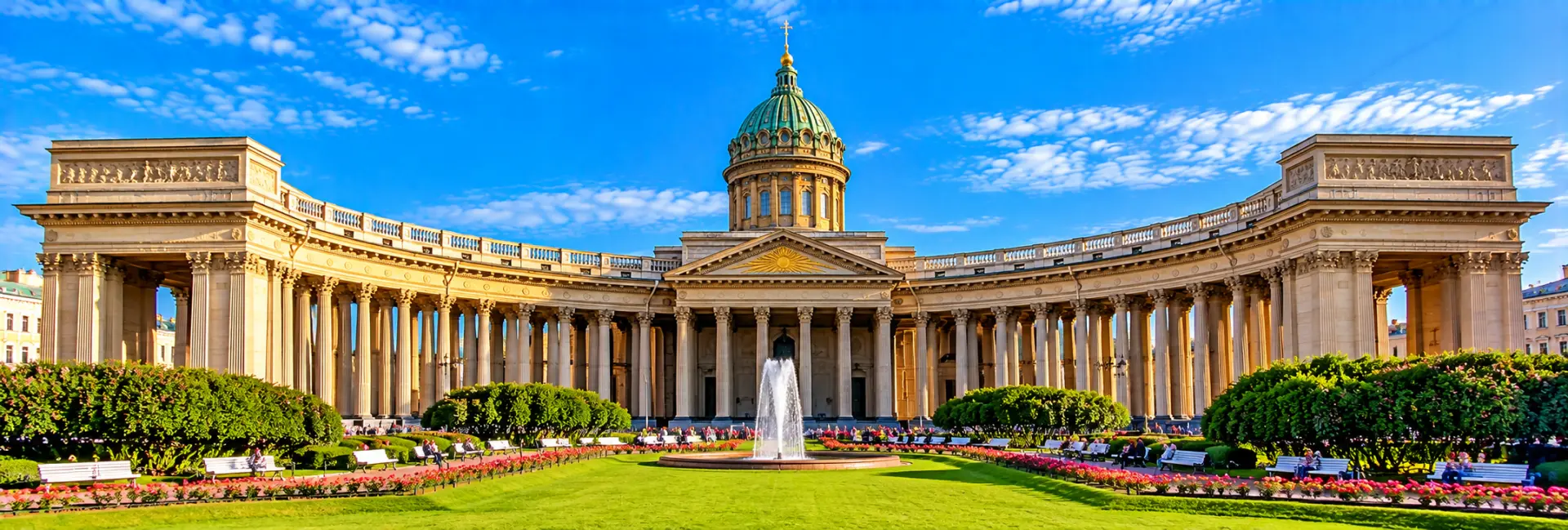
Kazan Cathedral is one of the most recognizable buildings on Nevsky Prospekt. Its great curved colonnade opens toward the avenue like a pair of outstretched arms, framing a small square and drawing passers-by toward the church behind it. Few places in Saint Petersburg combine such strong architecture with so much living tradition.
Officially the Cathedral of Our Lady of Kazan, the church was built in the first decade of the nineteenth century to house a revered copy of the Kazan icon of the Mother of God. It later became a memorial to Russia's victory over Napoleon, and it holds the tomb of Field Marshal Mikhail Kutuzov, the commander who led the army in 1812.
Unlike several of the city's other great churches, Kazan Cathedral is again a working place of worship, with regular services. Entry is normally free, which makes it an easy and rewarding stop in the middle of a walk along the avenue.
History
A Cathedral for the Capital
Construction began in 1801 under Emperor Paul I and continued for about ten years. The architect Andrey Voronikhin was a former serf who had risen to become one of the leading designers of his generation. The cathedral replaced an earlier church on the site, the Church of the Nativity of the Virgin, whose icon of Our Lady of Kazan was moved to the new building when it was completed in 1811.
Monument to 1812
When Napoleon invaded Russia in 1812, the commander-in-chief Kutuzov prayed before the icon before leaving to join the army. After the French retreat, the cathedral took on a new meaning as a war memorial. Captured French banners and the keys to enemy fortresses were hung inside, and Kutuzov was buried here in 1813. In 1837 statues of Kutuzov and another commander, Barclay de Tolly, were placed in front of the colonnade.
The Icon's Journey
The icon at the heart of the cathedral arrived in the capital in the early eighteenth century, when Peter the Great ordered a copy of the Kazan image to be brought to his new city. It was kept first at the Alexander Nevsky monastery and later in the Church of the Nativity of the Virgin on Nevsky Prospekt, before being moved to its present home in 1811. The icon was later given a golden frame set with precious stones, and in 1865 a large painted image of the Mother of God was added to the outer wall of the apse.
Closure and Revival
The Bolsheviks closed the cathedral for worship in the late 1920s, and in 1932 it became the Museum of the History of Religion and Atheism. That arrangement lasted until the early 1990s, when the building was handed back to the church. It was consecrated again with full rites in 1998 and regained cathedral status in the following years.
Architecture & Design
The cathedral is a leading work of Russian Neoclassicism. Voronikhin took inspiration from Saint Peter's Basilica in Rome, and the curved colonnade in front is the clearest echo of that model. Yet the result is not a copy: the building is lighter and more intimate, designed to fit into the busy rhythm of an urban avenue.
The Colonnade
The semicircular colonnade consists of 96 Corinthian columns, each around 13 meters high, which sweep out from the main body of the church. It encloses a small garden with a fountain and creates one of the most elegant outdoor spaces in the city center. Statues of saints and archangels stand at the ends, and large biblical reliefs decorate the side walls.
Sculpture on the Facade
Sculpture plays a major role in the exterior. The sculptor Ivan Martos created figures of the archangels Gabriel and Michael for the ends of the colonnade, and bronze statues of saints, including Prince Vladimir, John the Baptist, Alexander Nevsky and the apostle Andrew, stand in niches of the portico. Large biblical reliefs fill the walls above, so the building works almost as a stone gallery of Russian art from the early nineteenth century.
An Unusual Orientation
Following Orthodox tradition, the altar lies in the east and the main entrance faces west, toward Kazanskaya Street. This means the colonnade facing Nevsky Prospekt is technically the side of the church rather than its front. Voronikhin turned this problem into a strength by making the side facade the grand ceremonial approach.
Size and Dome
The cathedral stands about 72 meters tall, including its dome, and is similar in length. The central drum and dome give the whole composition a calm vertical accent that balances the long horizontal curve of the colonnade.
Notable Features & Interior
The interior is calm, spacious and dignified rather than flamboyant. Tall granite columns line the nave, and a floor of colored Karelian marble stretches beneath the vaults. Paintings and sculpture by leading Russian artists of the early nineteenth century decorate the walls, and the whole space feels both grand and prayerful.
The Kazan Icon
The main shrine is a copy of the Kazan icon of the Mother of God, a revered image associated with protection of the Russian land. It was brought to Saint Petersburg in the early eighteenth century and is regarded as one of the most important copies of the icon. Worshippers still gather in front of it to light candles and pray.
Kutuzov's Tomb
Kutuzov rests in the northern chapel, and his grave remains one of the most visited parts of the cathedral. Nearby you can see military trophies from the wars with Napoleon, including banners and keys to captured fortresses. The poet Alexander Pushkin wrote lines inspired by this tomb.
Doors and Details
The bronze doors of the north portal copy a celebrated set of doors from the baptistery in Florence, a sign of how closely the architects followed Italian models. Other details to look for include the carved reliefs, the iconostasis and the quiet side chapels.
Cultural & Religious Significance
Kazan Cathedral has long been a symbol of how the Russian state and the Orthodox Church were intertwined. Emperors worshipped here, victory celebrations were held here, and memorial services for generals and artists took place within its walls. The funeral service for the composer Pyotr Tchaikovsky was held in this cathedral.
The twentieth century brought a dramatic reversal, as the church became a museum devoted to atheism. Its return to worship in the 1990s is regarded by many people in the city as a symbol of recovery and continuity, and the building is once again a living part of religious life.
The cathedral also gives its name to the square, the nearby bridge and the street beside it, which shows how central it has been to the geography of the city. Together with the neighboring Singer House and Griboedov Canal, it forms one of the most photographed corners of Nevsky Prospekt.
Visiting Etiquette & Tips
Because Kazan Cathedral is an active church, visitors are expected to show the same respect they would in any place of worship. Opening hours and service times change, so check the official cathedral website before you go.
- Dress modestly, keeping shoulders and knees covered, and remove hats before entering.
- Speak quietly, and avoid walking in front of people who are praying or attending a service.
- Check photography rules, which can be stricter during services and near the main icon.
- Enter on the west side, from Kazanskaya Street, since the Nevsky Prospekt colonnade is not the main entrance.
- Allow about 30 to 45 minutes for a visit, or longer if you join a guided tour or want to study the military trophies.
- Expect queues and heavier crowds on major religious holidays and weekends.
- Ask staff about accessibility, as ramps are available and staff can help visitors using wheelchairs.
Best Time to Visit
The exterior can be admired at any time, and the colonnade looks especially fine in the soft light of early morning or late afternoon. Summer evenings are lively, with crowds filling the square and the fountain, while winter brings a quieter and more atmospheric mood, with snow on the garden and steps.
For the interior, weekday mornings are generally the calmest, with fewer tour groups and a more peaceful atmosphere. If you want to experience the cathedral as a living church, try to attend part of a service, when the singing and candlelight transform the space.
Orthodox holidays such as Easter and Christmas draw large congregations and can make the cathedral very crowded. If you want to see the interior in a relaxed way, avoid those dates, or arrive very early.
Nearby Attractions
Kazan Cathedral sits at one of the most convenient points in the historic center, so many other highlights are only a few minutes away on foot.
- The Singer House, an Art Nouveau landmark with a glass dome, directly across Nevsky Prospekt
- The Church of the Savior on Spilled Blood, a short walk along the Griboedov Canal
- The Stroganov Palace, a Baroque mansion on the avenue, now linked with the Russian Museum
- Gostiny Dvor, the historic shopping arcade, and the Nevsky Prospekt metro stations
- Palace Square and the Hermitage, within a pleasant walk toward the Neva
- Saint Isaac's Cathedral and the Admiralty, a little farther west
- The Arts Square, the Russian Museum and Mikhailovsky Garden to the north
FAQs about visiting Kazan Cathedral
What is Kazan Cathedral known for? +
It is known for its huge curved colonnade on Nevsky Prospekt, inspired by Saint Peter's in Rome, and for the tomb of Field Marshal Kutuzov. It is also the home of a revered copy of the Our Lady of Kazan icon.
Is it free to enter? +
Entry to the cathedral is normally free. Guided tours or special exhibitions may have their own charges, so check the official website for current details.
Is it a church or a museum? +
It is an active Russian Orthodox cathedral with regular services. It was a museum of religion and atheism for decades in the Soviet era, but it returned to church use in the early 1990s.
Which entrance should I use? +
The main entrance is on the west side, facing Kazanskaya Street, not on the colonnade side facing Nevsky Prospekt. Following the signs and the flow of visitors makes the route easy to find.
How long should I spend there? +
Plan on 30 to 45 minutes for the interior, plus a little extra if you want to walk the colonnade and the small garden in front. A guided visit or time spent at Kutuzov's tomb can take up to an hour or more.
Who is buried in Kazan Cathedral? +
Field Marshal Mikhail Kutuzov, the commander who led Russian forces against Napoleon in 1812, was buried here in 1813. His tomb lies in the northern chapel of the cathedral.
How do I get there? +
It is a short walk from the Nevsky Prospekt and Gostiny Dvor metro stations, and it stands directly on Nevsky Prospekt next to the Griboedov Canal. Many walking routes through the city center pass right by it.
Is Kazan Cathedral accessible and suitable for children? +
The cathedral has ramps and staff who can help visitors using wheelchairs. Children are welcome, but they should be reminded to stay quiet and respectful, particularly during services.
