
Table of Contents
Overview
Every city has a starting point, and for Saint Petersburg it is a small island in the Neva River. The Peter and Paul Fortress occupies Hare Island, across the water from the Winter Palace, and the whole metropolis grew outward from the earthworks that Peter the Great ordered here in 1703.
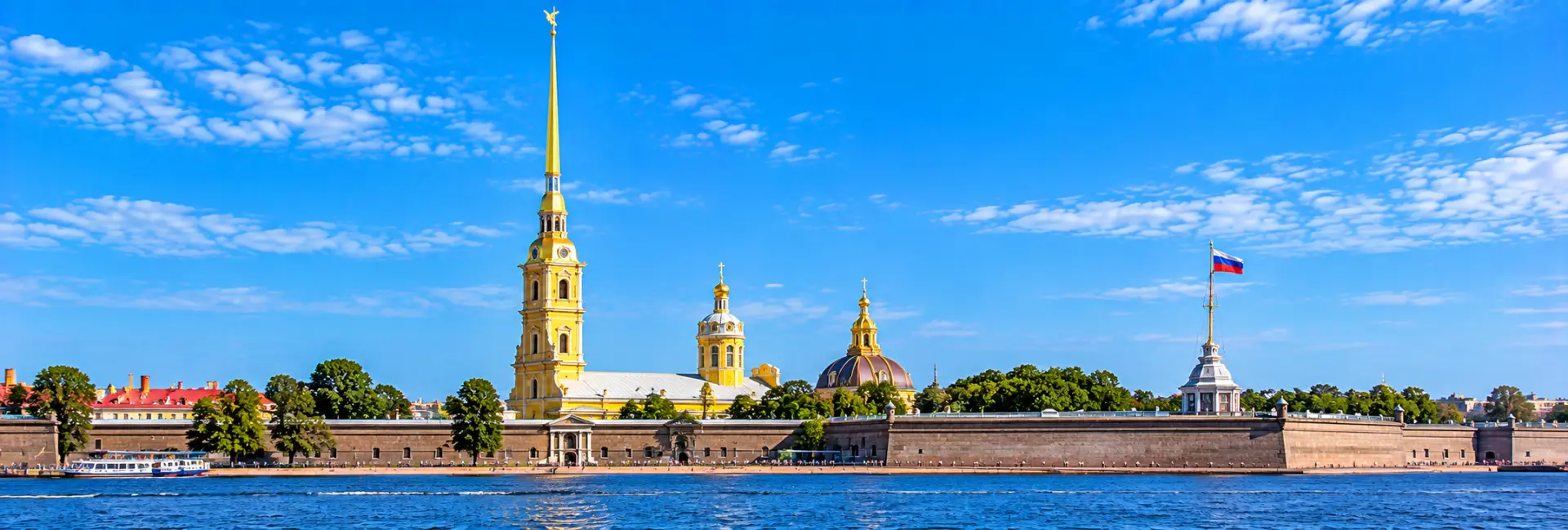
Today the fortress is a sprawling museum complex with the feel of a small walled town. Low brick bastions enclose a green, open interior, and in the center rises the gilded spire of Peter and Paul Cathedral, topped by an angel that has become one of the symbols of the city. Around it sit a working mint, historic houses, memorial statues, prison cells and a sandy riverside beach.
A visit here mixes several stories at once: imperial grandeur at the cathedral, political repression in the prison bastion, and everyday city life in the exhibitions and on the ramparts. It is one of the most rewarding places in Saint Petersburg for anyone who wants to understand how the city began.
History
Founding a City
The fortress was founded on 27 May 1703 (16 May in the old calendar), a date that is generally treated as the birthday of Saint Petersburg itself. Peter the Great, who was then at war with Sweden, selected Hare Island for its position at a wide point in the river, where the guns of a fortress could control access to the Neva and the lands beyond. A local legend says the island got its name from a hare that leapt into the tsar's boot during a flood.
From Earth to Stone
The first defenses were built quickly from earth and timber. From 1706 the walls were rebuilt in brick and stone, a long project that continued into the 1740s, with the Italian-Swiss architect Domenico Trezzini overseeing the design. Yet the fortress never faced the assault it was built to resist, and it soon found a different role.
Prison and Museum
For two centuries the fortress served as the empire's main prison for political detainees. Peter's own son Alexei died in custody here in 1718, and later inmates included writers, revolutionaries and members of the Decembrist movement. The writer Fyodor Dostoevsky was held in the fortress after his arrest in 1849.
The prison closed after the revolution, and in 1924 the complex was opened as a museum. Today it forms a major part of the State Museum of the History of Saint Petersburg, and it stands inside the UNESCO-listed Historic Centre of Saint Petersburg.
Layout & Fortifications
The fortress follows the classic star-fort logic of the early eighteenth century, with a six-sided outline of thick walls and projecting bastions that allowed defenders to cover every approach with crossfire. Each bastion has its own name, often taken from a nobleman or a member of the imperial family, and some of them hold exhibitions or serve as vantage points.
Gates and Bridges
Visitors usually enter across the Ioannovsky Bridge from the north bank, passing through a ravelin, a triangular outwork designed to protect the main gate. Two ceremonial gates stand in the walls, including the Saint Peter's Gate, built in the early eighteenth century and decorated with carved reliefs and statues that give it the look of a small triumphal arch.
Cathedral Square and the Grounds
Inside the walls, the cathedral, the Mint, the former Commandant's House and a few smaller buildings cluster around an open central square. Beyond them the bastions and curtain walls form a broad ring that you can walk along, giving the whole complex a surprisingly open and airy feel for a military site.
Peter and Paul Cathedral & the Romanov Tombs
The cathedral is the heart of the fortress and the oldest major landmark in the city. Built between 1712 and 1733 to a design by Trezzini, it broke with Russian church tradition by combining a Western-style baroque body with a slender bell tower. The tower rises to about 122 meters, which long made it the tallest structure in the center of Saint Petersburg, and its gilded spire carries an angel holding a cross.
The Imperial Necropolis
The cathedral is the burial place of most Russian emperors from Peter the Great onward. Before the founding of the new capital, rulers had been laid to rest in the Kremlin in Moscow, so the move to Saint Petersburg created a new dynastic sanctuary. The white marble tombs stand in rows inside the nave, plain and strikingly similar in style, and the great carved iconostasis rises behind them.
The last emperor, Nicholas II, and members of his family were buried here in 1998, decades after their deaths during the revolution, in a side chapel near the main space. A separate building, the Grand Ducal Burial Vault, holds the graves of other members of the imperial family.
Bells and Carillon
The bell tower also houses a carillon, a set of tuned bells played by a keyboard. If you are lucky enough to be nearby when it sounds, the music adds a memorable layer to the experience of crossing the central square.
Trubetskoy Bastion Prison
The Trubetskoy Bastion is the best-known part of the fortress after the cathedral. A purpose-built prison building went up here in the early 1870s, and it quickly became the imperial government's main facility for political prisoners. Many of the empire's best-known radicals, writers and activists passed through its cells.
What You See
The museum preserves the layout of the original prison, with narrow corridors, small cells, heavy doors and spartan furnishings. Exhibits explain the rules prisoners lived under, the isolation they faced and the stories of some of the people held here. The atmosphere is quiet and sobering, a deliberate contrast to the grandeur of the cathedral only a few steps away.
Why It Matters
For many Russians, the bastion symbolizes the political repression of the old regime, and it helps explain why the fortress was nicknamed the Russian Bastille. A visit adds a darker dimension to the history of a city usually remembered for palaces and white nights.
Other Sights Within the Walls
Beyond the headline attractions, the fortress rewards slow exploration. Many smaller sights are free to look at or inexpensive to enter.
- The Saint Petersburg Mint, still in operation and one of the oldest of its kind in Russia, which stands across the square from the cathedral
- The Commandant's House, now a museum of the city's history from its founding to the early twentieth century
- The Boat House, a small building that preserves a boat associated with Peter the Great
- The unusual seated statue of Peter the Great, whose small head and elongated limbs make it one of the most talked-about monuments in the city
- The little Hare monument by the bridge, a nod to the local legend of the island's name
- The daily noon cannon shot, fired from a bastion in a tradition that goes back generations
- The sandy beach along the walls, popular with sunbathers in summer and with hardy swimmers in winter
Ways to Experience It
The fortress is large enough that it helps to decide what you most want to see before you begin. Many visitors choose a combination of the following.
- Walk the grounds and ramparts for free-flowing views over the river, the Winter Palace and the golden dome of Saint Isaac's Cathedral
- Visit the cathedral and the Romanov tombs for the dynastic story
- Tour the Trubetskoy Bastion to understand the political history
- Join a guided tour for stories and context that signage cannot give
- Follow the wall walk between the bastions for panoramic photographs
- Stay for the noon cannon shot, which draws a small crowd every day
A combined ticket covering several museums is often available and offers better value if you plan to see more than one exhibition. Check the official museum website for current options.
Best Time to Visit
The grounds are open air and can be enjoyed year-round, but the experience changes with the seasons. Summer brings long days, green lawns and the beach, along with the largest crowds. The White Nights period, from roughly late May to mid-July, is especially atmospheric, when the sky stays pale well into the night and the spire glows against it.
Spring and early autumn offer comfortable walking weather and softer light for photographs. Winter is much quieter, with snow on the bastions and a stark, dramatic look to the walls, though the cold wind off the river can be sharp.
Weekday mornings are usually the calmest time to visit the cathedral and the prison museum. Late afternoon light is lovely for views across the Neva, and a visit timed to catch the noon cannon makes a fun midday highlight.
Visitor Tips
Opening hours, ticket categories and which buildings are open change with the season, so check the official museum website before you go.
- Allow at least half a day if you want to see the cathedral, the prison and a few other exhibitions without rushing.
- Entering the grounds has traditionally been separate from buying tickets for individual museums, so confirm what is covered by each ticket.
- Wear comfortable shoes, since the paths include cobblestones and uneven stone surfaces.
- Dress modestly for the cathedral, keeping shoulders covered and removing hats inside.
- Check the rules on photography, particularly inside the cathedral and the prison.
- Bring layers in cooler months, because the island is open to the wind.
- If you need step-free access, ask about accessibility in advance, as some historic areas have uneven surfaces and limited facilities.
Nearby Attractions
The fortress sits on the Petrograd Side, a pleasant district north of the river with a quieter character than the central bank.
- The Cruiser Aurora, a famous warship museum moored along the nearby embankment
- The Kronverksky area and the leafy park around the fortress walls
- Troitskaya Square and the wooden Cabin of Peter the Great, one of the city's oldest surviving buildings
- The Artillery Museum, housed in a former arsenal just across the park
- The Strelka of Vasilyevsky Island, with its Rostral Columns, a short walk across the river
- The Winter Palace and the Hermitage, visible across the water and easily reached by bridge
- Kamennoostrovsky Prospect, a lively avenue with shops, cafes and historic mansions
FAQs about visiting the Peter and Paul Fortress
Why is the Peter and Paul Fortress so important? +
It is the place where Saint Petersburg was founded in 1703, and the city grew outward from its walls. It later became the burial site of the Russian emperors and the most famous political prison of the empire.
How much time do I need? +
Plan around three to four hours for a good overview that includes the cathedral and a museum or two. Add more time if you want to walk the ramparts, visit several exhibitions or relax on the beach.
Do I need a ticket to enter the fortress? +
Access to the grounds has historically been free, while the cathedral, prison museum and other exhibitions are ticketed separately. Rules and prices change, so check the official museum website before your visit.
Who is buried in Peter and Paul Cathedral? +
Most Russian emperors from Peter the Great to Alexander III are buried here, along with Nicholas II and members of his family, who were laid to rest in 1998. Other members of the imperial family lie in the nearby Grand Ducal Burial Vault.
What is the noon cannon? +
A cannon is fired from one of the bastions every day at noon in a tradition that goes back generations. Residents once used it to set their watches, and today it is a popular ritual for visitors.
How do I get there? +
The nearest metro station is Gorkovskaya, about a five to ten minute walk from the Ioannovsky Bridge. Many visitors also arrive on foot from the center across the Troitsky Bridge.
Can I swim at the beach by the fortress? +
There is a sandy beach along the walls that is popular for sunbathing in summer, and some hardy locals swim there in winter. Check local conditions and posted signs, as water quality and safety guidance can vary.
Is the fortress suitable for children and for visitors with limited mobility? +
Children usually enjoy the open space, the ramparts and the cannon shot. Paths include cobblestones and some steps, so check with the museum about accessibility in advance if you need smooth routes.
