
Table of Contents
Overview
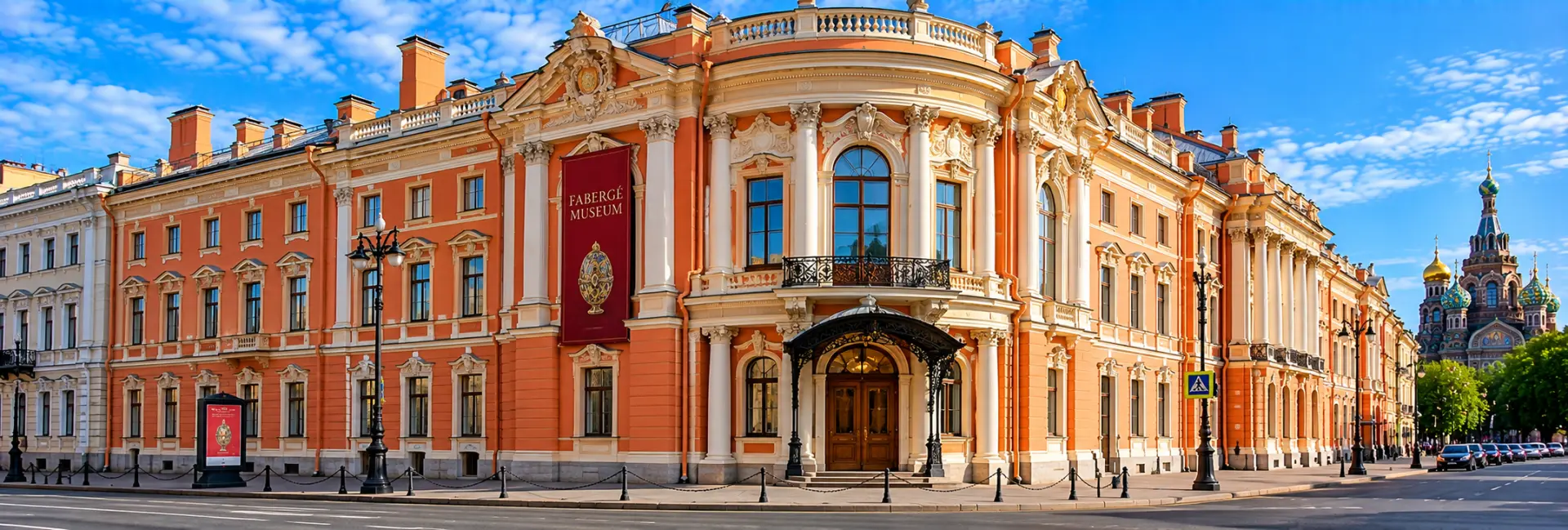
The Fabergé Museum stands on the bank of the Fontanka River in central Saint Petersburg, inside the restored Shuvalov Palace. Opened in 2013, it is a privately owned museum, and it has quickly become one of the city's most talked-about stops for anyone drawn to jewelry, craftsmanship and the last years of imperial Russia.
The museum is best known for nine Imperial Easter eggs that the House of Fabergé made for the final two Russian emperors, Alexander III and Nicholas II. Each one was a private gift between members of the imperial family, and together they make up one of the most significant groups of such eggs anywhere in the world.
Yet the eggs are only the beginning. The collection holds more than 4,000 works of Russian decorative and applied art, from gem-set trinkets and cigarette cases to silver, enamel, porcelain and icons. The palace around them, with its gilded halls and painted ceilings, is a highlight in its own right, so the visit works as both an art museum and a walk through a grand aristocratic home.
History of the Museum and Palace
A Palace on the Edge of the City
The building was raised in the closing years of Catherine the Great's reign, at a time when the Fontanka marked the limit of the built-up city. Its first owners were the Vorontsov family. In 1799 it passed to Maria Naryshkina, wife of the courtier Dmitry Naryshkin, and under the Naryshkins it became a fashionable address for music, dances and literary evenings.
Guests are recorded to have included the poet Alexander Pushkin, the fabulist Ivan Krylov, the painter Karl Bryullov and even Emperor Alexander I. One famous ball, held in 1834 to mark the sixteenth birthday of the future Alexander II, filled the great ballroom with as many as a thousand guests.
The Shuvalov Years
Between 1844 and 1859 the palace was thoroughly rebuilt in the Neo-Renaissance style for the marriage of Sofia Naryshkina to Count Pyotr Shuvalov. After the wedding in 1846 the building became known as the Naryshkin-Shuvalov Palace, the name it still carries today.
War, Revolution and Neglect
When the First World War began, the last owner, Yelizaveta Shuvalova, handed the palace over for use as a hospital for wounded soldiers. It was nationalized in 1918, and from 1919 to 1925 it housed a short-lived Museum of Aristocratic Life. Later it served as a printing house and a design institute. In September 1941, during the Siege of Leningrad, bombing destroyed the courtyard wing and a fire collapsed part of the roof, leaving the building badly scarred.
Birth of the Museum
The modern museum grew out of a 2004 purchase by the businessman Viktor Vekselberg, who acquired a celebrated collection of Fabergé works that had belonged to the American publisher Malcolm Forbes. His Link of Times foundation aimed to bring significant Russian treasures back to Russia and display them to the public. The foundation rented the palace, carried out its first full restoration in over two centuries between 2006 and 2013, and opened the museum on 19 November 2013.
Architecture & Building
Neo-Renaissance Interiors
The palace dates to the late eighteenth century, and some sources link its original design to the Italian architect Giacomo Quarenghi, though the exact authorship is uncertain. What visitors see today owes most to the mid-nineteenth-century rebuilding by Bernard de Simone and Nikolai Efimov, who gave the interiors their rich Neo-Renaissance character. Think carved and gilded details, patterned ceilings, decorative panels and richly colored walls.
A Sequence of Named Rooms
The museum is arranged through a series of rooms that carry their own identities, including the Blue Room, the Gold Room, the Red Room, the Beige Room, the White Room, the Sky Blue Room, the Buffet Room, the Gothic Hall and the Knights' Room. Moving from one to the next gives a sense of how a wealthy Petersburg family once lived and entertained, while each space also acts as a showcase for objects chosen to suit it.
The Ballroom
The grand ballroom, known as the Alexander Hall or White Column Hall, was the heart of the palace's social life in the nineteenth century. Its scale gives a clear hint of why the Naryshkin and Shuvalov gatherings were so celebrated.
A Careful Restoration
The seven-year restoration aimed to recover the palace's historical appearance while adapting it for modern museum use, including climate control and display requirements. Because so much had been lost or damaged during the twentieth century, the result is as much a work of reconstruction as of preservation, and it is worth looking up and around as much as into the display cases.
Collections & Exhibits
The museum's holdings pass 4,000 objects and cover the full range of work produced by the House of Fabergé, alongside pieces by other leading Russian makers of the same era. Founded by Gustav Fabergé and later led by his son Carl, the firm became the official jeweler to the imperial court, and its workshops turned out everything from grand presentation gifts to small, witty novelties.
What the Collection Includes
- The Easter series, including the Imperial eggs and other Fabergé eggs made for private patrons
- Objets de fantaisie, the playful luxury objects such as miniature frames, flowers and animals
- Objets de vertu, including cigarette cases, bell pushes, clocks and other fine everyday items
- Cabinet gifts presented by the imperial family
- Russian silver, enamels and porcelain, including pieces from the Imperial Porcelain Factory
- Russian icons, military memorabilia and works of fine art
More Than One Maker
Although the Fabergé name leads the billing, the museum also features work by rival and contemporary firms such as Ovchinnikov, Khlebnikov, Grachev, Sazikov and Bolin. Seeing them side by side shows how rich and varied Russian goldsmithing and silverwork were at the turn of the twentieth century, and how Fabergé earned its reputation within that crowded field.
The Craft Behind the Objects
The materials listed across the collection range from gold, platinum and diamonds to nephrite, rock crystal, agate and enamel. Many pieces carry the marks of individual workmasters such as Mikhail Perkhin and Henrik Wigström, who ran the workshops that produced the finest items. Looking closely at the enamel finish, the stone cutting and the hidden hinges is half the pleasure.
Must-See Highlights
The Nine Imperial Easter Eggs
Each of these was made as an Easter present within the Romanov family, and each hides a surprise or a miniature world inside. The group on display is as follows.
- Hen Egg (1885): the very first imperial egg, given by Alexander III to his wife, Maria Feodorovna
- Renaissance Egg (1894): another gift from Alexander III to Maria Feodorovna
- Rosebud Egg (1895): the first egg that Nicholas II presented to his wife, Alexandra Feodorovna
- Coronation Egg (1897): famous for the tiny carriage tucked inside, made by Georg Stein
- Lilies of the Valley Egg (1898): a delicate gift from Nicholas II to Alexandra
- Cockerel Egg (1900): given by Nicholas II to his mother, the Dowager Empress
- Fifteenth Anniversary Egg (1911): a commemorative piece for Alexandra, with painted miniatures
- Bay Tree Egg (1911): another gift from Nicholas II to his mother
- Order of St. George Egg (1916): made in wartime Petrograd for the Dowager Empress
Other Fabergé Eggs
The display also includes eggs made for private clients rather than the court, among them the Duchess of Marlborough Egg of 1902 and the Kelch Hen Egg of 1898, which was commissioned by the industrialist Alexander Kelch for his wife, Varvara. They offer a useful comparison with the imperial commissions.
The Blue Room
The eggs are presented in the Blue Room, which sits at the center of the palace. Even if you are not a jewelry enthusiast, the combination of the room's décor and the glowing display cases makes this the emotional high point of the visit.
Beyond the Eggs
Do not rush past the cabinets of small objects. Cigarette cases, clocks, miniature frames and decorative animals show a lighter, more inventive side of the workshop, and many of them are just as impressive up close as the famous eggs.
Ways to Experience It
Self-Guided Visit
Most people walk through at their own pace. The museum offers an audio guide, and a downloadable guidebook to the exhibition is available on its website, which is helpful for choosing what to focus on before you arrive.
Guided and Private Tours
Guided tours, which usually last around an hour, add useful context about the eggs, the workmasters and the palace's former owners. Individual tours for smaller groups can also be arranged through the museum. Booking ahead is wise in busy seasons.
Online and Family Options
- A 3D virtual tour on the museum's website lets you preview the rooms before you go
- Programs and materials for children help younger visitors engage with the collection
- Temporary exhibitions, concerts, lectures and conferences take place through the year
- A museum café offers a place to pause between rooms
Best Time to Visit
Time of Year
Because the collection is indoors, the museum works in any season. Winter is a quiet stretch of the year in Saint Petersburg, and a warm palace interior is a welcome break from the cold. In late spring and summer, the city's famous long, light evenings mean you can combine the museum with an unhurried stroll along the Fontanka afterward.
The Easter period may bring special programming linked to the museum's best-known theme, so it is worth checking the current events calendar if your trip falls around that time.
Time of Day
The museum is open every day of the week, and the Blue Room can fill up quickly once tour groups arrive. Arriving soon after opening, or in the later part of the day, generally gives you more space around the display cases and a calmer experience.
Visitor Tips
- Check opening hours and ticket details on the museum's official website before you go, as these can change and are not fixed here
- Allow roughly one to two hours for a full visit, longer if you plan to follow an audio guide or tour in detail
- Remember that the exhibition halls close a little before the museum itself does, and the ticket office stops selling tickets earlier still
- Review the museum rules, including any limits on photography, bags and coats, before you arrive
- The museum publishes information about its accessible environment for visitors with disabilities, so contact the staff in advance if you have specific needs
- Confirm current travel advisories from your own government and how payments and ticket booking work for foreign visitors, as arrangements for international travelers to Russia can change
- Bring a little patience for the Blue Room, where you may need to wait for a clear view of each egg
The museum is within a short walk of Nevsky Prospect. From Gostiny Dvor metro station, the walk takes about ten minutes toward the Anichkov Bridge, and the museum is a short way along the embankment from there. From the Mayakovskaya or Ploshchad Vosstaniya stations it is around fifteen minutes on foot, or a short ride on a nearby bus or trolleybus.
Nearby Attractions
The museum sits in one of the most walkable parts of the city, so it pairs easily with other sights.
- Anichkov Bridge and Anichkov Palace: just along the Fontanka, famous for its dramatic horse sculptures and imperial associations
- Nevsky Prospect: the city's main avenue, lined with shops, cafés and historic buildings
- Gostiny Dvor: a long-established shopping arcade a short walk away
- Sheremetev Palace and the Anna Akhmatova Literary and Memorial Museum: a further stretch of palaces and cultural sites along the Fontanka embankment
- Beloselsky-Belozersky Palace: another elegant mansion on the same waterfront
A relaxed way to round off the day is to wander the Fontanka embankment, which gives a good sense of the old aristocratic city that once surrounded the Shuvalov Palace.
FAQs about visiting the Fabergé Museum
What is the Fabergé Museum in St. Petersburg famous for? +
It is known for housing nine Imperial Easter eggs made by the House of Fabergé for Alexander III and Nicholas II, along with more than 4,000 other works of Russian decorative art, all displayed inside the restored Shuvalov Palace.
Where is the museum located? +
It is at 21 Fontanka River Embankment, in the heart of Saint Petersburg, close to Nevsky Prospect and the Anichkov Bridge.
How do I get to the Fabergé Museum? +
The nearest metro stations are Gostiny Dvor and Nevsky Prospect, and the walk from Gostiny Dvor takes roughly ten minutes. From Mayakovskaya or Ploshchad Vosstaniya, allow around fifteen minutes on foot or take a nearby bus or trolleybus.
How long does a visit take? +
Plan on about one to two hours for a standard visit. Add extra time if you want to use the audio guide fully or join a guided tour.
How many Fabergé eggs can I see? +
The museum holds nine Imperial Easter eggs made for the last two Russian emperors, and its Blue Room also displays other Fabergé eggs made for private clients, so you can see about fifteen Fabergé eggs in total.
Do I need to book tickets in advance? +
Tickets can usually be bought at the museum, but booking ahead is wise in busy periods or if you want a guided tour. Prices and booking options change, so check the official website for current details.
Is the museum suitable for children? +
Yes, the museum offers programs designed for younger visitors, and the sparkling eggs and tiny hidden surprises tend to hold their attention. Younger children may need a reminder to look but not touch.
Is the museum accessible for visitors with disabilities? +
The museum publishes information about its accessible environment, including support for visitors with different needs. It is a good idea to contact the staff before your visit to confirm arrangements for your situation.
What else is there to see nearby? +
You can easily combine the museum with Anichkov Bridge, Nevsky Prospect, Gostiny Dvor and the other palaces along the Fontanka embankment, all within a short walk.
