
Table of Contents
Overview
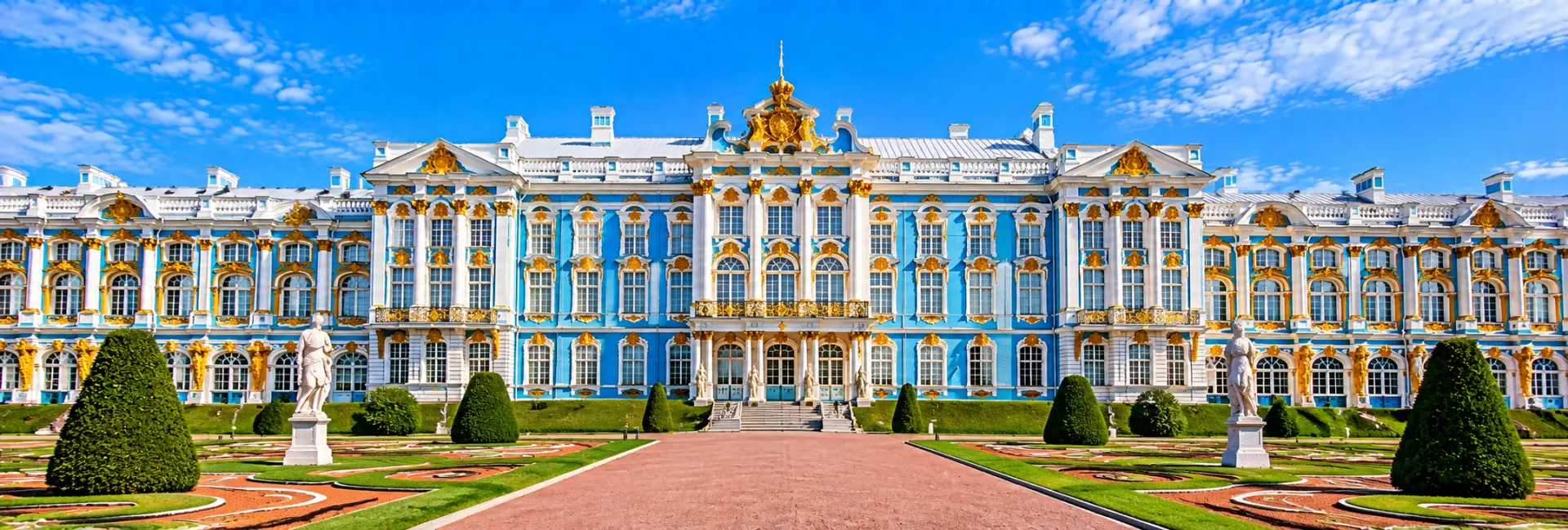
The Catherine Palace is the finest imperial summer residence in the Saint Petersburg region. It stands in Tsarskoye Selo, which means "the Tsar's Village," a former royal estate that is now part of the town of Pushkin, roughly 25 to 30 kilometers south of the city center. A long, sky-blue facade trimmed in white and gold stretches across the front of the palace, and behind it lies a vast landscaped park with ponds, pavilions and shaded avenues.
The palace is most often associated with the Amber Room, a chamber once lined entirely with panels of carved amber. The original was lost during the Second World War, and the version visitors see today is a painstaking reconstruction completed at the start of this century. Even so, the room is only one highlight in a series of dazzling ceremonial halls.
Together with its park and neighboring palaces, the Catherine Palace forms part of the Tsarskoye Selo ensemble, which is included in the UNESCO-listed Historic Centre of Saint Petersburg. A half-day trip here is one of the most rewarding excursions you can make from the city.
History
A Gift to an Empress
In 1710 Peter the Great gave the estate to his wife, the future Catherine I, and a modest summer residence was built for her in the following years. The village around it grew into Tsarskoye Selo and became a favorite retreat for the imperial family, who wanted a quieter alternative to the capital.
Rastrelli's Masterpiece
The palace reached its grand scale in the reign of Peter's daughter, Empress Elizabeth. Starting in 1752 she commissioned the architect Bartolomeo Rastrelli to rebuild the old residence as a vast Baroque showpiece. The result was a huge, richly gilded building with a continuous suite of state rooms, designed to impress visiting ambassadors and to host the lavish court life she loved.
Catherine the Great and the Neoclassical Turn
When Catherine the Great took the throne, she preferred a lighter, more restrained style. She brought in the Scottish architect Charles Cameron, who added elegant Neoclassical private rooms and new garden buildings. Tsarskoye Selo became the summer home of her court, and the Baroque grandeur of Rastrelli now sat alongside a more intimate taste.
War and Revival
After the 1917 revolution the palaces became museums. In the Second World War the area was occupied and the palace was badly damaged. Restoration lasted for decades, and the work continues, with rooms such as the Arabesque Hall, the Lyons Hall and the Palace Chapel brought back in more recent years. The town itself was renamed Pushkin in 1937, in honor of the poet who studied at the Lyceum next to the palace.
Architecture & the Palace Exterior
The Catherine Palace is a defining example of Russian Baroque, a style that borrowed from European models but pushed their decoration to new extremes. Its facade is close to 300 meters long, with columns, pilasters, sculpted figures and window frames picked out in white and gold against a vivid blue background. The effect is theatrical, especially when the sun strikes the gilding.
The Palace Form
The building is made up of long wings that frame a ceremonial courtyard on one side and open to the park on the other. This layout was designed so that a visitor could pass through a continuous sequence of rooms, each one more splendid than the last.
Cameron's Additions
At one end of the palace, Cameron introduced a lighter Neoclassical style, with a colonnaded gallery that leads out into the park. Its columns, busts and terrace give the complex a gentler, more classical face to complement Rastrelli's exuberance.
Palace Chapel
The palace also includes a church, the Chapel of the Resurrection, which was part of Rastrelli's plan. It was among the interiors affected by the war and was restored in 2018, so it is now accessible again to visitors.
The Great Hall & Golden Enfilade
The heart of the palace is the Golden Enfilade, a long suite of state rooms arranged in a straight line so that doors align and the whole sequence can be seen at once. Walking through it is like moving along a corridor of gold, mirrors and painted ceilings.
The Great Hall
The Great Hall, also called the Hall of Light, covers about 860 square meters and is one of the largest ballrooms in the country. Two rows of windows flood the room with daylight, and large mirrors between them multiply the glow. The carved and gilded decoration is extraordinary, and the ceiling painting seems to open the room to the sky.
Other Rooms Worth Noting
- The Chinese Room, decorated with porcelain and lacquer panels in the fashion for Asian motifs
- The Arabesque Hall, an elegant Neoclassical room created under Catherine the Great
- The Lyons Hall, notable for its silk wall coverings and refined ornament
- The Portrait Hall and the picture galleries along the enfilade
- The imperial private apartments, which show a more domestic side of palace life
The Amber Room
The Amber Room is the most famous interior in the palace and one of the best-known rooms in the world. Its walls are covered with panels of amber in warm shades of gold and honey, set with mirrors, mosaics and carved ornament that glows especially brightly in the light of candles or lamps.
Origins and Journey
The first version was made in Prussia in the early eighteenth century. In 1716 the Prussian king presented the panels to Peter the Great as a diplomatic gift. They were first installed in a palace in Saint Petersburg and later moved to Tsarskoye Selo, where Rastrelli fitted them into a larger chamber in the mid-1750s.
Loss and Reconstruction
During the Second World War the panels were removed by occupying forces and taken to Königsberg. The original room disappeared in 1944, and its fate remains one of the great mysteries of the war. In 1979 a project to recreate the room began, and it took more than two decades of work by restorers, using old photographs and surviving fragments as guides. The new Amber Room opened in 2003, in time for the city's three hundredth anniversary.
Visiting Tips for the Room
The room is smaller than many people expect, and tour groups pass through it quickly. Photography is usually restricted here, so check the rules, and look closely at the details on the walls while you have the chance.
Catherine Park & Gardens
The palace is surrounded by Catherine Park, a large landscape that combines a formal French-style garden near the building with a freer English-style area beyond. It is a lovely place for a long walk and often takes up a good part of the day.
Pavilions and Monuments
Scattered through the grounds are elegant garden buildings, each with its own story. The Grotto Pavilion, designed by Rastrelli, sits at the edge of the Great Pond and is decorated with shells and sculptural detail. The Hermitage Pavilion, at the end of a main avenue, was built for intimate dinners. Cameron's Agate Rooms and Cameron Gallery add a Neoclassical note, and the pond itself is dotted with monuments that commemorate Russian military victories.
Walking and Relaxing
Shady avenues, lawns, bridges and small islands make the park feel quiet even when the palace is crowded. In the warmer months you can rent a boat, take a walking tour or use the electric cars that run through the park.
Ways to Experience It
Most visitors combine the palace with the park, though the right balance depends on how much time you have.
- Take the palace tour to see the Great Hall, the Golden Enfilade and the Amber Room
- Use an audio guide, which is available in several languages, to follow the route at your own pace
- Join a guided excursion from Saint Petersburg that handles transport and tickets
- Walk through Catherine Park to see the Grotto, the Hermitage Pavilion and the Cameron Gallery
- Add the neighboring Alexander Palace and park for a deeper look at the Romanov story
- Stop for lunch in the town of Pushkin, which has cafes within easy walking distance
Best Time to Visit
The park is at its best from late spring to early autumn, when the gardens are green, the ponds are open and the electric cars and boats are running. Summer is the busiest period, and the palace can be crowded, so aim to arrive at opening time or later in the afternoon if you can.
Winter has its own charm. Snow transforms the park and the facade into a postcard scene, and the palace interiors are far less busy. Be ready for cold, short days and occasionally limited access to some park pavilions.
Within the week, weekdays are quieter than weekends, and the palace has traditionally closed one day a week, so confirm the schedule before you set out. Autumn color along the park avenues makes late September and early October another good window.
Visitor Tips
The palace is a major attraction and often sells out for group visits, so some planning is helpful. Opening hours, ticket categories and entry procedures change, so check the official museum website in advance.
- Book timed tickets ahead of time, especially for summer weekends and holidays.
- Plan to go from the city by taxi, by a combination of metro or suburban train and a short bus ride, or on an organized excursion.
- Allow at least three to four hours for the palace and the park, or a full day if you want to see everything.
- Wear comfortable shoes, since the palace route is long and the park paths can be uneven.
- Check rules on photography, bags and tripods, which can differ in the Amber Room and other interiors.
- Expect lines at the entrance and a brisk pace inside during peak seasons.
- Ask in advance about accessibility if you need step-free routes, as the historic interiors have limits.
Nearby Attractions
The Catherine Palace sits inside a larger complex of palaces and parks, and several sights are within easy reach.
- The Alexander Palace and Alexander Park, a short walk away and linked to the last imperial family
- The Tsarskoye Selo Lyceum, where the poet Alexander Pushkin studied as a teenager
- The Cameron Gallery and the Agate Rooms, within Catherine Park itself
- The town center of Pushkin, with small museums, cafes and quiet historic streets
- Pavlovsk Palace and its large park, a short drive away
- The Saint Petersburg city center, where you can combine the trip with a visit to the Hermitage or Palace Square
FAQs about visiting the Catherine Palace
Where is the Catherine Palace? +
It is in Tsarskoye Selo, part of the town of Pushkin, about 25 to 30 kilometers south of central Saint Petersburg. The palace stands on Sadovaya Street within a large park.
Is the Amber Room the original? +
No. The original panels were lost during the Second World War, and the room that visitors see today is a reconstruction that opened in 2003. It was recreated over many years using photographs, drawings and surviving fragments.
How long should I spend there? +
Allow about three to four hours if you want to see the palace interiors and walk through part of Catherine Park. A full day gives you time to add the Alexander Palace, more park pavilions and a relaxed meal.
Do I need to book tickets in advance? +
Booking ahead is strongly recommended, particularly in summer and on weekends, when the palace is crowded. Check the official museum website for current prices, ticket types and entry times.
How do I get there from Saint Petersburg? +
Most visitors go by taxi or on an organized excursion, while others combine the metro or a suburban train with a short bus ride. Journey time varies with traffic, so allow plenty of time for the trip each way.
Is the palace open all year? +
It is open throughout the year, although some park attractions and boat or electric car services run only in the warmer months. The palace has traditionally closed one day a week, so verify the schedule before you travel.
Is it suitable for children and for visitors with limited mobility? +
Children often enjoy the glittering halls and the park, though the palace tour is long and quiet. Some historic interiors and park paths are not easy for wheelchairs, so ask the museum about accessibility arrangements in advance.
Can I photograph the interiors? +
Photography rules vary by room and can change, with stricter limits in the most sensitive interiors such as the Amber Room. Look for posted signs and ask the staff if you are unsure.
