
Table of Contents
Overview
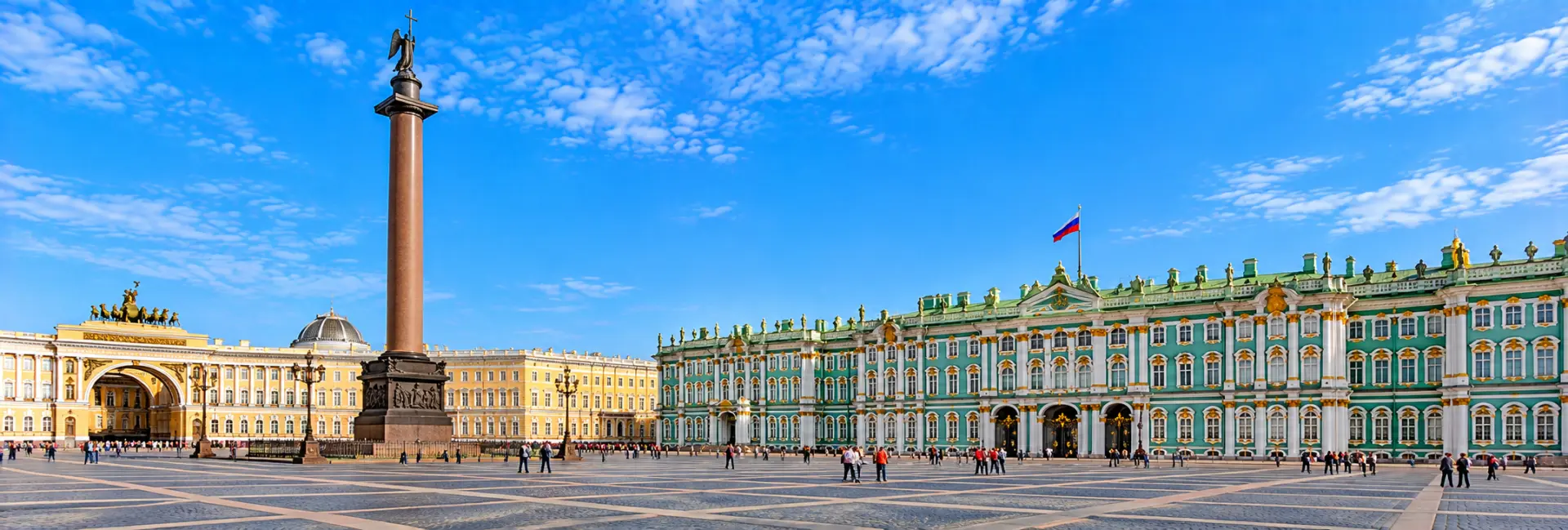
Palace Square is the stage on which Saint Petersburg shows off. It is a vast open space of roughly eight hectares, enclosed on one side by the green-and-white facade of the Winter Palace and on the other by a long, curving yellow building with a triumphal arch at its center. In the middle stands a single towering column, and everything else seems arranged to lead the eye toward it.
For more than two centuries this was the ceremonial heart of the Russian Empire, a place for military parades, state celebrations and moments of political upheaval. Today it is the most visited public space in the city, where tour groups, street performers and residents all cross paths beneath the biggest sky in the center of town.
Palace Square is not a museum with an entrance gate, so you can experience it any time of day, and it is also the gateway to the Hermitage, which occupies the Winter Palace itself. Even if you only have a short visit to Saint Petersburg, this is one of the places you will almost certainly walk through.
History
A Square Takes Shape
The square grew up around the Winter Palace, whose present building was completed in 1762 as the residence of the Russian emperors. In the late eighteenth century the open space in front of it was loosely defined, and a curved line of buildings was proposed to close off the southern side. The area did not take its famous form until the early nineteenth century.
Rossi's Grand Design
After the Russian victory over Napoleon, Alexander I wanted the square to become a monument to the triumph. The architect Carlo Rossi was commissioned to redesign it, and between 1819 and 1829 he built the General Staff Building, a sweeping, bow-shaped structure that wraps around the south side. A double triumphal arch connects its two halves, and the whole composition gives the square its unusual sense of scale and unity.
A Century of Change
The Alexander Column rose in the center in 1834, and the eastern side was completed with the Guards Corps Headquarters in the 1840s. The square then served as a venue for parades and imperial ceremonies for the rest of the century. After the 1917 revolution it was renamed for a Soviet official, and it did not recover the name Palace Square until 1944.
Architecture & the Square's Design
The brilliance of Palace Square lies in how different buildings were made to feel like one ensemble. The Winter Palace is an exuberant Baroque creation of Bartolomeo Rastrelli, full of columns, statues and ornament. Rossi's Neoclassical General Staff Building across from it is deliberately calmer, with restrained lines and a long, regular rhythm. The contrast makes each building look stronger rather than competing with it.
The General Staff Building
The southern building curves for roughly 580 meters, one of the longest continuous facades in the city. It was built to house government offices and still has a strong ceremonial presence. Its central arch, about 28 meters tall, is topped by a bronze sculpture of a chariot drawn by six horses, carrying a figure of victory. Walking through the arch from the street behind it is one of the best ways to arrive, because the entire square is suddenly revealed.
Open Space as Architecture
The empty space itself is part of the design. By leaving the middle clear and placing a single vertical monument in the center, the architects created a sense of grandeur and made the surrounding buildings feel even larger.
The Alexander Column
The Alexander Column is the focal point of the square and one of the most recognizable monuments in Russia. Designed by Auguste de Montferrand, the same architect responsible for Saint Isaac's Cathedral, it was unveiled in 1834 to commemorate the victory over Napoleon's army. It is named for Alexander I, the emperor who reigned during the war.
A Single Piece of Granite
The column is about 47.5 meters tall and is carved from one monolithic piece of red granite, which makes it among the tallest monuments of its kind in the world. The shaft was quarried on the Gulf of Finland, shipped to the city and raised in place using a complex system of scaffolding and ropes, which drew crowds at the time.
Held by Its Own Weight
One of the best-known facts about the column is that it stands without being fixed to its base. Its enormous weight holds it in place, which means it relies on gravity rather than on metal fastenings. At the top, a bronze angel carries a cross and stands above a coiled serpent, a symbol of peace after the war.
Surrounding Landmarks
The Winter Palace and the Hermitage
The north side of the square is closed by the Winter Palace, once the main residence of the emperors and now the principal home of the Hermitage Museum. Its pale green facade, white columns and rooftop statues make it unmistakable. The palace was rebuilt after a serious fire in 1837, so much of its interior dates from that period.
The General Staff Building
Across the square, the General Staff Building now houses part of the Hermitage collections in addition to other offices, so it is worth a visit on its own if you are interested in modern art and exhibitions.
The Guards Corps Headquarters
On the eastern side stands the former headquarters of the Guards Corps, designed by Alexander Bryullov and completed in the early 1840s. Its calm facade closes the square without competing with the Winter Palace.
The Open West Side
To the west the square opens toward the Admiralty and its garden, connecting Palace Square to the great sequence of squares along the river. This opening is one reason the space feels so airy.
Cultural & Historical Significance
Few squares in the world have seen such concentrated drama. On 22 January 1905, troops fired on a peaceful procession of workers who had marched toward the Winter Palace to present a petition. The event, known as Bloody Sunday, sparked the revolutionary movement of that year and weakened the standing of the monarchy.
In 1917 the square became a central stage again. After the February Revolution the Winter Palace housed the Provisional Government, and in October the building was stormed, an episode that became one of the defining images of the revolution and was later turned into a legend by Soviet film and art.
The square is part of the Historic Centre of Saint Petersburg, a UNESCO World Heritage Site. Today it also serves as a venue for concerts, festivals and public celebrations, which keeps the old tradition of using it as the city's main stage alive.
Ways to Experience It
Palace Square can be enjoyed in a few minutes or turned into a longer exploration, depending on how much time you have.
- Arrive through the General Staff Arch from Bolshaya Morskaya Street for the most dramatic first view
- Walk the full perimeter to see how the facades change as the light moves
- Photograph the Alexander Column with the Winter Palace behind it
- Visit the Hermitage in the Winter Palace, or the modern art galleries in the General Staff Building
- Join a walking tour that covers the history of the square and the surrounding sights
- Watch street performers and horse-drawn carriages that gather around the square in good weather
- Sit near the edge of the square and take in the scale of the architecture at your own pace
Best Time to Visit
The square looks impressive in every season, but timing shapes the mood. Early morning is the quietest, with long shadows across the pavement and few people between you and the buildings. Late evening is also atmospheric, particularly in summer, when the White Nights extend soft light well past what would be sunset elsewhere.
Summer is the busiest period, with festivals, crowds and long lines for the Hermitage. Spring and early autumn are comfortable for walking and offer more manageable crowds. In winter the square can be bitterly cold and windy, but snow and low sun make for dramatic photographs, and the crowds are thin.
The Winter Palace is lit after dark, and the buildings often look their most theatrical at dusk. If you want a photo of the column against a clear sky, aim for mid-morning or the golden hour before sunset.
Visitor Tips
There is no ticket to enter the square itself, but nearby museums and some events have their own rules, so check official sources before you go.
- Allow at least thirty minutes for the square on its own, and several hours if you plan to visit the Hermitage.
- Buy Hermitage tickets in advance when possible, and check which entrance and security procedures apply.
- Wear comfortable shoes, since the square is paved with stone and wide, so distances feel longer than they look.
- Dress for the wind, because the open space has little shelter in any season.
- Be cautious with belongings in busy periods, as tourist crowds can attract pickpockets.
- Check the city's events calendar, since large concerts or festivals can close parts of the square or change access.
- Treat street photographers and costumed performers with care, and agree on prices before you pose for any paid photo.
Nearby Attractions
Palace Square sits at the center of the historic core, so many of Saint Petersburg's best-known sights are only a short walk away.
- The Hermitage Museum, entered through the Winter Palace itself
- The Admiralty and the Alexander Garden, just to the west
- Senate Square and the Bronze Horseman monument, a few minutes beyond the Admiralty
- Saint Isaac's Cathedral, an easy walk across the neighboring squares
- Nevsky Prospect, the city's main avenue, starting right behind the General Staff Arch
- The Church of the Savior on Spilled Blood, a pleasant stroll along the canal
- The Palace Bridge and the Neva embankment, with views toward the Peter and Paul Fortress
FAQs about visiting Palace Square
What is Palace Square known for? +
It is the central square of Saint Petersburg, framed by the Winter Palace and the General Staff Building and marked by the Alexander Column. It was the stage for major moments in Russian history, including Bloody Sunday in 1905 and the events of 1917.
Is there an admission fee? +
No, the square is a public space and can be visited freely at any time. The Hermitage and other nearby museums charge their own admission, and rules or prices may change.
How long should I spend there? +
Half an hour is enough to take in the main sights and photographs. If you want to look at the architecture closely, sit and watch the square or combine it with the Hermitage, plan on a few hours or a full day.
Why doesn't the Alexander Column fall over? +
It is not attached to its base. Its enormous weight holds it firmly in place, which is part of what makes it such a famous engineering achievement of the nineteenth century.
What is the best way to approach the square? +
Many people walk from Nevsky Prospect through the central arch of the General Staff Building, which reveals the full expanse of the square in one dramatic moment. You can also arrive along the river embankment or from the Admiralty side.
How do I get there by public transport? +
The nearest metro stations are Admiralteyskaya and Nevsky Prospect, and both are a reasonable walk from the square. Many city buses and trolleybuses also stop along Nevsky Prospect and nearby streets.
Is Palace Square suitable for children and people with limited mobility? +
Yes, the square is flat, open and paved, which makes it easy to walk around or to use with a stroller or wheelchair. The cobbled sections can be uneven in places, so take your time.
Can I go inside the buildings around the square? +
The Winter Palace is part of the Hermitage Museum and the General Staff Building also holds museum galleries. Other buildings on the square are government offices and are generally not open to visitors.
