
Table of Contents
Overview
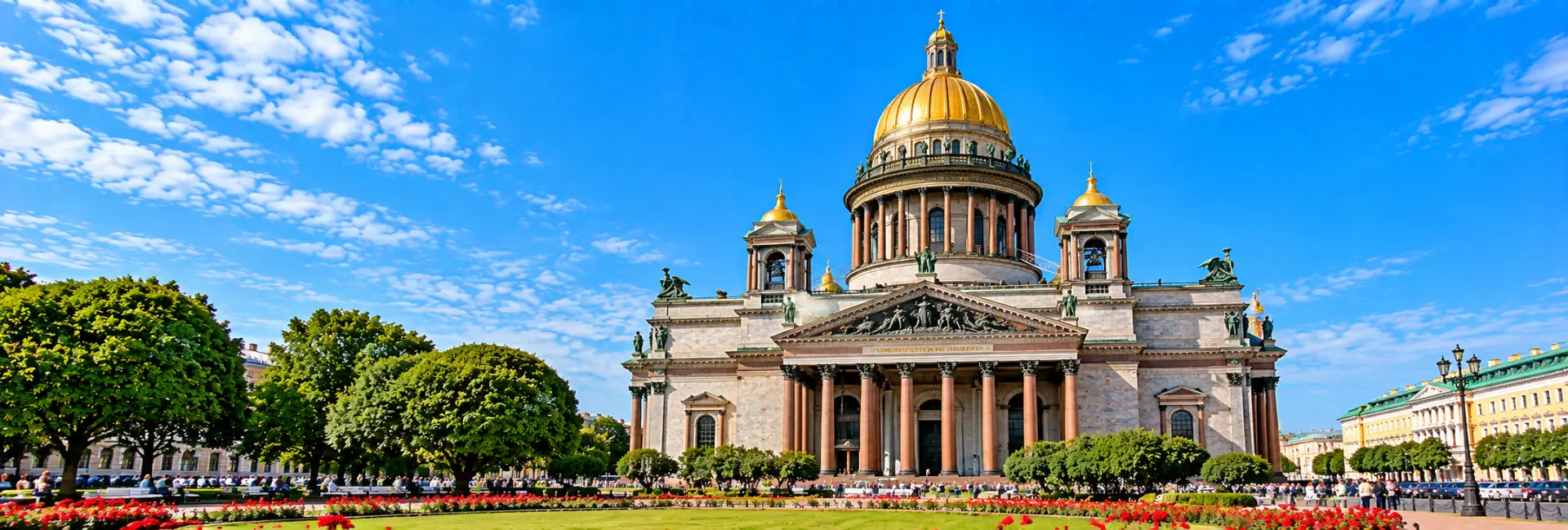
St. Isaac's Cathedral is the building that gives Saint Petersburg its skyline. Its gilded dome rises above the rooftops of the historic center and is visible from bridges, embankments and avenues across the city, a bright focal point that has defined the view for well over a century and a half.
It is the largest Orthodox cathedral in the city and one of the largest domed buildings in Europe. Dedicated to Saint Isaac of Dalmatia, whose feast day was the birthday of Peter the Great, it was meant to express the power and confidence of the Russian Empire at its height. Granite columns, polished marble, gold, malachite and mosaics all serve that ambition.
Today the cathedral operates as a museum, with church services held on a separate schedule. A visit usually combines two experiences: a walk through the vast, richly decorated interior, and a climb up to the colonnade around the base of the dome, which gives one of the best panoramas in the city.
History
Four Churches on One Site
The cathedral you see today is the fourth church dedicated to Saint Isaac in this part of the city. The first was a modest wooden building from the earliest years of Saint Petersburg, linked to the Admiralty shipyard and to Peter the Great himself. Later versions grew larger, and a marble church begun under Catherine the Great was consecrated in 1802. By the early nineteenth century, however, its style was judged too modest and out of step with the grand ensemble of neighboring squares and palaces.
Montferrand's Cathedral
In 1809 Alexander I announced a competition for a new cathedral. The French-born designer Auguste de Montferrand, still a young newcomer in Russia, eventually won the commission, and his design was approved in 1818. Construction then continued for four decades, long enough that Nicholas I was able to push the project toward an even more monumental scale than first imagined.
Engineers faced enormous challenges, especially in raising the giant granite monoliths for the porticos and the dome drum. They relied on elaborate wooden scaffolding and lifting machinery designed by the engineer Augustin de Betancourt. The cathedral was consecrated on 30 May 1858, and Montferrand died only weeks later.
The Twentieth Century
The cathedral closed as a place of worship in 1928 and was turned into a museum. In the early Soviet period the dove that hung beneath the dome gave way to a giant Foucault pendulum, presented as a demonstration of the Earth's rotation. During the Second World War the golden dome was painted over so it would not act as a landmark for enemy aircraft, and the building came through the siege of Leningrad damaged but standing.
Church services returned in 1990, and the dove was later restored beneath the dome. The facades underwent a major restoration in the early 2000s, and the cathedral remains a state museum-monument today.
Architecture & Design
St. Isaac's is generally described as a late Neoclassical building, though Montferrand blended in Renaissance and Byzantine elements, giving it a heavier and more eclectic character than the lighter palaces nearby. The plan is a Greek cross, with four identical porticos facing the four directions and a large central dome flanked by four smaller ones at the corners.
Scale and Materials
The cathedral stands about 101.5 meters tall and measures roughly 111 by 98 meters including its porticos. The facades use light gray Ruskeala marble, while 112 monolithic granite columns frame the entrances and ring the dome drum. Each one was quarried, shaped and hoisted into place as a single piece, a feat that was widely admired in its day.
The Dome
The golden dome is the cathedral's most recognizable feature. Its surface was covered with a very large quantity of gold leaf, and the shine is visible from far across the city on a clear day. Corner domes, a ring of statues and carved pediments add visual weight, so the building feels both solid and sculptural from every side.
Sculpture and Details
The porticos carry large bronze and stone reliefs and statues of biblical figures and saints. Look closely at the carved friezes and you can find a small portrait of Montferrand himself among the decoration, a quiet signature from the man who devoted much of his life to the project.
Interior & Notable Features
The interior is as imposing as the exterior. The central space is lined with polished marble, columns of semiprecious stone, gilded details and a floor of colored stone, all rising toward the painted dome. Many people say the effect is overwhelming at first, with so much to take in that it takes time to notice individual works.
Mosaics and Paintings
Dozens of large mosaic panels, created over several decades, cover the walls and pillars, designed to match the quality of painted icons while lasting far longer. Painted scenes, including works associated with Karl Bryullov, decorate the dome and vaults and fill the upper space with figures that appear to float above the nave.
The Iconostasis
The main iconostasis, the screen between the nave and the altar, is one of the interior's most dazzling elements. Columns of malachite and lapis lazuli flank the central doors, and the rich blue and green stonework stands out against the gilding around it.
Stained Glass and the Dove
Behind the altar is a large stained glass window of the Resurrection, an unusual feature in an Orthodox church where painted and mosaic images are the norm. Beneath the dome, a white dove symbolizes the Holy Spirit, restored to the spot where the pendulum once swung.
What to Look For
- The central dome and the dove suspended beneath it
- The malachite and lapis lazuli columns of the iconostasis
- The Resurrection stained glass window
- Mosaic panels on the pillars and walls
- Exhibits explaining how the cathedral was built, including the lifting equipment
Cultural & Religious Significance
For most of the nineteenth century St. Isaac's was a principal cathedral of the empire, a stage for great state and church occasions. Its scale was a statement of the dynasty's authority and of Saint Petersburg's status as the capital.
The building has also been at the center of debates about heritage. Its decades as a museum, its postwar survival and the arguments over its future use have made it a symbol that matters to residents as much as to visitors. Many people in the city feel a strong attachment to it as a museum open to everyone.
The cathedral stands within the Historic Centre of Saint Petersburg, inscribed as a UNESCO World Heritage Site, and it appears on countless photographs, paintings and postcards of the city. Its dome is, in many ways, the visual shorthand for Saint Petersburg itself.
The Colonnade & Ways to Experience It
There are two main ways to see the cathedral, and many visitors choose both: the interior museum route and the climb to the colonnade.
The Interior
The museum route takes you through the nave, the iconostasis area and the side spaces, often with exhibits about construction, art and history. An audio guide or a guided tour helps make sense of the many details, especially if you are short on time.
The Colonnade
The colonnade circles the drum of the dome at a height of around 43 meters and is reached by a spiral stair of roughly 260 steps. It requires a separate ticket and a bit of stamina, but the reward is a 360-degree view over rooftops, the Admiralty spire, the Neva and the long avenues radiating from the center. It is especially popular in the evening light.
- Choose the interior alone if you prefer a relaxed visit or have limited mobility
- Add the colonnade for the best skyline photographs
- Take a guided tour to learn the stories behind the mosaics and engineering
- Walk around the outside of the building to admire the porticos from each side
Visiting Etiquette & Tips
As the cathedral still hosts religious services, visitors are expected to respect its dual role. Opening hours, ticket categories and entry rules change from season to season, so check the official website of the museum before you go.
- Dress modestly, keeping shoulders covered, and remove hats inside the cathedral.
- Speak softly, and follow posted rules about photography, flash and tripods.
- Buy tickets for the cathedral and the colonnade separately, and check whether advance booking is recommended.
- Arrive early or later in the day to avoid peak crowds from tour groups.
- Be prepared for stairs and narrow passages on the colonnade climb, and travel light because large bags may not be permitted.
- Plan two to three hours if you want to see the interior, the colonnade and the square outside at a comfortable pace.
- Confirm current accessibility arrangements in advance if you need step-free routes.
Best Time to Visit
The cathedral is rewarding in every season, but timing affects both comfort and views. Summer brings long days and the famous White Nights, when extended hours often make an evening visit possible and the colonnade glows in late light. It is also the busiest time, so expect queues and plan ahead.
Spring and early autumn offer a good balance of mild weather, reasonable crowds and clear air for panoramas. Winter is the quietest period, with snow settling on the roofs and a gentler mood inside, although the climb to the colonnade can be cold and slippery in bad weather.
For photographs, early morning gives the cleanest views of the dome without crowds in the square, while late afternoon and evening bring warmer light. The museum has traditionally closed one day a week, usually Wednesday, so check the calendar before you set your itinerary.
Nearby Attractions
St. Isaac's Square sits in the middle of the imperial core of the city, so it is easy to combine with other highlights on foot.
- Senate Square and the Bronze Horseman statue, just a few minutes away
- The Admiralty building with its golden spire and the Alexander Garden
- The Hermitage Museum and Palace Square, a short walk to the east
- The Mariinsky Palace, across the square, once home to government bodies
- Nevsky Prospect, the city's main avenue, for shops, cafes and Kazan Cathedral
- The Church of the Savior on Spilled Blood, a pleasant walk through the center
- The Neva embankment, for river views and an easy riverside stroll
FAQs about visiting St. Isaac's Cathedral
Is St. Isaac's Cathedral a church or a museum? +
It operates mainly as a museum-monument with ticketed visiting hours. Church services are held on a separate schedule, so a sightseeing visit and a worship visit are not the same thing.
How long does a visit take? +
Plan about one to one and a half hours for the interior and another 45 minutes or so for the colonnade. With time to walk around the square outside, two to three hours is comfortable.
Do I need separate tickets for the colonnade? +
Yes, the colonnade is usually ticketed separately from the cathedral interior, and some combined options exist. Check the official museum website for current prices, categories and booking rules before you visit.
How many steps are there to the colonnade? +
The climb is roughly 260 steps up a spiral staircase, so it takes some effort. There is no lift, and the passages can be tight in busy periods, so it is best for visitors who are comfortable with stairs.
When is the cathedral closed? +
The museum has traditionally closed on Wednesdays, and operating hours change between seasons and on holidays. Always verify the schedule on the official website before you go.
How do I get there? +
It stands on St. Isaac's Square in the center of the city, a walk of around ten to fifteen minutes from the Admiralteyskaya metro station. Many visitors also reach it on foot along Nevsky Prospect and past the Admiralty.
Is the cathedral suitable for children and visitors with limited mobility? +
The interior is largely flat and spacious, and children often enjoy the scale and the gold. The colonnade is stair-only, so confirm current accessibility arrangements with the museum if you need step-free access.
Can I take photographs inside? +
Photography rules can vary and may change, so look for posted signs and ask staff if you are unsure. Flash and tripods are commonly restricted, and the best skyline shots are usually taken from the colonnade or from the square outside.
