
Table of Contents
Overview
Peterhof is a grand palace-and-park ensemble on the southern shore of the Gulf of Finland, about 29 kilometres west of central St Petersburg. Created for Peter the Great and expanded by later rulers, it is often called the Russian Versailles, though its mood is distinctly its own: seaside, playful and full of water.
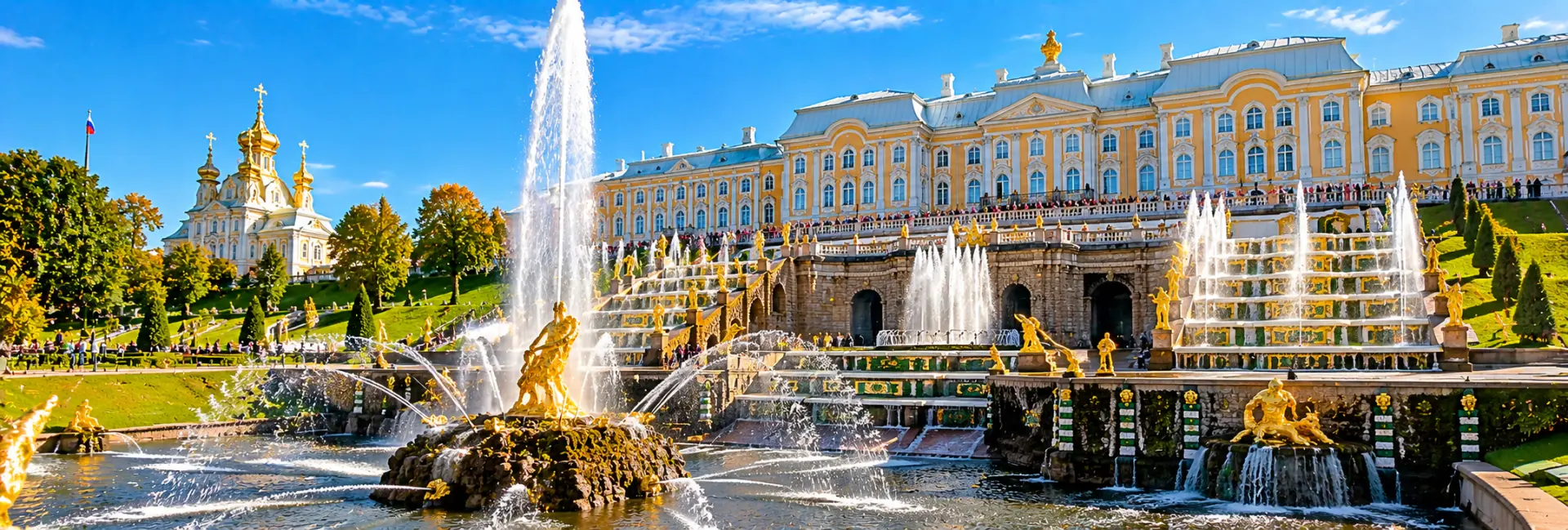
The centrepiece is the Grand Palace, perched on a natural terrace, with the golden Grand Cascade tumbling below it toward the sea. Around it spread formal gardens, shaded alleys, small palaces and more than 150 fountains, many of them decorated with gilded statues that gleam in the sun.
Peterhof is one of the most popular day trips from St Petersburg. It rewards both a quick visit focused on the cascade and a full day of wandering through palaces, gardens and seaside paths, so it suits families, couples, history lovers and photographers alike.
History
Peter's Seaside Retreat
Peter the Great began developing the site in the early eighteenth century, soon after founding St Petersburg. The name Peterhof is Dutch for Peter's court. In 1714 he started work on Monplaisir, a modest palace built beside the sea and designed partly from his own sketches, and he soon dreamed of a far larger residence inland that could rival Versailles.
Growing Into an Imperial Residence
The original main palace was relatively small, but later monarchs made it grander. Empress Elizabeth commissioned the architect Bartolomeo Rastrelli to enlarge the palace in the 1740s and 1750s, giving it its present Baroque splendour. Catherine the Great and subsequent emperors added their own pavilions, gardens and decoration over almost two centuries.
War and Restoration
During the Second World War the estate was occupied by German troops and suffered heavy damage. The palaces were burned, the fountain system was wrecked and many statues were looted, including the original Samson. After the war, restorers spent decades rebuilding from drawings and photographs. The Grand Cascade was reopened in the late 1940s and again carefully restored in the late twentieth century, and the work continues to this day.
The Grand Palace & Other Palaces
The Grand Palace
The Grand Palace stands on a bluff about sixteen metres high, looking north over the Lower Park and the sea. Seen from the gardens it appears imposing, but it is actually fairly narrow and contains around thirty rooms. Inside, state apartments are decorated with gilded carving, painted ceilings, mirrors and elaborate parquet, reflecting the tastes of successive rulers.
Monplaisir
Peter's favourite little palace, Monplaisir, stands right by the water in the Lower Park. Its simple design, sea views and intimate rooms offer a very different feel from the Grand Palace and give a sense of the tsar's personal taste.
Marly and the Hermitage Pavilion
The Marly Palace, built in the early 1720s and named for a French royal retreat, lies on the western side of the Lower Park near ponds and cascades. Nearby, a small garden pavilion known as the Hermitage was designed so that guests could dine in an intimate setting.
Other Residences
In the eastern part of the estate the Alexandria Park contains Gothic Revival buildings from the nineteenth century, including a palace for Nicholas I. The grounds also include the Belvedere Palace and several museums, giving visitors plenty to explore beyond the main palace.
The Grand Cascade & Fountains
The Grand Cascade
The Grand Cascade is the spectacle that defines Peterhof. It flows down the face of the bluff beneath the palace, with waterfall staircases, grottoes and dozens of gilded statues, vases and reliefs. A canal then leads from its foot straight toward the Gulf of Finland, creating a striking axis from palace to sea.
Samson Tearing the Lion's Jaws
At the heart of the cascade stands the Samson fountain, unveiled in 1735 to mark the Russian victory over Sweden at Poltava, which was won on St Samson's Day. The lion was a Swedish emblem, so Samson prising open its jaws carried a clear message. A jet of water rises about twenty metres from the lion's mouth, the highest in the park. The original statue was stolen during the war, and the present one is a faithful replica from the late 1940s.
Engineering Without Pumps
One of Peterhof's greatest achievements is that most fountains work without pumps. Spring water collects in reservoirs in the Upper Garden, and the difference in height creates the pressure that drives the Lower Park fountains. The Samson fountain has its own aqueduct more than four kilometres long.
Trick Fountains and Surprises
The park also has playful trick fountains designed to splash unsuspecting visitors, adding a dose of humour to the formal splendour. They operate only in the warm season, so children in particular tend to love them.
Gardens & Parks
The Upper Garden
South of the palace, the Upper Garden is a tidy, formal space of pools, flowerbeds and clipped lawns. Its fountains, including the Neptune fountain, are among the few that visitors can usually enjoy without entering the Lower Park, and its reservoirs help feed the system below.
The Lower Park
The Lower Park is the heart of Peterhof, stretching from the foot of the palace to the seaside. Tree-lined paths cross formal parterres, fountains sparkle in every direction and the Golden Mountain, decorated with marble statues, adds yet another focal point. The park lies lower than sea level, which gives it its name.
Alexandria and the English Park
Beyond the formal gardens, landscaped parks created in the eighteenth and nineteenth centuries offer a quieter, more natural atmosphere. Alexandria Park, with its Gothic Revival buildings, is ideal for a relaxed stroll away from the crowds.
Recognition & Cultural Significance
Peterhof is part of the UNESCO World Heritage Site covering the historic centre of St Petersburg and related monuments, inscribed in 1990. It was also named one of the seven wonders of Russia in 2008. Today the State Peterhof Museum Reserve includes dozens of museums, hundreds of hectares of parks and gardens and well over a hundred fountains.
Culturally, the estate stands for Peter the Great's drive to modernise Russia and to place it on equal terms with the great European powers. Its design borrows from French models but is rooted in a distinctly Russian story of naval victory and imperial ambition, which is why symbols of the Great Northern War, from Samson and the lion to the sea canal, appear throughout.
It also reflects resilience. The scale of the postwar rebuilding is a point of national pride, and many Russians visit Peterhof not only for beauty but as a symbol of the city's recovery after the war.
Ways to Experience It
Arrive by Water
In the warm months, the most memorable way to arrive is by hydrofoil from the centre of St Petersburg. The fast boat crosses the Gulf of Finland and lands you at the Lower Park, so you step ashore straight into the gardens and see the palace and cascade from the sea side, just as Peter intended.
The Classic Route
Many visitors begin at the Grand Cascade and Samson fountain, wander the Lower Park, visit Monplaisir and the seaside paths, then climb to the Grand Palace. If time allows, the Upper Garden and the Alexandria Park round out the day.
Guided Tours and Museums
Guided tours explain the symbolism of the sculpture and the engineering behind the fountains. Alongside the palaces, the reserve has numerous smaller museums, so you can tailor the visit to your interests, whether that is imperial history, decorative arts or garden design.
Best Time to Visit
By Season
Late spring through early autumn is the prime period, because the fountains operate and the gardens are at their best. The fountain season opens with a ceremonial celebration in late spring and closes with another event around mid-September. Summer is the busiest period, particularly during the White Nights, while early autumn gives softer light and fewer crowds.
Outside the fountain season the estate stays open, and the gardens have a calm, quiet charm, but the fountains are turned off and hydrofoil service stops when the sea freezes. Winter visits focus on the palaces and snowy parks.
By Time of Day
Arrive early to see the Grand Cascade before the biggest tour groups arrive. The cascade looks best in direct sunlight, when the gilded statues sparkle, while late afternoon is a good moment for a quiet stroll along the shore.
Visitor Tips
- Getting there: the hydrofoil from the Admiralty Embankment in St Petersburg is the scenic route in summer, while trains and buses reach the town of Petergof year-round, followed by a short walk or local transport to the park.
- Tickets: the Upper Garden is generally accessible, but the Lower Park and the palaces need separate tickets. Check official sources for current prices, as boat fares do not normally include park entry.
- Opening days: palace museums usually close on one day each week, often Monday, and hours change by season, so confirm before you go.
- Plan your time: the grounds are huge, so choose a few priorities and allow at least half a day, or a full day for the complete experience.
- Clothing: bring a light waterproof layer, since the sea breeze can be cool and the trick fountains may splash you.
- Footwear: comfortable shoes are essential, as distances between the palaces and fountains are long.
- Before you travel: entry rules and government travel advice for Russia can change, so check the latest requirements for your nationality well in advance.
Nearby Attractions
Peterhof sits on the Gulf of Finland coast, which is lined with other former imperial estates. The Konstantinovsky Palace at Strelna and the palace-and-park complex at Oranienbaum are within reach of a day trip and make good companions for anyone who enjoys the same mix of palaces and gardens.
Back in St Petersburg, the Hermitage Museum and the Winter Palace offer a natural pairing, since both belong to the story of the Russian imperial court. Tsarskoye Selo, to the south of the city, is another major palace complex that is often visited on a separate day.
FAQs about visiting Peterhof Palace & Gardens
What is Peterhof? +
Peterhof is a palace and park complex on the Gulf of Finland near St Petersburg, built for Peter the Great and known for its fountains, the Grand Palace and the golden Grand Cascade.
How far is Peterhof from St Petersburg? +
It is about 29 kilometres west of the city centre. You can reach it by hydrofoil in summer or by train, bus or car all year.
When do the fountains operate? +
They run through the warm season, typically from a ceremonial opening in late spring to a closing event in mid-September. Check the official schedule for exact dates.
Is the park free to enter? +
Parts of the grounds, such as the Upper Garden, are generally accessible, but the Lower Park and the palace museums require tickets.
How much time do I need? +
Plan at least half a day for the highlights. A full day is better if you want to see several palaces and the Alexandria Park.
Is Peterhof the same as the Russian Versailles? +
It is often nicknamed that because Peter the Great wanted a residence to rival Versailles, though Peterhof has its own character, with a strong seaside setting and spectacular fountains.
Is it worth visiting outside summer? +
Yes, if you are happy without the fountains. The parks are peaceful, the palaces remain open and the crowds are smaller, but the hydrofoil does not run in winter.
