Table of Contents
Overview
Tucked into the San Lorenzo district just a few minutes' walk from Florence's cathedral, Mercato Centrale is the city's largest and oldest covered food market, housed in a soaring 19th-century hall of iron and glass. The building operates on two distinct levels: a working ground-floor market where local shoppers buy fresh produce, meat, cheese, and fish from independent stallholders, and a lively upper-floor food hall added in 2014, where artisan vendors serve ready-to-eat dishes around shared seating. Together, the two floors make Mercato Centrale one of the most visited food destinations in Tuscany, appealing equally to residents restocking their kitchens and to travelers looking for an accessible, all-under-one-roof introduction to Florentine and Tuscan cooking. Its central location, a short walk from the Duomo and the Accademia Gallery, makes it easy to combine with a day of sightseeing in the historic center.
History
Origins and the Risanamento
Mercato Centrale was built in 1874 as part of a sweeping redevelopment of central Florence carried out while the city briefly served as the capital of the newly unified Kingdom of Italy. City planners cleared a dense tangle of narrow streets around the San Lorenzo quarter to make way for a single, modern covered structure that could gather food stalls scattered across nearby piazzas into one hygienic building. The commission went to Giuseppe Mengoni, the engineer-architect who had just completed the Galleria Vittorio Emanuele II in Milan, and the new market opened to the public alongside an international agricultural exhibition.
A Century of Change
For most of the twentieth century, the ground floor handled fresh produce, meat, and fish, while greengrocers initially worked from an open triangular space inside the building until they were finally moved indoors in the late 1970s. The upper floor, originally used for storage and wholesale trade, gradually fell out of everyday use as supermarkets and a shrinking residential population in the city center drew shoppers away from the surrounding neighborhood.
The 2014 Revival
In 2014, restaurateur Umberto Montano led a renovation of the long-neglected first floor, converting roughly 3,000 square metres of disused space into a contemporary food hall built around individual artisan counters and communal tables. The project kept Mengoni's original iron framework largely untouched, adding wood, wicker, and glass fittings rather than altering the historic structure underneath. The market marked its 150th anniversary in 2024 with a year of public events tracing its role in the city's food culture.
Architecture & Design
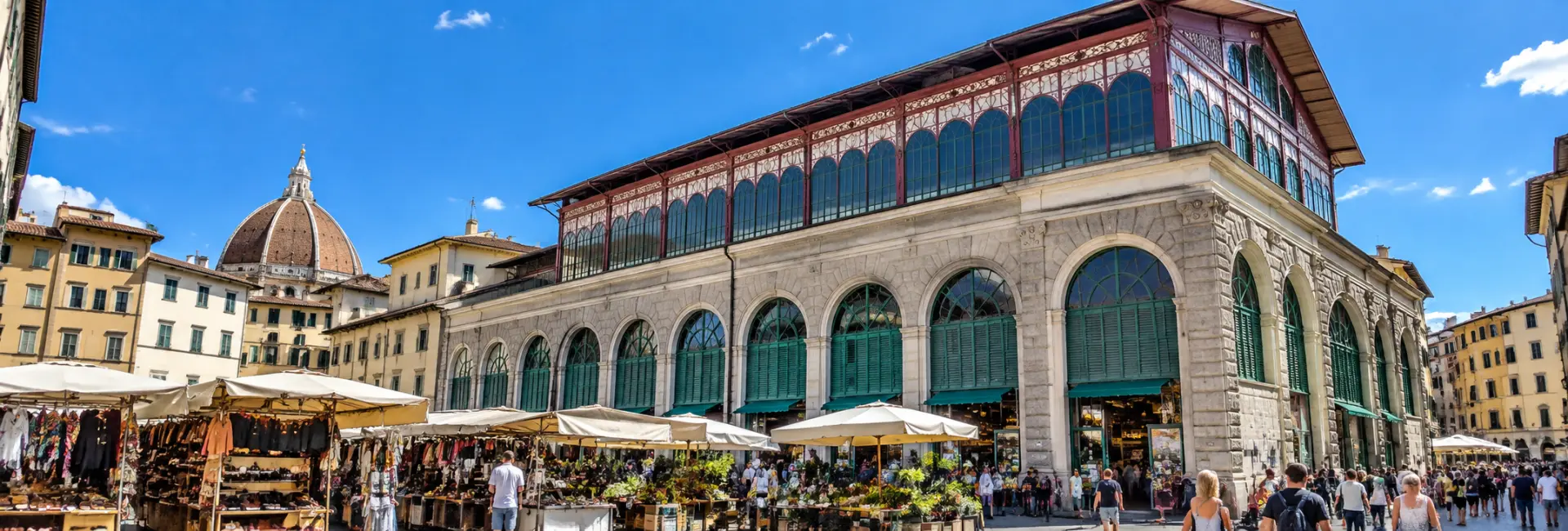
Mengoni designed Mercato Centrale as a single rectangular pavilion built almost entirely from cast iron and glass, a construction method he borrowed from Paris's Les Halles market and from the great exhibition halls fashionable across Europe at the time. A perimeter base of rusticated stone arcades, a nod to the masonry tradition of Florence's older civic palaces, grounds the building visually in its surroundings, while the iron skeleton above allows for wide interior spans uninterrupted by heavy supporting walls.
- A cast-iron structural frame supports large glass panels across the roof and upper walls
- A stone arcaded base echoes the masonry tradition of Florence's historic palazzi
- Rows of skylights and glazed sections flood both levels with natural daylight
- The 2014 renovation added wood counters, wicker fixtures, and communal tables without covering the original ironwork
The Ground Floor: Florence's Working Market
The ground floor is where Mercato Centrale still functions as a genuine neighborhood market rather than a purely touristic stop. Independent stallholders sell fruit, vegetables, cheese, cured meats, fresh pasta, bread, and other staples of Tuscan cooking, with a dedicated corner given over to fishmongers selling wild-caught and imported seafood. Many of the stalls are long-standing family businesses, and shoppers can buy ingredients to take away or stop for a quick bite at a handful of small counters and trattorias woven between the produce stands.
Outside the building, the surrounding streets host the separate San Lorenzo street market, better known for leather goods and clothing than food, which is easy to combine with a visit to the market itself.
The First Floor: Mercato Centrale Food Hall
Upstairs, the renovated first floor operates as a single open food hall built around more than twenty independent kitchens and counters, each specializing in one type of dish or product rather than offering a broad restaurant menu. Visitors order and pay at individual stalls, then carry their food to shared long tables or smaller seating clusters arranged around the hall's center, a format designed to encourage strangers to sit down together over a meal.
The food hall keeps considerably longer hours than the ground-floor market and stays open into the evening, which makes it a practical option for a late lunch, dinner, or an after-hours snack once much of the rest of the historic market has already closed for the day.
What to Eat and Notable Vendors
The food hall's strength lies in its range of specialists rather than any single restaurant, and first-time visitors usually do better sampling two or three counters instead of settling on one full meal.
- Lampredotto and other Florentine tripe dishes from stalls that specialize in this traditional street food
- Fresh pasta made and cooked to order at dedicated pasta counters
- Wood-fired pizza, cured meat and cheese boards, and Tuscan bread-based dishes such as crostini and panini
- Wine bars pouring Tuscan labels by the glass, alongside gelato and pastry counters for dessert
On the ground floor, a handful of small stand-up trattorias serve simple, market-fresh dishes at lower prices than the upstairs food hall, which suits visitors after a quick counter meal rather than a formal sit-down experience.
Best Time to Visit
The ground-floor market is busiest, and most authentic, in the late morning on weekdays, when local shoppers and stallholders are at their most active; it closes by mid-afternoon and does not open at all on Sundays. The first-floor food hall follows a different rhythm entirely, staying open daily well into the evening, so it can be visited comfortably at almost any hour, including for dinner after the historic market has shut its doors.
Both floors are noticeably quieter early on weekday mornings and busiest around the traditional lunch hour and on weekend afternoons, when visitors from the nearby Duomo and Accademia Gallery tend to arrive in the largest numbers.
Visitor Tips
- Visit the ground floor before around 1pm on a weekday to see it operating as a working market rather than mainly as a food hall
- Bring cash in small denominations, since several individual counters upstairs prefer it for quick transactions
- Arrive slightly before or after the main lunch rush to find seating more easily at the communal tables
- Sample food from more than one counter rather than filling up at the first stall, since portions are generally small and inexpensive
- Check opening hours in advance if visiting on a Sunday or public holiday, when the ground-floor market is typically closed
Nearby Attractions
Mercato Centrale sits within easy walking distance of several of Florence's best-known sights, making it a natural stop to combine with sightseeing in the historic center.
- Basilica di San Lorenzo and the Medici Chapels, just a short walk away
- Florence's Duomo and Baptistery, roughly a five-minute walk south
- The Accademia Gallery, home to Michelangelo's David, a short walk northeast
- Santa Maria Novella train station and its namesake basilica, about ten minutes on foot
FAQs about visiting Mercato Centrale
What is Mercato Centrale in Florence? +
It's Florence's largest historic covered food market, split between a working ground-floor market selling fresh Tuscan produce and meat, and a first-floor food hall of artisan counters and communal seating added in 2014.
Is Mercato Centrale free to enter? +
Yes, walking through both floors is free; you only pay for what you buy from individual stalls and counters, so there's no admission ticket required.
What's the difference between the ground floor and the first floor? +
The ground floor is a genuine working market for locals buying fresh ingredients, open only in the morning and early afternoon on weekdays and Saturdays, while the first floor is a food hall for eating on the spot, open daily until midnight.
When is the best time to visit? +
Weekday late mornings show the ground-floor market at its most active, while the first-floor food hall can be visited comfortably any time it's open, including for dinner once the historic market downstairs has closed.
How much time should I plan for a visit? +
Most visitors spend around one to two hours browsing both floors and eating, though a quick stop for a snack or coffee can take as little as twenty minutes.
Is Mercato Centrale suitable for families and visitors with dietary restrictions? +
Yes, the food hall's range of independent counters makes it easy for a group to order different dishes, including vegetarian options, though visitors with specific allergies should check with each counter directly since they're independently run.
What should I try there? +
Popular choices include Florentine lampredotto, fresh pasta made to order, wood-fired pizza, and cured meat or cheese boards, best sampled a little at a time across two or three different counters rather than at just one.
Is Mercato Centrale within walking distance of other Florence attractions? +
Yes, it sits a short walk from the Basilica di San Lorenzo and Medici Chapels, the Duomo, the Accademia Gallery, and Santa Maria Novella train station.