
Table of Contents
Overview
The Cimitero Monumentale is Milan's most famous cemetery and one of Europe's most striking examples of funerary architecture, often described by locals as an open-air museum rather than a simple burial ground. Spread across roughly 245,000 square meters in the Porta Volta area, just north of the city's historic center, it brings together neo-medieval architecture, dramatic sculpture and over a century and a half of Milanese social history in a single walkable site.
Unlike a conventional cemetery visit, a walk through the Monumentale is closer to touring a sculpture gallery: wide tree-lined avenues are lined with elaborate family tombs, temple-like mausoleums and finely carved marble and bronze memorials, many of them commissioned from the leading Italian sculptors of their era. At its entrance stands the Famedio, a civic pantheon honoring the Milanese who shaped the city's history.
History
Origins
Discussion of a large, modern cemetery for Milan dates back to 1829, though it took decades for the idea to become reality. An early design by architect Giulio Aluisetti was approved in 1846, and initial construction work began in the 1850s before being interrupted by the political upheaval of the era. It was only after a fresh design competition in 1860, held shortly after Italian unification, that the project moved forward under a new architect.
Maciachini's Design and Opening
The commission went to architect Carlo Maciachini, who began construction in the early 1860s with a plan to consolidate a number of smaller cemeteries scattered around Milan into one large, purpose-built site. The Cimitero Monumentale officially opened on 2 November 1866, the Day of the Dead, when the city's population stood at a little over 230,000. Its first burial, that of a Milanese resident named Gustavo Noseda, took place the same day.
From Overflow Problem to Prestige Address
Within just two years of opening, the cemetery was already struggling to keep up with the needs of a fast-growing city, forcing the temporary reuse of older burial grounds elsewhere in Milan. The pressure was finally relieved in 1895 with the opening of the much larger Cimitero Maggiore in the Musocco district. From that point on, the Monumentale was reserved mainly for perpetual burials, and it gradually became the preferred resting place for Milan's wealthiest and most prominent families, who competed to commission increasingly elaborate tombs from the top sculptors of the day.
That competitive spirit among patrons is part of what makes the cemetery so visually rich today. As tastes shifted across the decades, from the solemn realism fashionable in the late nineteenth century to the flowing lines of Art Nouveau and the sharper geometry of early twentieth-century modernism, families continued adding new monuments, so the grounds effectively document more than a century of changing Italian artistic style in one place.
Architecture & Design
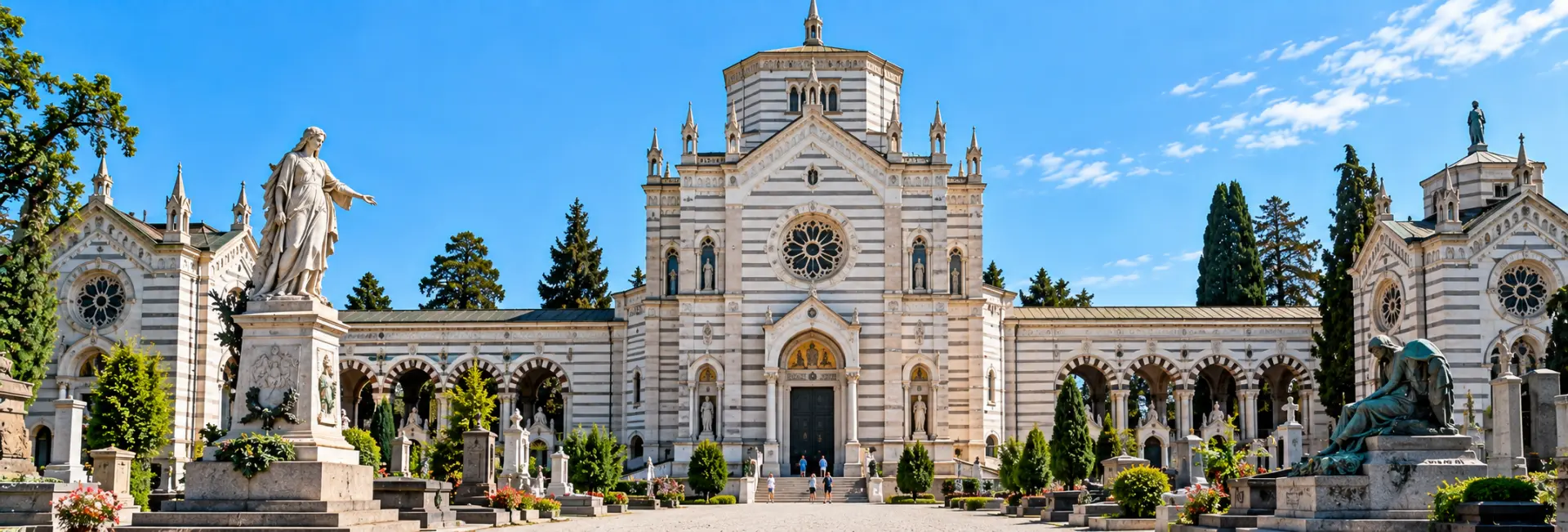
Maciachini designed the cemetery in a deliberately eclectic style, blending Gothic-Pisan elements with Lombard Romanesque forms and touches of Byzantine ornament, an approach sometimes summarized simply as neo-medieval. The layout is organized around two main perpendicular avenues crossing near the entrance, with a dense network of secondary paths branching outward through the various sections.
The Entrance and Porticoes
Visitors enter through an imposing neo-medieval facade of alternating bands of stone, arranged around a large forecourt. Covered porticoes line parts of the grounds, sheltering rows of wall tombs and offering a shaded route for exploring the site on hot days.
Civico Mausoleo Palanti
Among the cemetery's individual structures, the Civico Mausoleo Palanti, designed by architect Mario Palanti, stands out as a dedicated tomb for distinguished citizens of Milan who might not otherwise have a family plot in the cemetery. Its residents include figures from entertainment, sport, literature and the arts, reflecting a broad definition of civic merit that extends well beyond politics and business.
Materials and Layout
Much of the cemetery's grandeur comes from its material palette: pale marble, dark bronze and rough-hewn stone are used side by side across neighboring tombs, often deliberately contrasted for dramatic effect. The two main axes divide the grounds into large rectangular sections, each further subdivided by rows of family plots, so that even first-time visitors can navigate the site loosely by section number while still stumbling on unexpected sculptural surprises along the way.
The Famedio & Notable Burials
The Famedio, whose name loosely translates as "temple of fame," sits at the cemetery's main entrance and functions as a civic pantheon for Milanese citizens judged to have brought honor to the city. Admission to the Famedio is decided by a dedicated commission, making a place inside one of the most exclusive honors the city can bestow after death. Its interior is finished with colorful mosaics and formal decoration befitting its ceremonial role.
Writer Alessandro Manzoni was the first to be honored with burial in the Famedio, and his tomb remains its centerpiece. Other notable figures resting there include poet Salvatore Quasimodo and patriot and philosopher Carlo Cattaneo. Selection for the Famedio is not automatic even for well-known Milanese; the honor is meant to be reserved for those judged to have made a lasting contribution to the city or the country, so the roster inside stays relatively small compared to the cemetery's overall population of notable burials.
- Business dynasties such as the Campari, Bocconi, Branca and Falck families have elaborate tombs elsewhere in the grounds
- Conductor Arturo Toscanini is buried in the cemetery
- The Civico Mausoleo Palanti holds figures including actor Walter Chiari, singer-songwriters Giorgio Gaber and Enzo Jannacci, poet Alda Merini, artist Bruno Munari, and Herbert Kilpin, the English founder of AC Milan
- A memorial designed by the architecture group BBPR commemorates roughly 800 Milanese citizens who died in Nazi concentration camps during the Second World War
Because so many of Milan's industrial and commercial dynasties chose the Monumentale as their family resting place, walking its avenues doubles as a quiet tour through the city's economic history, with tomb after tomb bearing the names of companies and brands that remain recognizable across Italy today.
Funerary Art & Sculpture
Part of what sets the Monumentale apart is the sheer range of sculptural styles on display, spanning more than a century of Italian art history. Wealthy families used their tombs as showcases for the leading sculptors of the moment, so a single walk through the grounds moves from nineteenth-century realism through Liberty-style Art Nouveau and into twentieth-century modernism.
- Works and tombs connected to sculptors including Medardo Rosso, Adolfo Wildt, Leonardo Bistolfi, Giannino Castiglioni and Giacomo Manzù
- Contributions from later twentieth-century artists such as Lucio Fontana and Aldo Pomodoro
- A scaled-down replica of Rome's Trajan's Column, along with Greek-temple-style mausoleums and monumental obelisks
- A small permanent exhibition of two historic horse-drawn funeral carriages once used for processions to the cemetery
The cemetery is officially non-denominational, and side entrances lead to dedicated non-Catholic and Jewish sections; the Jewish cemetery is set apart from the rest of the grounds by its own boundary wall, reflecting its long-standing separate administration.
Beyond individual tombs, the cemetery's covered porticoes function almost like an outdoor gallery corridor, with wall-mounted plaques and relief sculptures arranged in long sequences. Many visitors find that some of the most delicate carving is tucked into these quieter arcaded sections rather than concentrated only in the largest freestanding monuments.
Visiting Etiquette & Tips
- Entry is free, and the cemetery functions as an active burial ground, so visitors should keep voices low and be mindful of funerals or families visiting graves
- Photography is generally permitted outdoors, but it's respectful to avoid photographing mourners or active services
- Pick up a free site map near the entrance, or use the information kiosk, since the grounds are large enough to make specific tombs hard to find without guidance
- Comfortable shoes are worth wearing, as the paths cover considerable distances between the more famous sections
- A guided tour is a good option for anyone hoping to understand the stories behind specific tombs rather than simply admiring the sculpture
- The cemetery sits outside Milan's restricted traffic zone, so arriving by car is straightforward, though the tram and metro connections tend to be the more convenient option for visitors already staying in the center
Best Time to Visit
The cemetery is open Tuesday through Sunday, generally from morning until early evening, and closed on Mondays. Weekday mornings tend to be the quietest time to visit, with soft light that suits photography of the stonework and sculpture. Weekends can bring a modest increase in visitors, including families tending graves, particularly around religious holidays.
Overcast days can actually be a good time to visit, since the muted light softens the contrast on the pale marble monuments. Around 2 November, Italy's Day of the Dead and the cemetery's own opening anniversary, the site sees noticeably higher local visitor numbers as families come to honor relatives. Outside of that date, the Monumentale tends to stay far less crowded than Milan's headline sights, making it a comparatively peaceful stop even during the city's busiest tourist seasons.
Nearby Attractions
- The Porta Nuova and Isola districts, Milan's modern skyscraper and design-focused neighborhoods, a short walk away
- Corso Como, a lively street of boutiques, bars and restaurants close to the cemetery
- Milano Porta Garibaldi railway station, a major transport hub within easy walking distance
- Castello Sforzesco and its museums, reachable by tram from the cemetery entrance
FAQs about visiting the Monumental Cemetery
What is the Monumental Cemetery known for? +
It's Milan's principal historic cemetery, celebrated for its dense concentration of elaborate 19th- and 20th-century funerary sculpture and for the Famedio, a civic pantheon honoring the city's most distinguished citizens.
Is the Monumental Cemetery free to visit? +
Yes, entry is free of charge, though donations toward preservation are welcomed and guided tours are available for a fee.
How much time should I plan for a visit? +
Most visitors spend one to two hours walking the main avenues and the Famedio; art and history enthusiasts often stay longer to seek out specific sculptors' work across the wider grounds.
Who is buried at the Monumental Cemetery? +
Notable figures include writer Alessandro Manzoni, poet Salvatore Quasimodo, philosopher Carlo Cattaneo, conductor Arturo Toscanini, and members of prominent Milanese business families such as Campari and Bocconi, alongside artists, entertainers and sportspeople.
Is the cemetery suitable for children or casual visitors? +
It can be a meaningful stop for older children interested in art or history, though its primary purpose as an active cemetery means a quiet, respectful pace works better than a typical sightseeing visit.
How do I get to the Monumental Cemetery? +
It's reachable by metro lines M2 and M5, several tram lines, and is a short walk from Milano Porta Garibaldi railway station, making it easy to combine with a visit to the nearby Isola and Porta Nuova districts.
What day is the cemetery closed? +
The cemetery is closed on Mondays and open Tuesday through Sunday, with reduced hours on certain Italian public holidays.
What should I know before visiting? +
Remember that it remains an active burial site, so quiet, respectful behavior is expected, and it's worth picking up a map at the entrance since the grounds are large and the most notable tombs are spread throughout.
