
Table of Contents
Overview
The Galleria Vittorio Emanuele II is a soaring, glass-roofed arcade in the heart of Milan that links Piazza del Duomo to Piazza della Scala. Built in the 1860s and 1870s and named for Italy's first king, it is often called "il salotto di Milano," or "Milan's drawing room," because generations of Milanese have used it as a meeting place rather than just a shopping street.
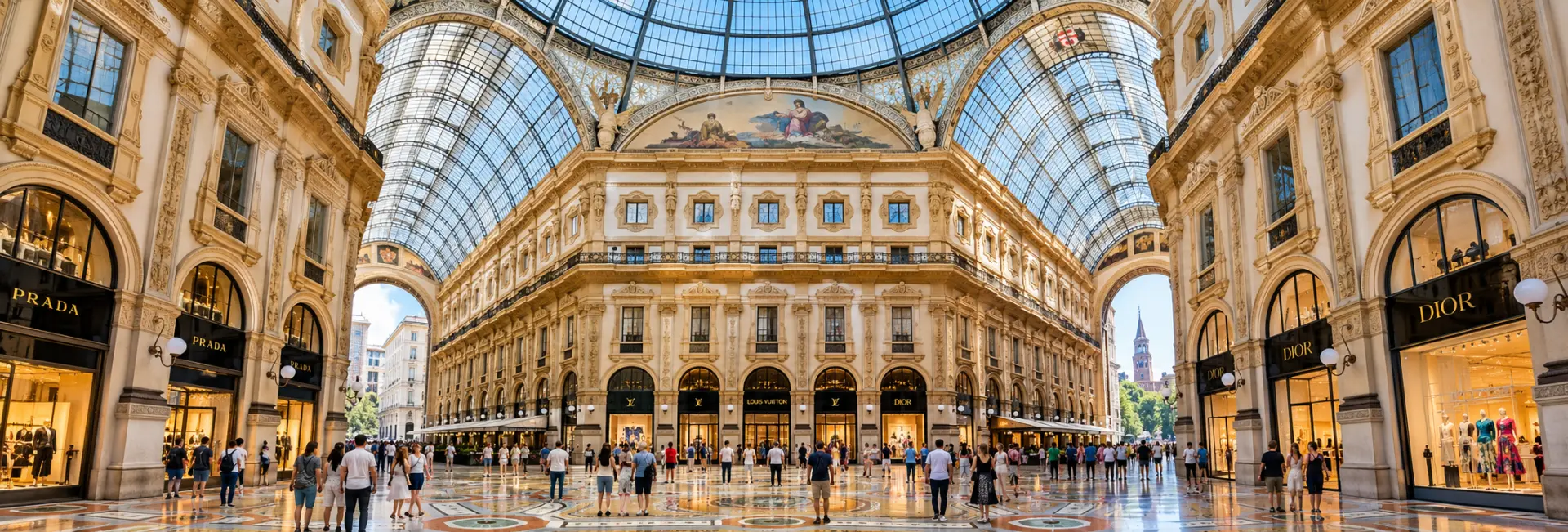
Beneath its arched iron-and-glass roof, four grand wings meet at a central octagon paved with marble mosaics. Luxury boutiques, historic cafés, and a storied restaurant scene fill the ground floor, while the upper storeys hide apartments, offices, and one of the city's most exclusive hotels. It costs nothing to walk through, and for most visitors, doing exactly that is the whole point.
Few buildings anywhere combine so many roles at once: the Galleria is at the same time a functional pedestrian shortcut, a protected historic monument, a working shopping centre, and an informal civic stage where Milanese have gathered for well over a century. Its scale still surprises first-time visitors, and its ornament rewards anyone willing to look upward rather than only at the shopfronts.
History
Origins and Construction
The idea for a covered street connecting the cathedral square to the opera house took shape after Italian unification, when city leaders wanted a modern showcase for the newly formed nation. An earlier version of the plan, floated before unification, had even considered honouring the Austrian emperor; by the time a design competition was held in the early 1860s, the project was firmly reimagined as a monument to the new Kingdom of Italy. The competition, drawing well over a hundred entries, was won by the young architect Giuseppe Mengoni, and construction began in March 1865 with a foundation stone laid by King Vittorio Emanuele II himself. The main arcade opened to the public on 15 September 1867, though the grand entrance arch facing the Duomo remained unfinished for another decade, delayed by funding shortfalls and a change in city leadership.
A Tragic Completion
Finishing the triumphal arch proved slow, held up by funding troubles, a change of city government, and the bankruptcy of the British company originally contracted to build it. On 30 December 1877, while inspecting the nearly completed arch from its scaffolding, Mengoni fell to his death. The circumstances were never fully explained, and the accident has become one of the arcade's most retold stories. The completed arch was formally inaugurated on 1 January 1878 by the king whose name the Galleria bears; Vittorio Emanuele II himself died just over a week later.
War, Restoration, and Renewal
Allied bombing in August 1943 heavily damaged sections of the Galleria, shattering large portions of the glass roof and scarring several façades; rebuilding continued into the mid-1950s as the arcade slowly reopened to shoppers and diners. Further conservation work marked the arcade's 1967 centenary, refreshing the floor mosaics and finishing restoration work left unresolved after the war. Decades later, a major cleaning and restoration project ahead of Expo Milano 2015 stripped away decades of grime to reveal the original two-tone stonework of the façades, along with brighter mosaics and statues, and remains the most extensive intervention the building has seen since it was built.
Recognition & Status
The Galleria has held official heritage protection since 1982, a status that safeguards its structure, façades, and decorative details as the property has passed through changing commercial and civic pressures over the decades. It remains owned by the City of Milan, which leases individual units to tenants through long-term concession agreements rather than a single private operator.
Beyond formal protection, the Galleria functions as an informal civic symbol: it is consistently treated as one of the defining images of Milan, appearing alongside the Duomo and La Scala in the city's own sense of itself as a capital of fashion, finance, and design.
Architecture & Design
The Cruciform Plan
Mengoni laid the Galleria out as a Latin cross, with a longer arm running about 196 metres between Piazza del Duomo and Piazza della Scala and a shorter arm crossing it. The two glass-vaulted passages meet at a central octagonal space, a layout that let the arcade double as both a functional shortcut through the city centre and a grand architectural set piece.
The Iron-and-Glass Dome
Over the octagon rises a dome of cast iron and glass roughly 47 metres high, an ambitious engineering feat for its era that used more than 300 tonnes of iron in prefabricated sections assembled on site. Concealed tie rods span the arches so the structure reads as light and open rather than heavy, letting daylight flood the marble floor below.
The Triumphal Arch and Façades
The entrance facing the Duomo takes the form of a monumental stone arch in a Renaissance Revival style, decorated with statuary and reliefs celebrating Italian art, science, and commerce. Upper-storey façades along all four arms repeat this ornamentation, with carved figures, pilasters, and balustrades that give the arcade the feel of an open-air palace rather than a plain shopping street.
Key Areas & Highlights
The Octagon and Its Mosaics
At the crossing point of the four arms, the Octagon is the Galleria's symbolic centre. Its marble floor bears four large mosaic roundels showing the coats of arms of Turin, Florence, Rome, and Milan, the cities that in turn served as capital of the Kingdom of Italy. Above, four lunette mosaics beneath the dome personify Europe, Asia, Africa, and America.
The Four Arms
Each of the arcade's four wings has its own character, lined with flagship boutiques, jewellers, and bookshops beneath a continuous run of glass vaulting. Walking the full length from the Duomo entrance to Piazza della Scala takes only a few minutes, but the detail overhead, statues, medallions, and painted lunettes rewards a much slower pace.
The Rooftop Walk
A ticketed walkway along the Galleria's rooftop terraces gives close-up views of the dome's ironwork and a rare street-level perspective on the Duomo's spires and the surrounding rooftops of central Milan, a vantage point unavailable from the arcade floor.
Cultural Significance & Traditions
Since the late 19th century, the Galleria has drawn writers, intellectuals, and political movements as much as shoppers. Its cafés hosted Futurist gatherings in the early 20th century, and the arcade turns up in the travel writing of visitors such as Mark Twain, who marvelled at its scale and its marble-paved streets lined with café tables.
The best-known local ritual centres on a mosaic bull set into the floor of the Octagon, part of the Turin coat of arms. Generations of visitors have spun on one heel with a foot pressed into the bull's groin, a superstition said to bring good luck; the tile has worn visibly smooth from the practice. Longtime cafés and restaurants inside the arcade, some dating to its opening year, are themselves treated as part of the city's cultural fabric rather than simple tourist stops, having hosted generations of Milanese business deals, first dates, and post-opera suppers after evenings at La Scala.
The Galleria's association with Italian craft and design has also endured well beyond its 19th-century origins, with its upper floors now home to a contemporary art and photography space, alongside the flagship stores of Italian fashion houses that continue to treat an address inside the arcade as a statement of prestige rather than simple retail strategy.
Ways to Experience It
- Walk the full cross-shaped route between Piazza del Duomo and Piazza della Scala, pausing under the central dome.
- Sit at one of the historic cafés for coffee or an aperitivo while watching the crowds pass beneath the glass roof.
- Book a rooftop walkway visit for close-up dome views and rooftop panoramas over the Duomo.
- Browse flagship boutiques and the Galleria's long-running bookshop, part of daily Milanese life rather than a purely touristic stop.
- Join a guided walking tour of the Duomo–Galleria–La Scala area, which typically covers the arcade's history and architecture in detail.
Best Time to Visit
Early morning is the quietest time to see the Galleria, when the light through the dome is strongest and the marble floors are largely free of crowds. Midday and early evening draw the heaviest foot traffic, as both tourists and Milanese workers pass through on their way between the Duomo and La Scala districts.
The arcade is open around the clock, though shops and cafés keep standard business hours. Winter brings elaborate Christmas decorations and a large tree beneath the dome, making December a particularly festive, if busier, time to visit.
Visitor Tips
- Entry to the arcade itself is free at any hour; only the shops, restaurants, and the rooftop walkway charge admission.
- The nearest stop is the Duomo metro station, served by Lines 1 and 3, with exits leading directly toward the Galleria.
- Photography is generally welcome, but be mindful of other visitors when using tripods or filming, especially near the busy Octagon.
- Prices at cafés and restaurants inside the Galleria run well above the Milan average, reflecting the location; nearby streets offer more affordable options.
- Floors can be slippery when wet, so wear sensible shoes, particularly in rainy weather.
Nearby Attractions
- Milan Cathedral (Duomo di Milano) and its rooftop terraces, directly adjacent to the Galleria's main entrance.
- Teatro alla Scala and the adjoining La Scala Museum, at the arcade's far end in Piazza della Scala.
- Museo del Novecento, a museum of 20th-century Italian art overlooking Piazza del Duomo.
- Palazzo Reale, a former royal palace hosting rotating major art exhibitions beside the Duomo.
- La Rinascente department store, whose rooftop terrace offers another close-up view of the Duomo's spires.
FAQs about visiting Galleria Vittorio Emanuele II
Is the Galleria Vittorio Emanuele II free to visit? +
Yes, walking through the arcade is free and it is open 24 hours a day; only individual shops, restaurants, and the rooftop walkway charge for anything.
How long does it take to see the Galleria? +
Walking end to end takes only a few minutes, but most visitors spend 20 to 40 minutes taking in the architecture, mosaics, and shopfronts, longer if stopping for coffee.
What is the story behind the bull mosaic? +
A mosaic bull set into the floor of the central Octagon is part of Turin's coat of arms, and visitors traditionally spin on one heel with a foot pressed into it for good luck, a habit that has worn the tile smooth over time.
How do I get to the Galleria by public transport? +
The Duomo metro station, served by Lines 1 and 3, sits right beside the arcade's main entrance, with several exits leading directly into Piazza del Duomo.
Can you go up to the rooftop of the Galleria? +
Yes, a ticketed rooftop walkway lets visitors walk along the terraces near the dome for close-up architectural views and rooftop panoramas over the Duomo.
Is the Galleria worth visiting if I'm not shopping? +
Yes, most visitors come for the architecture, mosaics, and atmosphere rather than the luxury boutiques, and simply walking through or having a coffee is a common way to experience it.
What is the best time of day to visit? +
Early morning offers the quietest visit and the best light through the glass dome, while midday and early evening are the busiest as both tourists and commuters pass through.
Are there historic cafés inside the Galleria? +
Yes, several cafés and restaurants inside date back to the arcade's 19th-century opening and remain popular meeting spots, though prices reflect the central location.
