
Table of Contents
Overview
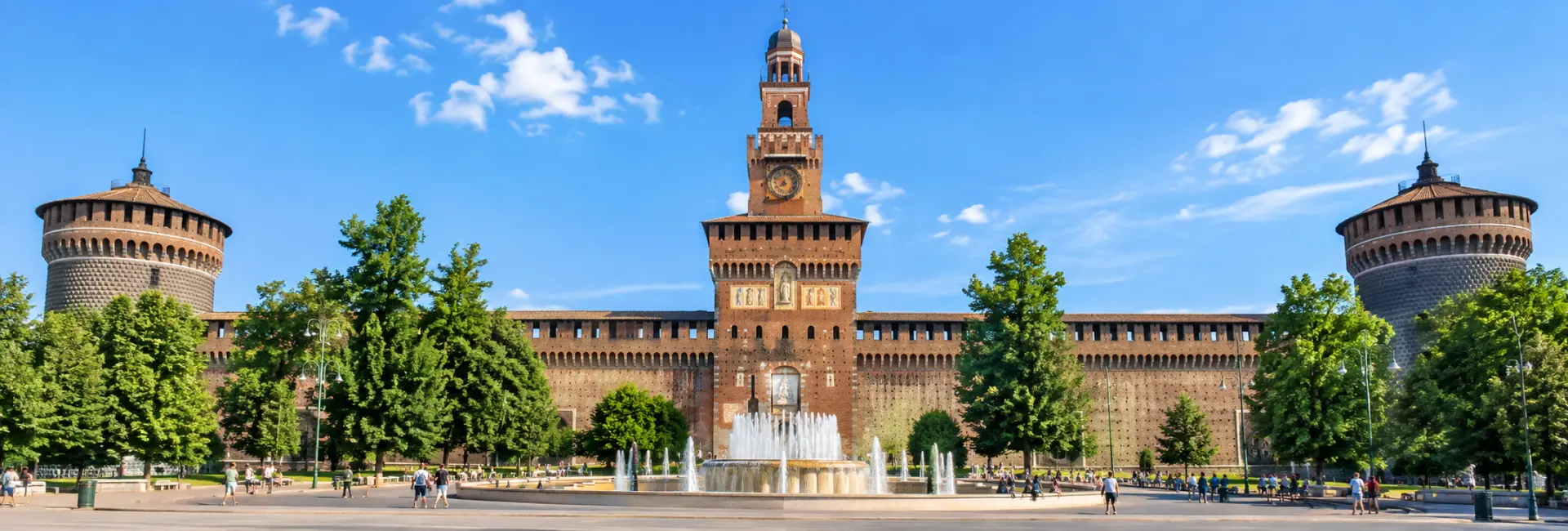
Sforza Castle sits at the edge of Milan's historic centre, where the dense grid of the old city gives way to the green sweep of Parco Sempione. Built of dark red brick and ringed by a wide moat, it is one of the largest citadels ever raised in Europe, and today it functions as the city's largest museum complex rather than a fortress.
The castle began life as a defensive stronghold for the ruling Visconti family, then was rebuilt and expanded into a princely court by the Sforza dukes who gave it their name. Under Ludovico Sforza, known as "il Moro," it became one of the most cultivated courts in Renaissance Italy, drawing artists such as Leonardo da Vinci and Donato Bramante into its service. Centuries of military use, an accidental explosion, wartime bombing, and a major turn-of-the-century restoration have all left their mark on the building visitors walk through today.
Its courtyards are free to enter and double as a shortcut between downtown Milan and the park behind it, while its ticketed museums hold one of the city's richest collections of sculpture, painting, and decorative art, including Michelangelo's unfinished last work.
History
Visconti Origins
A fortress first stood on this site in the 1360s, built by the Visconti family, who then ruled Milan, on the remains of an earlier Roman-era stronghold known as the Castrum Portae Jovis. When the Visconti line ended and a short-lived republic took power in Milan in the mid-1400s, the fortress was partly torn down as a symbol of ducal rule the new government wanted to erase.
The Sforza Court
Francesco Sforza, a condottiero who married into the Visconti family and seized control of Milan, rebuilt the fortress from around 1450 onward as the residence of a new ducal dynasty, and it took his family name. The castle reached its cultural peak under his descendant Ludovico Sforza in the final decades of the fifteenth century, when the court became a magnet for painters, engineers, and scholars. Leonardo da Vinci worked at the Sforza court in these years, both as a military and hydraulic engineer and, eventually, as a painter, decorating an entire room of the castle with an illusionistic canopy of trees for Ludovico.
Decline, Damage, and Restoration
Milan's fall to French forces in 1499 ended Sforza rule, and the castle passed through Spanish, French, and Austrian hands over the following three centuries, serving mainly as a barracks and garrison. In 1521, lightning is thought to have set off a store of gunpowder inside the castle's central tower, destroying it in the blast. The building fell into further disrepair and was even threatened with demolition during the Napoleonic period. Its fortunes turned only at the end of the nineteenth century, when the city of Milan took ownership and architect Luca Beltrami led a sweeping restoration between 1893 and 1905, rebuilding the ruined central tower and converting the complex into a home for the city's civic art collections. Allied bombing in 1943 badly damaged parts of the castle during the Second World War, and the postwar rebuilding of its museum spaces was overseen by the architectural firm BBPR.
Architecture & Notable Rooms
The castle is laid out as a roughly square fortress with sides around 200 metres long, framed by corner towers and faced almost entirely in exposed red brick, a hallmark of Lombard Gothic building. A moat, now landscaped rather than filled with water along most of its course, still traces the perimeter of the walls.
The Torre del Filarete
The central gate tower, known as the Torre del Filarete after the architect who first designed it in 1452, is the castle's best-known landmark and the point through which most visitors enter. The tower seen today is a careful reconstruction built between 1900 and 1905 on the basis of Renaissance-era drawings, following the tower's destruction in the 1521 explosion; it carries a sundial and sculpted decoration honouring the Sforza dukes.
Courtyards
Inside, the castle unfolds through a sequence of courtyards rather than a single interior. The largest, the Piazza d'Armi, was once a military parade ground and is now an open public space. Closer to the old ducal apartments, the Corte Ducale gives access to the museum wings, while the smaller Rocchetta courtyard, tucked into one corner, was the most secure and private part of the complex in Sforza times.
The Sala delle Asse
Among the castle's rooms, one stands apart: the Sala delle Asse, painted around 1498 at Ludovico Sforza's request. Leonardo covered its vaulted ceiling and upper walls with an illusion of a wooden pergola, sixteen tree trunks whose branches interlace overhead into a canopy of leaves and knotted golden cord, framing the Sforza coat of arms at the centre. The decoration was lost from view for centuries under later whitewash and alteration before being rediscovered and progressively restored, and it remains one of only two surviving wall paintings attributed to Leonardo's own hand.
Museums & Collections
Since the late nineteenth century, Sforza Castle has served as the umbrella building for several of Milan's civic museums, most accessible on a single combined ticket.
- The Museo d'Arte Antica occupies the former ducal apartments and holds sculpture spanning the medieval to Renaissance periods, including the Pietà Rondanini, Michelangelo's last and unfinished sculpture, which he was still reworking shortly before his death.
- The Pinacoteca del Castello Sforzesco is the castle's picture gallery, bringing together paintings from the fourteenth to the eighteenth century by Lombard and other Italian masters.
- The Museo degli Strumenti Musicali displays historic musical instruments, from early keyboard instruments to string and wind instruments spanning several centuries.
- The Archaeological Museum's holdings, including Egyptian and prehistoric material, are also linked to the castle complex.
- The Applied Arts Collection covers furniture, ceramics, textiles, and ivories, while the Achille Bertarelli collection preserves prints, posters, and graphic material documenting Milan's visual history.
Grounds & Parco Sempione
Passing through the castle's rear gate leads directly into Parco Sempione, one of Milan's largest green spaces, laid out in the late nineteenth century on ground that had served as the castle's old parade field. The park's paths, lake, and tree cover make the walk from the castle's brick courtyards into open parkland feel like a single continuous space rather than two separate attractions.
Along the way, the castle's moat and outer walls are visible at close range, and on the park side the perspective back toward the Torre del Filarete is one of the classic photographic views of the complex.
Ways to Experience It
The castle can be experienced at several levels of depth, depending on how much time and interest a visitor brings.
- Walking through the courtyards and under the Torre del Filarete costs nothing and takes as little as twenty minutes.
- A combined ticket for the civic museums covers the Museo d'Arte Antica, the Pinacoteca, and the other collections housed in the castle, typically taking two to three hours to see at a comfortable pace.
- Guided tours, run periodically, can include areas such as the castle's ramparts or underground spaces that are otherwise closed to independent visitors.
- Access to the Sala delle Asse is sometimes limited or offered through special timed visits while restoration or conservation work is ongoing, so checking availability in advance is worthwhile for visitors who want to see it.
- Audio guides are available for visitors who prefer a self-paced route through the museum wings.
Best Time to Visit
Weekday mornings, shortly after opening, tend to be the quietest time to see both the courtyards and the museums, before tour groups and school parties build up later in the day. Weekend afternoons are consistently the busiest, particularly in the courtyards, which double as a public thoroughfare for people crossing between the city centre and Parco Sempione.
Spring and early autumn offer mild, comfortable weather for lingering in the open courtyards and walking on into the park afterward, while midsummer visits are best timed for the cooler morning hours. The castle is generally closed on Mondays, so it is worth checking the current weekly schedule before planning a visit around that day.
Visitor Tips
- The courtyards are free to enter; only the museum collections inside require a ticket.
- The castle is a short walk from the Cairoli Castello and Cadorna metro stations, both on central Milan lines.
- Cobbled courtyards and worn stone floors inside make comfortable, flat shoes a practical choice.
- Opening hours, ticket prices, and which rooms or exhibits are currently open can change, so it is worth confirming these details on the official site shortly before a visit.
- The complex is large enough to pair naturally with a walk into Parco Sempione immediately afterward, so building extra time into a visit is worthwhile.
- Buggy and wheelchair access is reasonable across the main courtyards, though some upper floors and older sections of the museum wings are less straightforward; checking current accessibility information in advance is recommended for visitors with mobility needs.
Nearby Attractions
Parco Sempione opens directly behind the castle and is worth combining with a visit, with the Arco della Pace triumphal arch marking its far end. Milan's Cathedral and Piazza del Duomo lie roughly fifteen minutes away on foot along Via Dante, a pedestrian route laid out specifically to connect the two landmarks.
Art lovers can continue to the Pinacoteca di Brera, a short walk to the east, which holds one of Italy's major painting collections. Santa Maria delle Grazie, home to Leonardo's Last Supper mural, is also within easy reach and is often visited on the same day, though it is a separate site from the castle and requires its own advance-booked ticket.
FAQs about visiting Sforza Castle
What is Sforza Castle known for? +
It is known as the former residence of Milan's ruling Sforza dukes, for its red-brick Renaissance architecture, and for housing Leonardo da Vinci's painted Sala delle Asse along with Michelangelo's unfinished last sculpture, the Pietà Rondanini.
Is it free to visit? +
Walking through the courtyards is free, but the civic museums inside, including the Museo d'Arte Antica and the Pinacoteca, require a paid ticket.
How much time should I plan for a visit? +
A quick walk through the courtyards takes around twenty minutes, while seeing the main museum collections at a comfortable pace generally takes two to three hours.
Can I see the Last Supper at Sforza Castle? +
No, Leonardo's Last Supper is a separate mural at the nearby church of Santa Maria delle Grazie and needs its own advance-booked ticket; the castle instead holds Leonardo's Sala delle Asse ceiling painting.
How do I get to Sforza Castle? +
It sits right in central Milan and is a short walk from the Cairoli Castello and Cadorna metro stations, making it easy to reach on foot from most of the historic centre.
Is Sforza Castle suitable for families and visitors with mobility needs? +
The open courtyards are easy going for families and buggies, and the main museum floors are generally accessible, though some older upper sections can be harder to navigate, so checking current accessibility details in advance is a good idea.
When is the best time to visit? +
Weekday mornings are quietest, spring and early autumn bring the most comfortable weather for the courtyards and adjoining park, and the castle is typically closed on Mondays.
What else is nearby that I can combine with my visit? +
Parco Sempione and the Arco della Pace sit directly behind the castle, the Duomo is about fifteen minutes away on foot, and the Pinacoteca di Brera and Santa Maria delle Grazie are both within easy walking or short transit distance.
