
Table of Contents
Overview
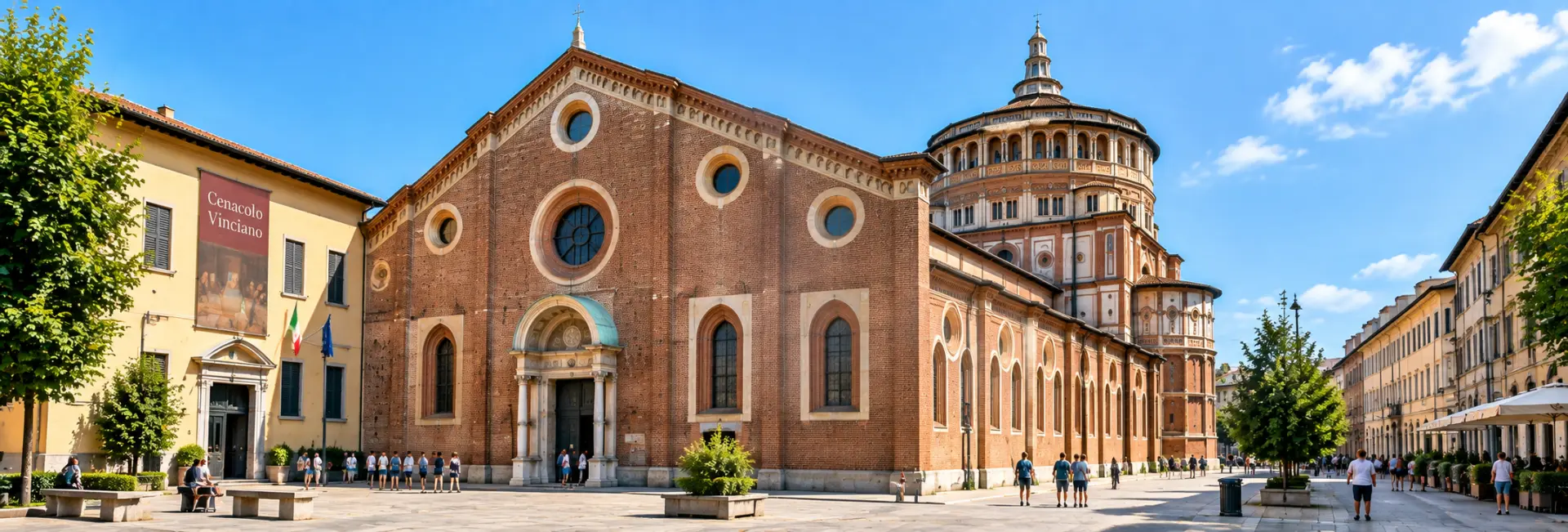
Santa Maria delle Grazie is a Dominican church and convent in central Milan, best known worldwide as the home of Leonardo da Vinci's Last Supper, painted on the wall of its refectory in the 1490s. The complex itself, a blend of Gothic nave and Renaissance apse, is a significant building in its own right, and the church and its mural together form one of Italy's UNESCO World Heritage Sites, a rare case of a building and the artwork inside it sharing that designation.
Commissioned as a Dominican foundation by Duke Francesco Sforza in the 1460s and later transformed by his son Ludovico into an intended family mausoleum, the complex brought together two towering figures of the Renaissance: the architect Donato Bramante, who redesigned its eastern end, and Leonardo, who painted its most famous work in the adjoining refectory.
Seeing the Last Supper today requires advance booking and a timed, limited-capacity visit, a legacy of the mural's fragile condition, but the church itself remains open to the public and free to enter, offering a quieter counterpart to the world-famous painting next door. Many visitors are surprised to learn that the church and the refectory are, in practical terms, two separate visits with two different sets of rules.
History
A Dominican Foundation
Construction began in 1463 under Duke Francesco Sforza, who commissioned a Dominican church and convent on the site of an earlier chapel dedicated to the Madonna delle Grazie. The architect Guiniforte Solari, also known for his work on Milan's cathedral, designed the original Gothic church and oversaw its construction over the following decades.
Bramante's Renaissance Expansion
In 1492, Francesco's son Ludovico Sforza, known as "il Moro," decided the church would become the burial place of his own dynasty and brought in the architect Donato Bramante to rebuild its eastern end. Bramante demolished the existing Gothic chancel and replaced it with a polygonal apse, a domed tribune, and a cloister in the new Renaissance style, work that stands among his most significant contributions to Italian architecture before he went on to draft early designs for St Peter's Basilica in Rome. It was during this same building campaign that Ludovico commissioned Leonardo da Vinci, then working at the Sforza court, to paint the Last Supper on the refectory's north wall, a work completed around 1498. Ludovico's wife, Beatrice d'Este, died in 1497 and was briefly buried in the church before her tomb, along with plans for Ludovico's own, was later moved elsewhere following the fall of Sforza rule in Milan.
Later Centuries and Wartime Damage
The convent passed through several uses in the centuries that followed, including a period as the seat of an Inquisition tribunal and later use as a military barracks after Napoleonic-era suppressions of religious houses. In the 1930s, the complex underwent a major structural consolidation and restoration, work that inadvertently helped the building withstand what came next. On 15 August 1943, Allied bombing struck the rear of the complex directly, destroying the refectory's roof and most of its walls. The wall carrying the Last Supper survived, largely because it had been reinforced in advance with sandbags and scaffolding as a precaution against exactly this kind of damage. The refectory stood open to the sky for several years before reconstruction was completed, and the wider complex has undergone continuous conservation work from the twentieth century onward.
Architecture & Design
Santa Maria delle Grazie is unusual for combining two distinct architectural styles in a single, coherent building. Its nave, dating to the church's original construction under Solari, follows the Lombard Gothic style typical of fifteenth-century Milan. Its eastern end, added later by Bramante, breaks sharply from that style into full Renaissance form: a polygonal apse, a drum-and-dome structure known as the tiburio rising over the crossing, and a light-filled tribune that reads as a distinct architectural moment from the older nave in front of it.
Attached to the church, the convent complex includes cloisters, a library, and the refectory, the dining hall where Leonardo's mural was painted. A smaller cloister within the complex is known for the bronze frogs decorating its fountain, while the adjoining Old Sacristy preserves finely worked wooden cabinetry from the same building campaign.
The Last Supper & the Refectory
Leonardo painted the Last Supper on the refectory's north wall between roughly 1495 and 1498, depicting the moment Christ tells his apostles that one of them will betray him. Rather than using true fresco technique, Leonardo experimented with tempera applied to a dry wall, a choice that let him work more slowly and revise details as he went, but which made the paint layer unusually unstable from very early on. The mural began showing signs of deterioration within decades of its completion, and it has been the subject of restoration efforts recorded from the eighteenth century through to a major twenty-year conservation project completed at the end of the twentieth century, which removed later overpainting and stabilised the surviving original paint.
Because of this fragility, access to the refectory is tightly controlled: visitors enter in small, timed groups for a strictly limited number of minutes, with humidity and visitor numbers both regulated to protect the painting. Climate control and monitoring equipment installed during and after the major restoration continue to track the conditions inside the room. On the opposite wall of the same room, a large Crucifixion fresco by Giovanni Donato da Montorfano, painted shortly before Leonardo's work, is often overshadowed by its more famous neighbour but shares the same room and history.
Cultural & Religious Significance
Beyond its fame as the setting for the Last Supper, Santa Maria delle Grazie remains an active Dominican church, with the religious life of the community continuing alongside its role as one of the most visited cultural sites in Italy. Its inclusion, together with the mural, on the UNESCO World Heritage list in 1980 recognised both the building's architectural significance and the singular importance of the painting inside it.
The church's seven side chapels hold additional artworks and monuments from across its history, offering a quieter picture of Milanese religious art than the refectory's single, world-famous scene.
Ways to Experience It
- Visiting the Last Supper requires booking a specific time slot in advance, as tickets are released periodically and often sell out quickly given the strict daily visitor limits.
- Entry to the refectory is organised in small groups, with each group given a short, fixed amount of time inside before the next group is admitted.
- The church itself is separate from the ticketed refectory visit, is free to enter, and can usually be visited without advance booking during its regular opening hours.
- Guided tours, offered by licensed operators, can combine skip-the-line access to the Last Supper with more context on the building's history than a self-guided visit provides.
- Combined tickets or itineraries pairing the Last Supper with nearby sights, such as Sforza Castle, are offered by some operators for visitors planning a fuller day around the two landmarks.
Best Time to Visit
Because access to the Last Supper is capped by fixed time slots rather than by how busy the site feels on arrival, timing a visit is really about booking early rather than choosing a particular season. Tickets for popular dates, especially weekends and holiday periods, can sell out weeks or even months ahead, so securing a slot as soon as booking opens is the most important factor for anyone determined to see the mural on a specific date.
For the church itself, weekday mornings tend to be quieter than afternoons, when visitors with Last Supper tickets add to general foot traffic around the complex.
Visitor Tips
- Book Last Supper tickets as far in advance as possible through official channels, since informal or last-minute availability is rare.
- Arrive at least fifteen minutes before the scheduled entry time, since latecomers can be denied entry and tickets are non-transferable to a later slot.
- Bags and coats typically need to be checked before entering the refectory, and photography inside is generally restricted to protect the mural.
- The church itself, free to enter, is a worthwhile stop even for visitors who could not secure a Last Supper ticket.
- The nearest metro stop is Cadorna, a short walk from the complex, with several tram lines also serving the area.
- Modest dress, covering shoulders and knees, is generally expected when entering the church itself, as at any active place of worship.
Nearby Attractions
Santa Maria delle Grazie sits within easy walking distance of several other central Milan landmarks. Sforza Castle and Parco Sempione lie a short walk to the northeast, while the Duomo and the city's historic centre are reachable in around twenty minutes on foot or a quick metro ride from Cadorna station.
The Brera district, with its art gallery and cluster of galleries and cafés, is also within reasonable walking distance for visitors looking to combine a Last Supper visit with a wider afternoon in the city.
FAQs about visiting Santa Maria delle Grazie
What is Santa Maria delle Grazie famous for? +
It is famous as the home of Leonardo da Vinci's Last Supper mural, painted in the convent's refectory in the 1490s, and for its Renaissance apse and dome added by the architect Donato Bramante.
Do I need to book tickets in advance? +
Yes, seeing the Last Supper requires a timed ticket booked well in advance, since visitor numbers are strictly limited and popular dates can sell out weeks or months ahead; the church itself is free and does not require booking.
How long can I spend looking at the Last Supper? +
Visits to the refectory are organised in small groups with a short, fixed time slot, so viewing time is limited rather than open-ended.
Is the church free to visit? +
Yes, the church of Santa Maria delle Grazie is free to enter, separate from the ticketed Last Supper visit in the adjoining refectory.
Why is access to the Last Supper so restricted? +
Leonardo used an experimental painting technique that made the mural unusually fragile, so humidity, visitor numbers, and time inside the refectory are all tightly controlled to protect it.
How do I get to Santa Maria delle Grazie? +
The complex is a short walk from Cadorna metro station, with several tram lines also serving the surrounding area of central Milan.
Did the Last Supper survive World War II bombing? +
Yes, a 1943 air raid destroyed much of the refectory's roof and walls, but the wall bearing the Last Supper survived because it had been reinforced with sandbags and scaffolding beforehand.
What else is nearby that I can combine with a visit? +
Sforza Castle and Parco Sempione are a short walk to the northeast, and the Brera district and Milan's historic centre are both reachable on foot or by a short metro ride.
