
Table of Contents
Overview
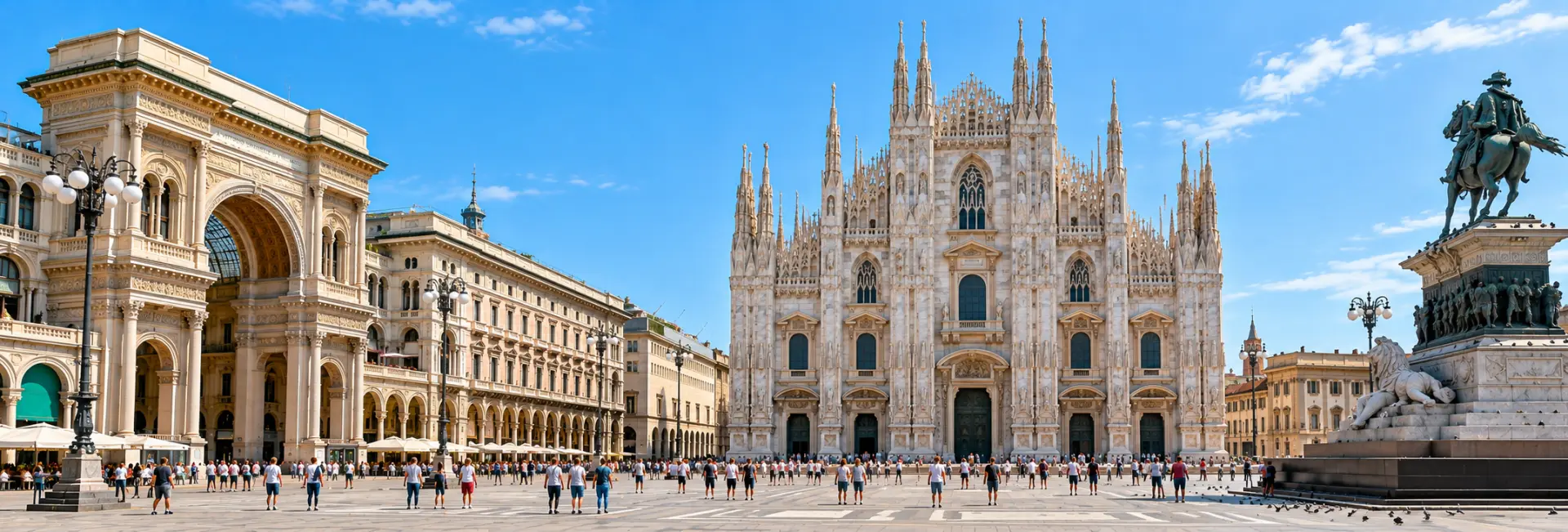
Piazza del Duomo is the central square of Milan and one of the most visited public spaces in Italy, anchored by the vast Gothic cathedral for which it is named. Rectangular in shape, largely pedestrianized, and covering roughly 17,000 square meters, it functions as the city's civic and geographic heart, where locals cut through on their daily commute and visitors gather beneath the cathedral's marble spires.
Beyond the cathedral itself, the piazza is ringed by some of Milan's most recognizable buildings: an elegant glass-roofed shopping arcade, a former royal palace, and a museum devoted to twentieth-century Italian art. Together they turn the square into as much an open-air architecture lesson as a meeting point, and it remains the natural starting spot for exploring the rest of the city's historic center.
Milanese residents often refer to the piazza as the city's "living room," a reflection of how much everyday life passes through it. It doubles as a stage for public life beyond sightseeing: political rallies, sports victory celebrations, open-air concerts and seasonal festivals have all filled the square over the decades, and its scale means it can absorb enormous crowds without losing its sense of order.
History
Origins
Piazza del Duomo traces its identity back to around 1330, when a cluster of taverns surrounding the city's main churches was cleared to make way for an open civic space known as Piazza dell'Arengario. The square began taking on a more defined shape in 1386, the year construction started on the cathedral that would eventually give it both its name and its skyline.
The project was championed by Azzone Visconti, the ruler of Milan at the time, whose vision for a grand civic space in front of the growing cathedral set a template that later generations of planners and architects would keep returning to over the following centuries. The cathedral's construction was later pushed forward in earnest under Gian Galeazzo Visconti, who committed substantial resources to the project and helped set it on the long path toward completion.
From Medieval Square to Royal Redesign
The piazza kept evolving well beyond its medieval origins. In the late eighteenth century, architect Giuseppe Piermarini transformed the old arengario building into what became the Royal Palace, and in doing so inadvertently created a second, smaller open space beside the main square, widening the overall public area. In the nineteenth century, Austrian emperor Ferdinand I commissioned architect Giulio Beccaria to redesign the piazza again; his most lasting contribution was the palace built to house the Veneranda Fabbrica del Duomo, the historic body responsible for maintaining the cathedral, a role it still performs today.
The Mengoni Plan
The piazza's modern layout dates to the years following the Second Italian War of Independence in 1859. In 1860, city authorities announced plans for a sweeping redesign of the square and a new avenue honoring King Victor Emmanuel II, triggering a series of architectural competitions. The winning plan, by architect Giuseppe Mengoni, reshaped nearly every building around the square except the cathedral and the Royal Palace, and by 1873 the piazza had essentially reached the form visitors recognize today. Mengoni's best-known addition, the glass-roofed Galleria Vittorio Emanuele II, remains one of the square's signature features, though he did not live to see it fully celebrated, having died after a fall from scaffolding at the site shortly before its official opening.
The square's ensemble of buildings kept filling in well into the twentieth century. The Palazzo dell'Arengario on the southern side, for instance, was built in stages between the 1930s and the years after the Second World War, completing the monumental frame that Mengoni's nineteenth-century plan had first sketched out.
Architecture & Notable Buildings
The Duomo
Dominating the square is the Duomo di Milano, a Gothic cathedral whose construction stretched across nearly six centuries, layering a mix of styles onto a single building. Its facade bristles with more than a hundred spires and thousands of individual statues, and at the very top of the tallest spire stands a gilded copper statue of the Madonna, known locally as the Madonnina, long treated as a symbolic guardian of the city. Its rooftop terraces offer sweeping views over the piazza, the city, and, on clear days, the Alps in the distance.
Palazzo Reale
Facing the cathedral is the Palazzo Reale, once the residence of Milan's rulers and today a major exhibition venue. Its current neoclassical appearance owes much to Giuseppe Piermarini's eighteenth-century remodeling, which converted an older civic building into a proper royal residence. The palace regularly hosts large touring exhibitions of international art, drawing a steady stream of visitors independent of the piazza's other attractions.
Palazzo dell'Arengario
On the square's southern side stands the Palazzo dell'Arengario, a pair of buildings whose name recalls the medieval tradition of addressing the public from a balcony. It now houses the Museo del Novecento, a collection devoted to Italian art from the twentieth century, arranged along a spiraling ramp that offers its own unusual views back out over the piazza and the cathedral through floor-to-ceiling windows.
Galleria Vittorio Emanuele II
Opening off the square's northern side, the Galleria Vittorio Emanuele II is often described as one of the world's oldest active shopping arcades. Built between 1865 and 1877 to Giuseppe Mengoni's design, it consists of two glass-roofed arcades crossing beneath a central octagonal dome, with mosaic floor panels representing the coats of arms of Turin, Florence and Rome.
- Lined with luxury boutiques, historic cafés and restaurants
- A long-standing meeting point for Milanese locals, not just tourists
- Connects Piazza del Duomo to Piazza della Scala, home to the Teatro alla Scala opera house
A well-known local tradition involves the mosaic of a bull set into the floor beneath the central dome, part of the coat of arms of Turin. Visitors and locals alike spin on one heel over the bull's groin for good luck, a habit that has worn a small hollow into the stonework over the decades.
Monuments & Points of Interest
At the center of the square stands a bronze equestrian statue of King Victor Emmanuel II, sculpted by Ercole Rosa and unveiled in 1896. It depicts the king reining in his horse and remains the piazza's most prominent standalone monument.
The square is also served directly by the Duomo metro station, whose several entrances open onto the piazza, making it one of the easiest points in Milan to reach by public transport. A more recent, and locally debated, addition is a row of palm trees planted opposite the cathedral in 2017, which some residents still consider an unusual fit for Milan's classic streetscape.
Ways to Experience It
- Climb to the Duomo's rooftop terraces for panoramic views over the piazza and the city skyline
- Walk through the Galleria Vittorio Emanuele II to browse its boutiques and pause at a historic café
- Visit the Museo del Novecento in the Palazzo dell'Arengario for a look at Italian art since 1900
- Check the current exhibition schedule at Palazzo Reale, which regularly hosts major art shows
- Join a walking tour that starts or ends at the piazza, since most of central Milan's historic core radiates outward from this point
- Head up to the rooftop terrace of the La Rinascente department store, just off the square, for a free eye-level view of the Duomo's spires
- Book a guided tour of the cathedral's underground archaeological area, where remains of an earlier basilica and baptistery are still visible
Best Time to Visit
The piazza is open around the clock and never technically closes, but it's busiest around midday and in the early evening, when tourists and commuters cross paths. Arriving shortly after sunrise gives the clearest view of the cathedral's facade without crowds, while an evening visit lets the marble catch the last light as the square's cafés fill up.
Seasonally, spring and early autumn bring comfortable temperatures for lingering outdoors, while summer afternoons can get hot with little shade across the open stone surface. In December, the square hosts Christmas markets and festive lighting, and on New Year's Eve it becomes one of the city's main gathering points for celebrations. Weekday mornings outside of peak summer months tend to be the calmest overall, since large tour groups typically arrive from mid-morning onward.
Visitor Tips
- Modest dress, with shoulders and knees covered, is required to enter the Duomo cathedral
- Book Duomo rooftop tickets online in advance to skip long ticket-line waits, especially in summer
- Watch for unofficial vendors and unsolicited "helpers" near the cathedral steps offering bracelets or bird feed
- The square itself is flat and easy to navigate; the Duomo's rooftop is more accessible by elevator than by the stairs for visitors with mobility needs
- Photographers get the clearest, least crowded shots of the facade early in the morning before tour groups arrive
- Keep valuables secure and stay alert for pickpockets in the densest crowds near the cathedral entrance and metro exits
- Security screening is required before entering the cathedral, so arrive a little early if visiting at a busy time
Nearby Attractions
- Galleria Vittorio Emanuele II and Piazza della Scala, home to the Teatro alla Scala opera house
- Museo del Novecento and the Palazzo Reale's temporary exhibitions, both directly on the square
- The Quadrilatero della Moda, Milan's fashion shopping district, a short walk northeast
- Sforza Castle and its museums, roughly a fifteen-minute walk away
- The Duomo Museum, dedicated to the cathedral's construction and artwork, located just off the square
- La Rinascente, a historic department store with a rooftop terrace and dining options overlooking the Duomo
FAQs about visiting Piazza del Duomo
What is Piazza del Duomo known for? +
It's Milan's main square, built around the city's Gothic cathedral and framed by landmark buildings including the Galleria Vittorio Emanuele II, the Palazzo Reale and the Museo del Novecento.
Is Piazza del Duomo free to visit? +
Yes, the square itself is open to the public at all times and free to enter; only specific attractions around it, such as the cathedral's rooftop or museum exhibitions, require paid tickets.
How much time should I spend at Piazza del Duomo? +
Seeing the square itself takes about 30 minutes, but most visitors spend two to three hours in the area once a cathedral visit, a walk through the Galleria and a stop at a nearby museum are added in.
What is the best time of day to visit? +
Early morning offers the quietest views of the cathedral facade, while late afternoon and evening bring a livelier atmosphere as cafés and the Galleria fill up.
How do I get to Piazza del Duomo? +
The Duomo metro station opens directly onto the square, with several entrances, making it one of the most straightforward stops to reach on Milan's subway network.
Is Piazza del Duomo suitable for visiting with kids or elderly relatives? +
Yes, the square is flat, pedestrianized and easy to navigate, and the cathedral rooftop can be reached by elevator rather than stairs for visitors who prefer not to climb.
What should I avoid when visiting? +
Be cautious of unofficial vendors near the cathedral steps offering bracelets, bird feed or unsolicited photos, since these often come with an aggressive request for payment afterward.
Can I combine a visit with other Milan landmarks? +
Yes, the Galleria Vittorio Emanuele II leads directly to Piazza della Scala and the opera house, and the fashion district and Sforza Castle are both within easy walking distance.
