
Table of Contents
Overview
The Navigli district takes its name from the navigli, or canals, that once threaded through central Milan, and today it refers to the area around the Darsena, the city's old inland port, and the two open waterways that still flow from it: the Naviglio Grande and the Naviglio Pavese. It is one of the few parts of Milan where the city's watery, pre-industrial past is still visible above ground rather than buried under asphalt.
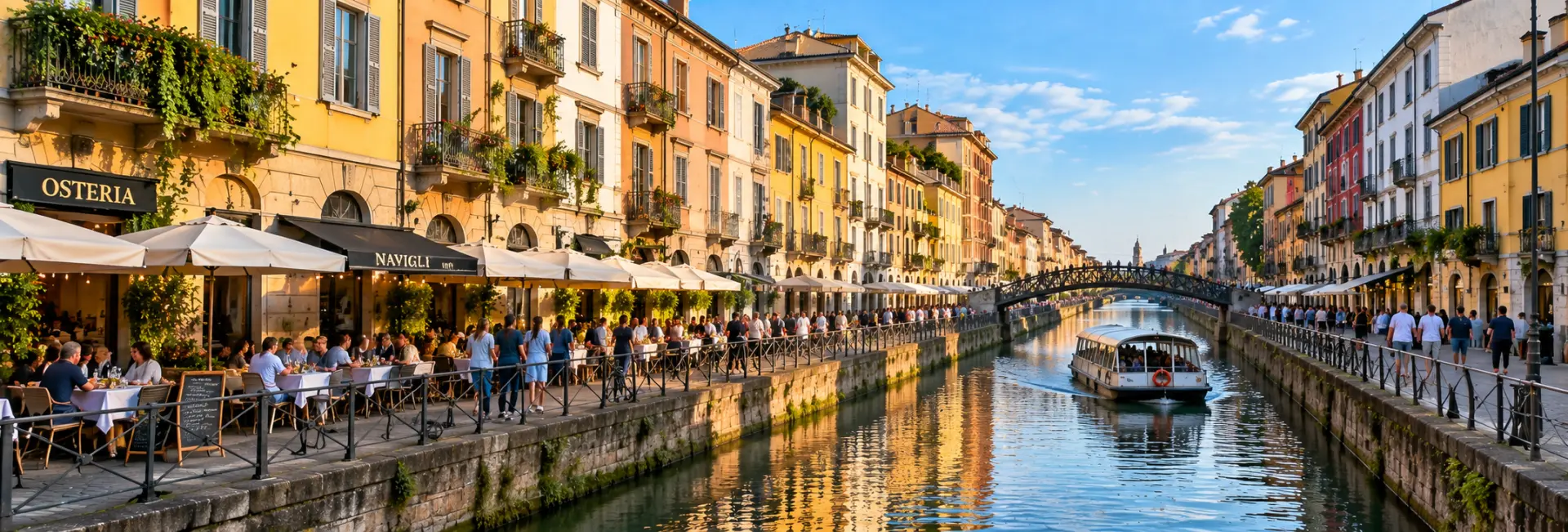
By day, the district has a relaxed, small-town feel, with canal-side walks, antique and vintage shops, and artists' studios tucked into old workshop buildings. By night, it becomes one of Milan's busiest destinations for aperitivo and dining, with bars and restaurants lining both banks of the canals and the Darsena's redeveloped waterfront.
Once a working port that moved marble, coal, and grain into the city, the Navigli today draws visitors for a very different reason: an evening spent walking along the water, canal-side glass in hand, watching the light change on the old buildings opposite. It is one of the few Milan neighbourhoods that feels distinctly different in mood between morning and night, and many visitors choose to experience both.
History
Medieval Origins
Milan's canal system began in the twelfth century, when a moat was widened into the city's first navigable waterway, the Ticinello, inaugurated in 1179 and later extended and renamed the Naviglio Grande. Reaching the city by 1209 and extended to a small lake near the church of Sant'Eustorgio, on the site of today's Darsena, by 1270, it became one of Europe's earliest large-scale navigable canals, linking Milan to Lake Maggiore and, beyond it, to Switzerland. A second major canal, the Naviglio della Martesana, was added to the north of the city in the following centuries, completing a network that connected Milan to the Ticino and Adda rivers. Between 1439 and 1475, engineers extended the wider provincial network to roughly ninety kilometres of navigable canals, an unusually fast pace of construction for the period.
Leonardo da Vinci and the Locks
Milan's uneven terrain meant that boats travelling into the city had to be raised and lowered between different water levels, and it is this problem that drew Leonardo da Vinci's attention during his years at the Sforza court in the late fifteenth century. Leonardo studied and refined the design of the canal locks used to manage these changes in level, and in return for his involvement in the system's maintenance he was granted rights to a share of irrigation water from the network, a privilege recorded in historical documents of the period. Traces of the lock system he studied, including the Incoronata lock on the former Martesana canal, can still be seen in parts of the city today.
From Working Port to Covered Streets to District
For centuries the canals were central to Milan's economy, carrying goods including the marble used to build the city's cathedral, along with coal, wine, grain, and other everyday cargo, and by the seventeenth century they also carried passengers on regular boat services. The rise of rail and tram transport in the late nineteenth century made the slow-moving canal traffic increasingly redundant, and from 1929 onward much of the inner-city canal network, including the historic ring known as the Cerchia dei Navigli, was progressively covered over and turned into ordinary streets; some of Milan's suspiciously wide, straight avenues today still trace the paths of canals that once ran beneath them. Only the stretches of the Naviglio Grande and Naviglio Pavese around the Darsena survived in the open, forming the district known today. The Darsena itself underwent a major redevelopment ahead of Milan's 2015 Expo, which restored water quality, reopened a short covered stretch of canal, and rebuilt its banks into the public waterfront visitors see now.
Streetscape & Architecture
The district's most distinctive residential buildings are the case di ringhiera, tenement-style apartment blocks built around a central courtyard with long open balconies, or ringhiere, running along each floor and once used as shared access corridors. Many of these older buildings, along with former workshops and small industrial spaces once used by artisans and boatmen, have been converted into galleries, studios, and bars while keeping their original brick and timber structure visible.
Small bridges cross the canals at regular intervals, and narrow lanes lead off the main canal-side streets into quieter courtyards, giving the district a layered, village-like feel that is unusual within central Milan's denser grid. The Darsena's rebuilt waterfront, with its wide paved banks and public seating, offers a more modern contrast to the older canal-side streets nearby, and the mix of old brick facades against newer landscaping is part of what gives the area its particular character.
Key Areas
- The Darsena, once Milan's river port and now a redeveloped public waterfront at the meeting point of the two open canals, anchors the district and hosts markets, events, and a popular evening promenade.
- The Naviglio Grande, Europe's oldest large navigable canal, runs southwest from the Darsena and is lined with the district's densest concentration of restaurants, antique shops, and bars.
- The Naviglio Pavese runs southeast from the Darsena toward Pavia and has a somewhat quieter, more local atmosphere than its larger counterpart, though it fills with its own crowd of bars and diners in the evening.
- Ripa di Porta Ticinese, the street running alongside the Naviglio Grande, has been singled out in international travel coverage as one of Europe's most attractive streets for a walk.
- Porta Ticinese, the historic gate marking the start of the district near the Darsena, gives its name to the surrounding streets and is itself worth a brief stop for anyone arriving from the city centre.
Ways to Experience It
- Walking the canal banks, particularly along the Naviglio Grande from the Darsena outward, is the simplest and most popular way to take in the district.
- An evening aperitivo at one of the many bars along the water is close to a local tradition here, with outdoor tables filling up as the sun goes down.
- On the last Sunday of each month, the Naviglio Grande hosts a large antique market, with stalls selling vintage furniture, books, jewellery, and collectibles along the canal-side streets.
- Short boat trips along the Naviglio Grande are occasionally available, offering a water-level view of the district's bridges and buildings.
- The area's galleries and artisan workshops, many tucked into converted courtyards just off the main canal streets, reward slower, more exploratory wandering.
- Live music venues and small clubs, concentrated mainly around the Naviglio Pavese, extend the district's evening activity well into the night on weekends.
Best Time to Visit
Weekday afternoons offer the quietest version of the Navigli, good for photographing the canals and browsing shops without much crowd. Evenings, especially Thursday through Saturday, are when the district is at its liveliest, with bars and restaurants along both canals filling with locals and visitors for aperitivo and dinner.
The last Sunday of the month adds the antique market to the mix and draws a noticeably larger crowd than a typical weekend. Spring and early autumn evenings tend to be the most comfortable time of year for the canal-side walk that most visits are built around, while summer brings the longest and busiest evenings.
Visitor Tips
- The nearest metro stop is Porta Genova, on the green line, a short walk from the Naviglio Grande.
- Canal-side streets can get crowded on weekend evenings, so arriving earlier gives a better chance at outdoor seating.
- The district's antique market runs only on the last Sunday of the month, so it is worth checking the date in advance if that is a specific reason for visiting.
- Restaurants and bars directly on the water tend to charge more than those a block or two back, which is worth keeping in mind for a more budget-friendly visit.
- Comfortable shoes are useful, since cobblestones and uneven paving are common along the older canal-side streets.
- Public transport, including trams along the main roads bordering the district, is a reasonable alternative to the metro for reaching parts of the Navigli not directly served by Porta Genova station.
Nearby Attractions
The Navigli district sits within reach of several other central Milan sights. Sant'Ambrogio, one of Milan's most important historic basilicas, and the nearby Bocconi University area lie a short walk to the northeast, while Porta Genova and the up-and-coming Tortona design district are close by to the north, known for their studios and the Salone del Mobile design events held there.
Milan's historic centre, including the Duomo, is reachable by metro from Porta Genova in a few stops, making it easy to combine a canal-side evening with a fuller day exploring the rest of the city.
FAQs about visiting the Navigli District
What is the Navigli district known for? +
It is known for Milan's last surviving open canals, the Naviglio Grande and Naviglio Pavese, along with its evening aperitivo scene, antique shops, and a monthly antique market.
Is the Navigli area free to visit? +
Yes, walking along the canals and through the district's streets is free; visitors only pay for what they eat, drink, or buy in shops and at the market.
When is the Navigli antique market held? +
It takes place on the last Sunday of every month along the Naviglio Grande.
How do I get to the Navigli district? +
The Porta Genova metro station, on the green line, is the closest stop and puts visitors within a short walk of the Naviglio Grande and the Darsena.
What is the best time of day to visit? +
Afternoons are quieter and better for photos and shopping, while evenings, especially from Thursday to Saturday, bring the district's well-known aperitivo atmosphere to life.
Did Leonardo da Vinci really work on these canals? +
Yes, Leonardo studied and helped refine the lock system used to manage changes in water level along Milan's canals while working at the Sforza court in the late fifteenth century.
Why are some of Milan's canals no longer visible? +
Most of the city's inner canal network was covered over starting in 1929 as rail and tram transport made canal traffic obsolete; only the stretches around the Darsena, forming today's Navigli district, remained open.
What else is nearby that I can combine with a visit? +
The Basilica of Sant'Ambrogio and the Tortona design district are both a short walk away, and Milan's historic centre is a few stops from Porta Genova by metro.
