
Table of Contents
Overview
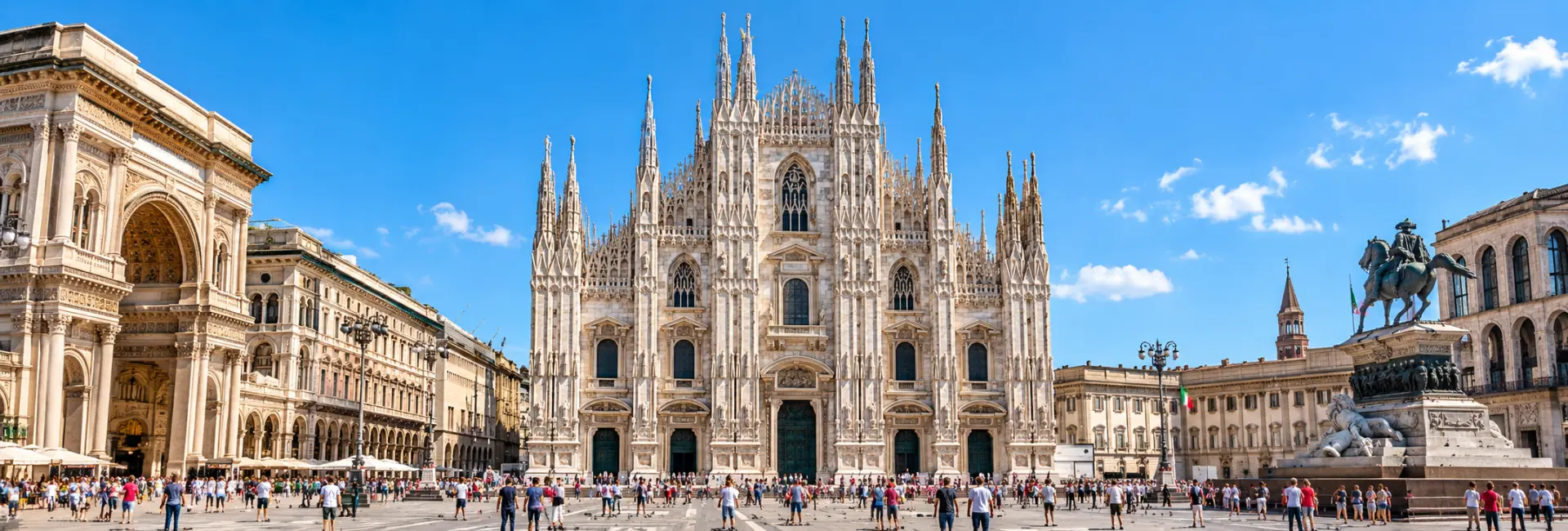
Rising from the middle of Milan's main square, the Duomo di Milano is the city's cathedral and one of the largest churches anywhere in the world. Its facade is covered in a dense forest of white and rose-tinted marble spires, pinnacles, and statues, giving the building a texture unlike any other cathedral in Italy.
Officially the Metropolitan Cathedral-Basilica of the Nativity of Saint Mary, it has served as the seat of the Archbishop of Milan for centuries and remains an active place of worship. For visitors, it functions as both a working church and one of the most rewarding buildings in Europe to explore in depth, with a museum, an underground archaeological site, and a rooftop that can be walked on foot.
Few buildings anywhere combine scale and detail so thoroughly: the footprint is large enough to hold tens of thousands of worshippers at once, yet the surfaces are carved down to the level of individual faces and folds of drapery. That contrast between sheer size and painstaking ornament is part of what makes a visit here feel different from other major European cathedrals.
History
Origins and a Duke's Ambition
Ground was broken on the cathedral in 1386 under the direction of Gian Galeazzo Visconti, the ruler of Milan, who wanted a church grand enough to rival the great cathedrals of France and Germany. The project replaced two older churches on the site and was placed under the care of a dedicated works authority, the Veneranda Fabbrica del Duomo, which still oversees the building's upkeep today.
Centuries of Slow Progress
Because the project outlived generation after generation of patrons, architects, and political rulers, its style shifted gradually over time. Builders imported white and pink-veined marble from a quarry at Candoglia reserved exclusively for the cathedral, and the work drew craftsmen from across Europe, which is part of why the building reads as Gothic overall while carrying later Renaissance and Baroque touches in places.
A Slow Finish
The tallest spire was finished in the late 1700s, and Napoleon later ordered the main facade completed in the early nineteenth century so he could be crowned King of Italy inside the building. Even so, sculptural details and the last of the bronze doors were not finished until the middle of the twentieth century, closing out a construction period of nearly six hundred years.
That timeline is long enough that it entered the local language: Milanese still describe any project that seems to drag on forever as being like the "fabbrica del Duomo," a nod to the works authority that has managed the cathedral's construction and, later, its restoration, since the fourteenth century.
Architecture & Design
The cathedral is built almost entirely in the International Gothic style, defined by soaring verticals, pointed arches, and elaborate stonework rather than the smoother classical lines common elsewhere in Italy. More than three thousand statues, well over a hundred gargoyles, and thousands of individual pinnacles cover the exterior, making it one of the most heavily sculpted buildings anywhere.
Inside the Nave
Inside, five long aisles are divided by rows of massive pillars topped with carved canopies, leading the eye toward a high altar lit by tall stained-glass windows. The floor is laid out in an inlaid pattern of light and dark marble that echoes the geometry of the columns above it.
The Facade
Because the main facade was not finished until Napoleon's era, it mixes late Gothic window tracery with Renaissance and neoclassical elements added centuries after the rest of the building was underway. Looking across the facade from left to right is, in effect, a walk through several hundred years of changing European taste applied to a single wall.
The Roofline
Unlike many cathedrals where visitors only glimpse the roof from a distant balcony, the Duomo's roof is flat enough near the nave to walk across, placing guests directly among the spires and statues. At the summit of the tallest spire stands a gilded copper statue of the Virgin Mary, known locally as the Madonnina, which by long-standing custom is meant to remain the highest point in the city.
Cultural & Religious Significance
The Duomo functions as the spiritual heart of Milan far more than as a museum piece. Regular Mass, feast-day services, and diocesan ceremonies continue inside a building that has hosted coronations, state funerals, and public gatherings across several centuries of Italian history.
For Milanese residents, the cathedral and its golden Madonnina have become symbols of civic identity as much as religious ones. The statue is treated with genuine local affection, and when a modern skyscraper was built tall enough to surpass the cathedral's height, a smaller replica of the Madonnina was placed on top of it purely to preserve the tradition that she remains the city's highest figure.
Notable Features
Beyond its scale, the cathedral holds a number of specific details that reward a closer look.
- The Holy Nail, a relic believed by tradition to be one of the nails from the crucifixion, is kept in a niche high above the altar and marked by a small red light visible from the floor.
- Each September, the Archbishop is raised on a decorated lift called the Nivola to retrieve the nail for public veneration, a ceremony rooted in a sixteenth-century plague-era procession.
- A brass sundial line set into the nave floor dates to the eighteenth century, when astronomers used it to calculate true solar noon for the whole city.
- A statue of Saint Bartholomew, carved so that his flayed skin appears draped over his shoulders like a cloak, is one of the interior's most striking sculptures.
- The stained-glass windows lining the nave rank among the largest in any church in the world and were assembled over several centuries in different styles.
- A carved marble candelabrum from the late twelfth century, older than the cathedral itself, was brought into the building and still stands in one of the side aisles.
Ways to Experience It
Visitors can choose how deep to go into the complex depending on the ticket they book, since the cathedral interior, rooftop terraces, museum, baptistery, and archaeological area are ticketed both separately and as combined passes.
- Walking the cathedral floor to see the nave, altar, sundial, and stained glass at ground level.
- Climbing the rooftop terraces by stairs or lift to walk among the spires with views over the city and, on clear days, the Alps.
- Descending into the archaeological area beneath the square, where remains of an early baptistery and earlier churches on the site are on display.
- Visiting the Duomo Museum next door, which holds original statues, stained glass, and tapestries removed from the building over the centuries.
- Booking a guided tour for context on the construction history, symbolism, and hidden details that are easy to miss on a self-guided visit.
- Combining a rooftop pass with the museum and archaeological area on a single ticket, which several providers allow to be used across more than one day rather than requiring everything to be done in one visit.
Visiting Etiquette & Tips
As an active place of worship, the Duomo enforces a dress code: shoulders and knees need to be covered, and clothing such as tank tops, shorts, or short skirts can lead to being turned away at the door.
- Large bags, luggage, and umbrellas are generally not permitted inside and may need to be left behind.
- Booking tickets online in advance is strongly recommended, since queues at the ticket office can run long, especially in peak season.
- Wheelchair access to the rooftop is limited to the lower terrace, reached via a dedicated elevator during set hours, so travelers with mobility needs should check current arrangements before visiting.
- Photography is generally allowed inside, but flash and tripods are typically discouraged out of respect for the space and other visitors.
Best Time to Visit
Arriving right when the cathedral opens or later in the afternoon tends to mean thinner crowds than the busy midday hours, when tour groups fill the square and the ticket lines. Weekday visits are generally calmer than weekends, particularly outside the summer travel season.
For the rooftop terraces, a clear morning offers the best chance of distant Alpine views, while a visit closer to sunset gives softer light for photographs across the spires and the city skyline. Winter visits are quieter overall, though shorter daylight hours narrow the window for the best rooftop light.
Major religious dates, such as the September rite involving the Holy Nail, draw larger local crowds into the cathedral itself, so travelers mainly interested in a quiet, uncrowded interior may prefer to avoid scheduling a visit around those specific days, while those curious about local tradition may want to time a trip around them on purpose.
Nearby Attractions
The Duomo sits at the center of a compact cluster of Milan's best-known sights, making it easy to combine with a short walk in almost any direction.
- Galleria Vittorio Emanuele II, an ornate nineteenth-century glass-roofed shopping arcade, opens directly onto the cathedral square.
- Teatro alla Scala, Milan's famed opera house, is a short walk through the Galleria from the Duomo.
- Museo del Novecento, a museum of twentieth-century Italian art, overlooks the square from a building beside the cathedral.
- Sforza Castle, a large Renaissance-era fortress with several museums inside, lies within easy walking distance to the northwest.
FAQs about visiting the Duomo di Milano
What is the Duomo di Milano famous for? +
It is famous for being one of the largest Gothic cathedrals in the world, covered in thousands of statues and spires and topped by the golden Madonnina statue, and for having taken nearly six centuries to build.
How much time should I set aside for a visit? +
Plan on roughly one and a half to two hours for the cathedral interior and rooftop terraces together, and longer if you also want to see the museum, baptistery, and archaeological area.
Do I need to buy a ticket, or is it free to enter? +
Basic entry to the cathedral interior is normally ticketed, and separate or combined tickets are needed for the rooftop terraces, museum, baptistery, and archaeological area, so it's worth deciding in advance which parts you want to see.
Is the rooftop worth the extra ticket? +
Most visitors find it worthwhile, since it's one of the few cathedral roofs in the world that can be walked on foot at close range to the spires and statues, with wide views over Milan on a clear day.
Is there a dress code? +
Yes, shoulders and knees must be covered to enter, since it remains an active church, and overly casual clothing such as tank tops or short shorts can result in being denied entry.
Is the Duomo suitable for visitors with limited mobility? +
The cathedral interior is accessible, and a dedicated elevator can reach the lower rooftop terrace during set hours, though full rooftop access on foot involves stairs and uneven surfaces.
What else is nearby that I can combine with a visit? +
The Galleria Vittorio Emanuele II shopping arcade opens directly onto the square, and Teatro alla Scala, Museo del Novecento, and Sforza Castle are all within easy walking distance.
When is the best time of day to visit? +
Early morning right after opening or the hour or two before closing tend to be quieter than midday, and a visit closer to sunset offers softer light for photos from the rooftop terraces.
