
Table of Contents
Overview
The Basilica di Sant'Ambrogio is one of the oldest churches in Milan and, after the Duomo, generally considered the city's second most important place of worship. Built in the late fourth century at the direction of Bishop Ambrose, it stands as a rare survivor of early Christian Milan, still functioning as an active parish and pilgrimage site more than sixteen centuries after its foundation.
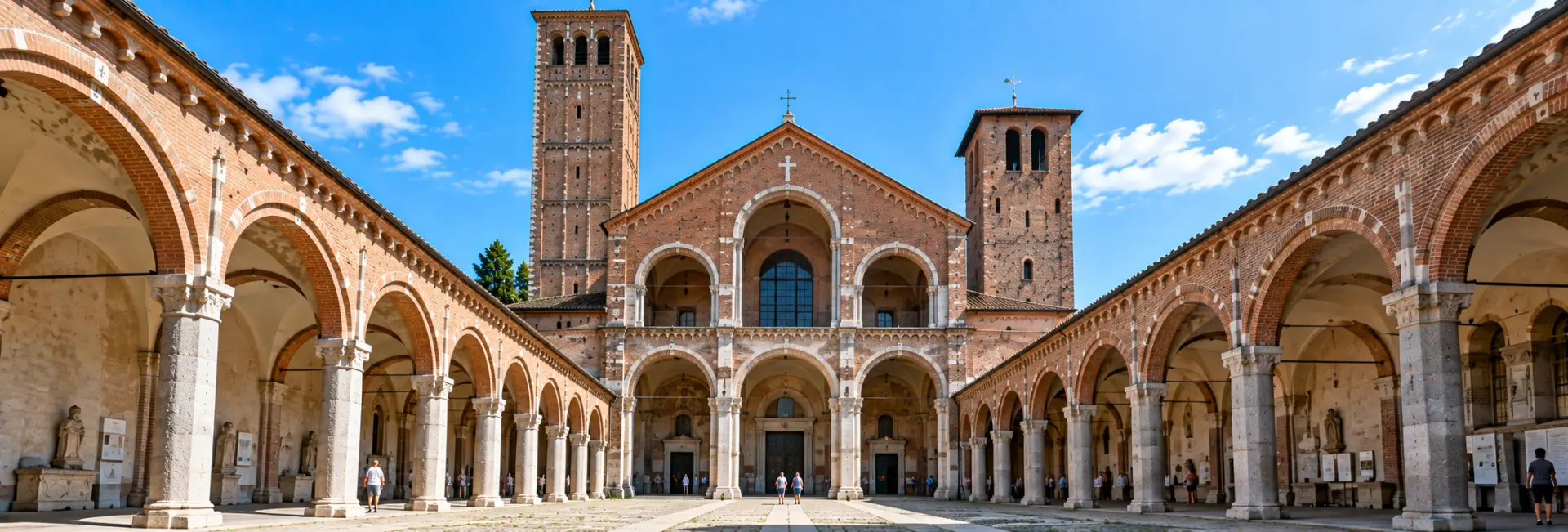
Its brick facade and enclosed atrium give it a much quieter presence than the Duomo's soaring marble spires, but the basilica rewards a closer look: inside are a glittering Carolingian gold altar, an early medieval mosaic ceiling, and the crypt where the remains of Saint Ambrose himself rest alongside two Roman martyrs. For visitors interested in Milan's history before it became a fashion and finance capital, this is arguably the single most important building in the city.
The basilica also gave its name to an entire architectural tradition. Because it was built and rebuilt using techniques that later spread across northern Italy, art historians often cite Sant'Ambrogio as a reference point for Lombard Romanesque architecture as a whole, making it a stop of genuine significance for anyone interested in medieval European building styles, not only Milanese history.
History
Foundation by Saint Ambrose
The basilica was built between 379 and 386 on the order of Bishop Ambrose of Milan, in a site where Christians martyred during the Roman persecutions had previously been buried. It was originally known as the Basilica Martyrum in honor of these martyrs, and Ambrose intended it to house the relics of several of them, including Gervasius and Protasius. When Ambrose himself died in 397, he was buried in the church next to the two martyrs, and the building was eventually renamed in his honor.
Carolingian and Ottonian Additions
In the ninth century, Bishop Angilberto II expanded the church significantly, adding the raised apse that still defines the sanctuary today. Under his patronage, master goldsmith Vuolvino created the basilica's celebrated golden altar between roughly 824 and 859, and the apse was decorated with a large mosaic that has survived largely intact. A century later, during the Ottonian period, the altar's protective canopy was completed with decorative stucco gables that remain in excellent condition.
Romanesque Rebuilding
The basilica took on its current appearance during a major eleventh and twelfth-century reconstruction in the Romanesque style, which gave the building its now-iconic brick facade, covered atrium and cross-vaulted naves. During the medieval period, the church also served a civic role: nine kings of Italy were crowned within its walls between the ninth and fifteenth centuries, reflecting its standing as one of the most important religious sites in northern Italy.
Renaissance Contributions and Later Setbacks
The monastery attached to the basilica passed from Benedictine to Cistercian control at the end of the fifteenth century, a transition that brought the architect Donato Bramante to the site to design new monastic buildings, chapels and a rectory. The basilica's fortunes dimmed during the economic difficulties of the seventeenth century, and religious activity was further disrupted during the Napoleonic era, when secularizing policies forced many Italian churches to close temporarily. Normal worship resumed only after the political Restoration that followed. The basilica was formally elevated to the status of minor basilica in 1874. In the twentieth century, Allied bombing partially destroyed parts of the complex in 1943, and the damaged sections were rebuilt during the 1950s.
Despite these interruptions, the basilica's core structure and its most treasured furnishings, the golden altar, the apse mosaic and the ancient crypt, survived largely intact, which is part of why the site still feels so continuous with its early medieval origins rather than like a modern reconstruction dressed up as something older.
Architecture & Design
Sant'Ambrogio is considered one of the finest surviving examples of Lombard Romanesque architecture, built from simple, honest materials, brick, stone and plaster, in a palette dominated by warm red and white tones. Visitors enter through a quadrangular atrium enclosed by arcaded porticoes on all four sides, a design that echoes the structure of the basilica itself and was originally used to shelter pilgrims and catechumens before they entered the church proper.
Facade and Towers
The brick facade is arranged as a pitched gable topped by two tiers of open loggias, flanked by a pair of distinct bell towers of different ages. The older, plainer tower belonged to the monks and dates to around the ninth or tenth century, while the taller, more richly decorated Canons' Tower was completed in 1181.
Interior Layout
Inside, the basilica follows a three-nave longitudinal plan, each nave ending in its own apse, with heavy cross-vaults overhead that were themselves innovative for the period. Light filters in through the tall windows of the facade, illuminating capitals carved with biblical and symbolic scenes, including depictions of the Adoration of the Magi and the labors of Adam and Eve.
The Apse Mosaic
Above the sanctuary, the ninth-century apse mosaic depicts Christ enthroned between the martyrs Gervasius and Protasius, flanked by the archangels Michael and Gabriel, with two smaller scenes recounting episodes from the life of Ambrose himself. Despite later restorations, the mosaic retains its early medieval character and remains one of the basilica's most studied artistic features.
Cultural & Religious Significance
As the church founded by Milan's patron saint, Sant'Ambrogio occupies a central place in the religious identity of the city and in the distinct Ambrosian Rite still practiced across the Milan archdiocese, a liturgical tradition that differs in various ways from the Roman Rite used in most of the rest of the Catholic world. The basilica's role as the burial place of Ambrose himself has made it a site of continuous pilgrimage since the fourth century.
The feast of Sant'Ambrogio, celebrated every year on 7 December, remains one of Milan's most important civic and religious dates. It marks the traditional start of the city's Christmas season and coincides with the Oh bej! Oh bej! street fair, a centuries-old market that fills the streets around the basilica with stalls, food and crowds each year.
The basilica has also long been tied to civic ceremony as much as religious life. Its historic role in crowning medieval Italian kings, and its continued use for major state and city commemorations, reflects a status that goes beyond that of an ordinary parish church, placing it alongside the Duomo as one of the two buildings most closely identified with Milan's own sense of identity.
Notable Features
The Golden Altar
At the heart of the basilica stands the Altare d'Oro, a masterpiece of Carolingian goldsmithing crafted from gold, silver, gemstones and enamel panels. Housed beneath an ornate ciborium whose four gabled sides carry finely preserved tenth-century stucco work, the altar is widely regarded as one of the finest surviving examples of early medieval metalwork in Europe.
The Crypt
Below the raised sanctuary, a tenth-century crypt holds the remains of Saint Ambrose, displayed alongside those of the martyrs Gervasius and Protasius, whose original burial nearby gave the site its founding purpose.
Sacello di San Vittore in Ciel d'Oro
Adjoining the main basilica is a small, separately built chapel known as the Sacello di San Vittore in Ciel d'Oro, constructed in the fourth century to hold the remains of Ambrose's brother Satyrus and of Saint Victor. Its dome preserves a fifth-century gold-ground mosaic that includes what scholars consider the oldest surviving portrait of Ambrose, created within living memory of the saint's own lifetime.
The Devil's Column
Standing alone in the small square to the side of the basilica is an ancient Roman column known locally as the Colonna del Diavolo, or Devil's Column. According to a long-standing local legend, two holes near its top were left by the devil's horns during a confrontation with Ambrose, and Milanese tradition holds that pressing an ear to the holes lets you hear faint, unsettling sounds rising from below.
Visiting Etiquette & Tips
- Modest dress covering shoulders and knees is expected, as in any active Catholic church
- Keep voices low and avoid visiting during Mass unless attending as a worshipper
- Photography without flash is generally permitted in the main basilica, though it may be restricted in the Sacello di San Vittore due to the fragility of the ancient mosaics
- Entry to the basilica itself is free, though a small fee may apply for access to specific areas such as the museum or restricted chapels
- A guide or audio guide adds real value here, since many of the basilica's most interesting details, from carved capitals to the mosaic's iconography, are easy to miss without context
Best Time to Visit
The basilica keeps different hours on weekdays and Sundays, opening in the morning and again in the afternoon with a midday break, so it's worth checking the current schedule before planning a visit around specific opening times. Weekday mornings tend to be the quietest, especially outside of the peak summer tourist season, while weekends can bring larger crowds of both visitors and worshippers.
Visiting around 7 December, the feast of Sant'Ambrogio, offers a distinctive atmosphere, with the basilica at the center of the city's Christmas season celebrations and the historic Oh bej! Oh bej! fair filling the surrounding streets, though this is also when the area is at its most crowded.
Nearby Attractions
- Università Cattolica del Sacro Cuore, whose campus incorporates cloisters from the basilica's former monastery
- The Sacrario dei Caduti, a memorial to Milan's war dead built directly behind the basilica in the early 1930s
- Castello Sforzesco and its museums, within comfortable walking distance
- The Navigli canal district, known for its restaurants, bars and evening atmosphere
FAQs about visiting the Basilica di Sant'Ambrogio
What is the Basilica di Sant'Ambrogio known for? +
It's one of Milan's oldest churches, founded by the city's patron saint in the fourth century and celebrated for its Carolingian golden altar, ancient crypt and well-preserved Romanesque architecture.
Is the Basilica di Sant'Ambrogio free to visit? +
Yes, entry to the main basilica is free, though certain areas, such as the small museum or specific chapels, may charge a modest fee.
How much time should I plan for a visit? +
Most visitors spend around 30 to 45 minutes inside, longer if joining a guided tour that covers the crypt, the golden altar and the Sacello di San Vittore in Ciel d'Oro in detail.
Where is Saint Ambrose buried? +
His remains rest in the basilica's crypt, alongside those of the martyrs Gervasius and Protasius, and can be viewed by visitors.
What is the Devil's Column? +
It's an ancient Roman column standing beside the basilica, tied to a local legend that two holes near its top were left by the devil's horns during a confrontation with Saint Ambrose.
How do I get to the Basilica di Sant'Ambrogio? +
The basilica is served by its own metro stop on line M2, making it one of the more straightforward historic sites in Milan to reach by public transport.
Is the basilica still an active church? +
Yes, it functions as a working parish church following the distinct Ambrosian Rite used across the Milan archdiocese, so visitors should be mindful of Mass times and ongoing services.
What else is nearby worth seeing? +
The Università Cattolica campus, built partly around the basilica's old monastic cloisters, and the Sacrario dei Caduti war memorial just behind the church are both worth combining with a visit.
