
Table of Contents
Overview
The Pinacoteca di Brera is Milan's principal public art gallery and one of Italy's most important museums of painting, housed within the historic Palazzo Brera in the heart of the city's artists' quarter. Its collection runs from the thirteenth century through to the twentieth, with its greatest strength in the Italian Renaissance, and includes works considered among the defining paintings of that period.
Unlike museums built around a single private collection, Brera's holdings grew out of a deliberate state policy: works confiscated from churches, convents, and religious houses across northern Italy in the early nineteenth century were brought together here to form a public teaching and display collection, which gives the gallery its distinctive concentration of large religious altarpieces alongside later secular and modern works.
The gallery shares its building with the Brera Academy of Fine Arts, and since December 2024 has expanded into the neighbouring Palazzo Citterio, adding modern and contemporary art to a visit that was previously focused almost entirely on painting from earlier centuries. Visitors sometimes underestimate how much ground the collection covers, and even those focused on a handful of famous names tend to find themselves slowing down in rooms they hadn't planned to spend time in.
History of the Museum
An Academic Collection
A first collection of paintings existed at Palazzo Brera from 1776, assembled for educational purposes alongside the newly founded Academy of Fine Arts, which the Austrian Empress Maria Theresa had established so that students could study important works up close. This early collection was modest and heterogeneous compared to what followed.
Napoleon and the Public Museum
The Pinacoteca as a public museum in its own right was officially established in 1809, under Napoleon Bonaparte, once Milan had become capital of the Napoleonic Kingdom of Italy. Rather than beginning as a prince's private collection, as many of Italy's other major galleries did, Brera was built from the outset as a state institution, intended to display paintings gathered from across the territories under French control. Works seized from suppressed religious houses throughout Lombardy and beyond poured into the museum in these years, explaining why the collection today is still dominated by large-scale religious paintings and altarpieces, a character that distinguishes Brera from museums built around a single collector's taste.
Modern Governance and the Grande Brera Project
The Pinacoteca was managed for much of the twentieth century as part of Italy's regional heritage administration before a 2014 reform granted it status as an autonomous state museum with its own budget and leadership. In December 2024, a long-planned expansion known as the Grande Brera project reached a major milestone with the opening of the neighbouring Palazzo Citterio, purchased by the state decades earlier and finally converted into exhibition space for twentieth-century collections that had previously had nowhere to be shown.
Architecture & Building
The Pinacoteca occupies part of Palazzo Brera, a large complex that began as a religious college before being rebuilt in the seventeenth century under the architect Francesco Maria Richini, following the suppression of the Jesuit order that had previously run it. Later additions were overseen by the neoclassical architect Giuseppe Piermarini, who was also appointed a professor at the newly founded Academy.
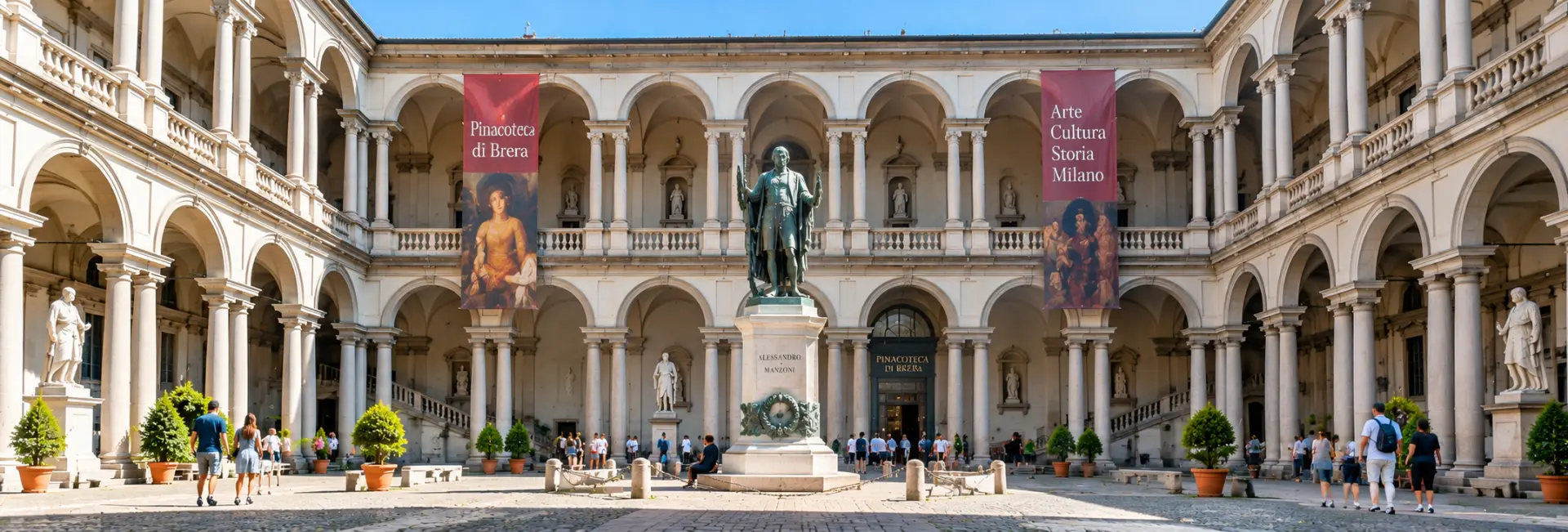
At the centre of the building's main courtyard stands a bronze statue of Napoleon, depicted in classical style as Mars the Peacemaker, sculpted by Antonio Canova in the early nineteenth century. The courtyard itself is freely accessible without a museum ticket, giving visitors a look at the building's grand proportions even before entering the galleries. Inside, the picture gallery is arranged across a sequence of rooms, roughly forty in total, that lead visitors chronologically through the collection, with the museum's longest axis deliberately arranged so that two of its most important paintings face one another across the central rooms.
Collections & Exhibits
The Pinacoteca's collection is organised broadly by school and period, moving from early Italian religious painting through the Renaissance and into later Venetian, Baroque, and nineteenth and twentieth-century work.
- Early rooms hold fourteenth and fifteenth-century altarpieces and devotional paintings, many removed from Lombard churches and convents in the early nineteenth century.
- Central rooms house the gallery's best-known Renaissance masterpieces, including major works by Andrea Mantegna, Piero della Francesca, and Raphael, alongside paintings by Bramante, Bernardino Luini, and Correggio.
- A dedicated sequence of rooms is given to Venetian painting, with works by Giovanni Bellini, Vittore Carpaccio, Carlo Crivelli, Tintoretto, Veronese, and Titian.
- Later rooms move into the Baroque, with Caravaggio's work shown alongside paintings by Rubens, Van Dyck, and members of the Carracci family, before continuing through Venetian view painters such as Canaletto and Francesco Guardi into Neoclassicism and Romanticism.
- Since the December 2024 opening of Palazzo Citterio, the collection has extended into the twentieth century, with modern and contemporary works including pieces by Modigliani, Boccioni, Morandi, and Carrà.
Must-See Highlights
A small number of works are consistently singled out as the gallery's essential paintings. Raphael's Marriage of the Virgin, completed in 1504, depicts the wedding ceremony of Mary and Joseph set against an elaborate temple background rendered in precise architectural perspective, and is widely considered one of the artist's finest early works. Andrea Mantegna's Lamentation of Christ, painted around 1480, shows the dead Christ laid out on a marble slab in a famously extreme foreshortened perspective that remains one of the most studied compositions in Renaissance art.
Piero della Francesca's Montefeltro Altarpiece, showing the Madonna and saints beneath a suspended egg, is often placed facing the Raphael along the museum's central axis, a deliberate pairing of two of the gallery's most important works. Caravaggio's Supper at Emmaus, painted in a darker, more restrained style than his earlier version of the same subject, is a highlight of the Baroque rooms. Francesco Hayez's The Kiss, a nineteenth-century Romantic painting that has become one of the most recognisable images in Italian art, closes out the historical galleries before the collection continues into the twentieth century in Palazzo Citterio.
Ways to Experience It
- A general ticket covers the full sequence of the Pinacoteca's rooms and typically takes one and a half to two hours to see at a comfortable pace.
- Palazzo Citterio, reachable from the main museum, adds a modern and contemporary art wing that can be visited on the same ticket for visitors with more time.
- Guided tours are available and are a useful option for visitors who want context on the collection's Napoleonic origins and its key works without navigating on their own.
- The courtyard, with Canova's statue of Napoleon, can be visited for free without a museum ticket, making it accessible even to visitors short on time.
- Temporary exhibitions are held periodically alongside the permanent collection, drawing on loans and thematic groupings of works, and are worth checking for ahead of a visit since they sometimes bring paintings not normally on display in Milan.
Best Time to Visit
Weekday mornings, shortly after opening, tend to be the quietest time to see the Pinacoteca's main rooms, before tour groups and later arrivals build up through the day. Certain days of the week can bring discounted admission for specific age groups, which is worth checking in advance if cost is a factor.
Because the museum is indoors and works well regardless of weather, it makes a reasonable choice for a rainy day in Milan, while its central location within the Brera district also makes it easy to combine with an evening in the surrounding streets after a daytime visit.
Visitor Tips
- Tickets can be booked in advance online, which is worth doing during busier periods or for specific time slots.
- The museum entrance is within the Palazzo Brera courtyard, reached from Via Brera; the courtyard itself is free to enter even without a ticket.
- Bag and coat storage is available near the entrance, useful for visitors carrying larger bags that are not permitted in the galleries.
- The museum is largely accessible for visitors with mobility needs, though it is worth checking current facilities in advance for specific requirements.
- Photography without flash is generally permitted in the galleries, though this can vary for temporary exhibitions and is worth confirming at the entrance.
- An audio guide or a printed room-by-room map can help with orientation, since the collection spans roughly forty rooms and is easy to move through too quickly without one.
Nearby Attractions
The Pinacoteca sits at the centre of the Brera district, within easy walking distance of the district's small squares, antique shops, and cafés, as well as Milan's Botanical Garden, tucked behind the palazzo and free to visit. Sforza Castle and Parco Sempione lie a short walk to the west.
To the south, the Duomo and Piazza del Duomo are reachable in around fifteen minutes on foot, while the La Scala opera house and Piazza della Scala sit roughly midway between the two, making the Pinacoteca a natural stop on a walking route through central Milan.
FAQs about visiting Pinacoteca di Brera
What is the Pinacoteca di Brera known for? +
It is known as Milan's leading public art gallery, holding major works of Italian Renaissance and later painting, including Raphael's Marriage of the Virgin, Mantegna's Lamentation of Christ, and Caravaggio's Supper at Emmaus.
How much time should I plan for a visit? +
Seeing the main collection at a comfortable pace typically takes one and a half to two hours, longer if adding the Palazzo Citterio modern art wing.
Is the museum free to visit? +
No, a ticket is required for the picture gallery, though the Palazzo Brera courtyard with Canova's Napoleon statue is free to enter without one.
What is Palazzo Citterio? +
It is a neighbouring building, opened as part of the museum in December 2024, that extends the Pinacoteca's collection into twentieth-century modern and contemporary art.
Do I need to book tickets in advance? +
It is not always required but is recommended, particularly during busy periods, since advance booking guarantees a specific entry time.
How do I get to the Pinacoteca di Brera? +
It is located on Via Brera in central Milan, within walking distance of the Lanza and Montenapoleone metro stops and the Brera district's main streets.
Is the museum suitable for a rainy day in Milan? +
Yes, since it is fully indoors, it is a reliable option for a rainy day and can easily fill an hour or two regardless of weather.
What else is nearby that I can combine with a visit? +
Milan's Botanical Garden sits directly behind the palazzo, the Brera district's shops and cafés surround the building, and Sforza Castle and the Duomo are both within a short walk.
