
Table of Contents
Overview
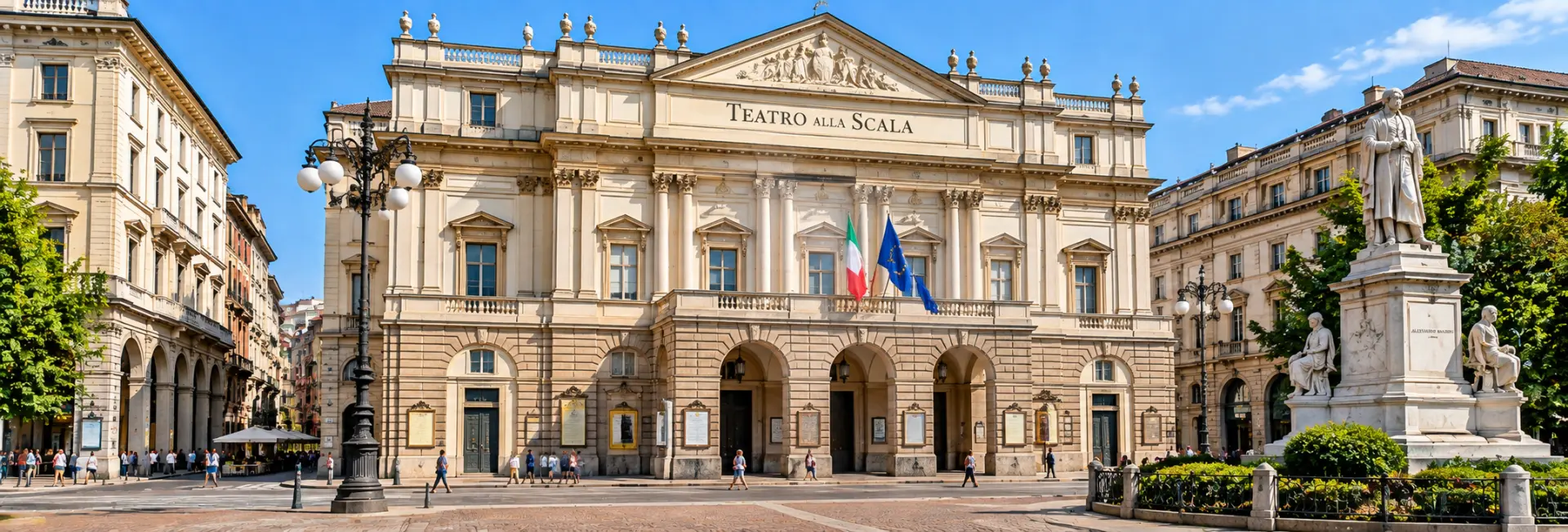
Teatro alla Scala, known simply as La Scala, is Milan's opera house and one of the most storied stages in the history of Western music. It stands on Piazza della Scala, a compact pedestrian square in the heart of the city, its restrained neoclassical façade giving little hint of the gilded horseshoe auditorium inside.
Opened in 1778 to replace a court theatre lost to fire, La Scala became, across the nineteenth and twentieth centuries, one of the defining venues of Italian opera, hosting premieres by Rossini, Verdi, and Puccini and shaping the careers of countless singers and conductors. Its opening night on 7 December each year remains a fixed date on the European cultural calendar, drawing attention well beyond Milan itself. It survived a direct hit during the Second World War and was rebuilt within three years, a rebuilding that came to symbolise the city's own postwar recovery.
Today it remains a fully working opera and ballet house with an active season, alongside an attached theatre museum that lets visitors see the auditorium and explore the building's history even without a ticket to a performance.
History
A Theatre Born From Fire
La Scala exists because of a disaster. On the night of 25 February 1776, Milan's previous court theatre, the Teatro Regio Ducale, burned down after a carnival gala. The wealthy box-holders who had lost their seats petitioned the Austrian authorities for a replacement, and Empress Maria Theresa approved a design by the neoclassical architect Giuseppe Piermarini. The new theatre rose on the site of a demolished church, Santa Maria alla Scala, from which it took its name, and opened on 3 August 1778 with an opera by Antonio Salieri.
The Golden Age of Italian Opera
Through the nineteenth century, La Scala became the venue where Italian opera measured itself against its own history. Gioachino Rossini had works staged there from 1812 onward, and the theatre developed a close association with Giuseppe Verdi, whose operas had some of their most important early performances on its stage. Giacomo Puccini's operas followed in the same tradition into the early twentieth century, cementing La Scala's reputation as a proving ground for new Italian opera. Singers and conductors who built their careers there became, in turn, part of the theatre's own history, with each generation measured against the standards set by the one before.
War, Reconstruction, and Renewal
Allied bombing in August 1943 severely damaged the theatre's auditorium and stage during the Second World War, though its neoclassical façade survived largely intact. Reconstruction began almost immediately, with an improvised concert reportedly held amid the wreckage even before rebuilding was complete, and La Scala reopened on 11 May 1946 with a concert conducted by Arturo Toscanini, a former principal conductor closely associated with Verdi and Puccini, in a performance widely remembered as a symbol of the city's postwar recovery. The building underwent a further major restoration and technical overhaul in the early 2000s, closing for stage and backstage modernisation before reopening in December 2004 with the same Salieri opera that had inaugurated it more than two centuries earlier, a deliberate echo of the theatre's origins.
Architecture & Design
Piermarini's exterior is deliberately restrained: a sober neoclassical façade with a shallow portico, designed to sit quietly on its square rather than announce the spectacle inside. That contrast between plain exterior and lavish interior was typical of court theatres of the period, built for an audience that arrived by carriage directly under the portico.
Inside, the auditorium follows the classic Italian horseshoe plan, with tiers of boxes curving around a deep stage and rising toward the topmost gallery, known as the loggione. Originally built with close to three thousand seats, the theatre was reconfigured in a 1907 renovation into the layout much closer to what audiences find today, and now seats just over two thousand across the stalls, boxes, and galleries. The horseshoe shape and materials used throughout were chosen as much for acoustics as for appearance, giving the hall a reputation for carrying both a solo voice and a full orchestra clearly to every tier, from the stalls floor up to the highest gallery seats.
The stage itself has been rebuilt and re-equipped more than once over the theatre's history, most recently during the early-2000s renovation, which modernised its machinery and backstage areas while leaving Piermarini's original auditorium largely as it has looked for generations.
The Auditorium & Performances
La Scala remains a working opera and ballet house rather than a preserved monument, with a full season of performances running for most of the year. Its opening night, traditionally held on 7 December to coincide with Milan's patron saint's feast day, is one of the fixed points of the European opera calendar and regularly draws international attention.
The theatre's uppermost gallery, the loggione, has long had a reputation as the most demanding section of the house, historically home to devoted operagoers whose reactions to a performance, favourable or otherwise, have been known to make headlines in their own right. La Scala also maintains its own resident opera company, orchestra, and ballet company, along with an affiliated academy that trains young performers and technicians.
La Scala Museum
Adjoining the theatre, the Museo Teatrale alla Scala has occupied its current premises since 1913 and holds one of Europe's major collections devoted to opera and theatrical history. Its displays include costumes, stage and set designs, musical instruments, autograph scores, and portraits of singers, composers, and actors connected to the theatre, alongside material relating more broadly to Italian theatrical tradition, including commedia dell'arte figures and memorabilia from celebrated stage performers of earlier eras.
A museum ticket typically includes access to a viewing box overlooking the auditorium itself, provided no rehearsal is under way, making the museum the most reliable way for visitors without a performance ticket to see La Scala's famous interior. An attached library holds tens of thousands of volumes on theatre and music history, available to researchers and students rather than casual visitors.
Ways to Experience It
- Attending an opera, ballet, or concert performance is the fullest way to experience the theatre, with tickets released in advance through La Scala's official box office and website.
- The Museo Teatrale alla Scala can be visited independently of any performance and usually includes a look into the auditorium from a box.
- Guided tours of the theatre are offered at set times and go into more depth on the building's history and backstage areas than a self-guided museum visit.
- Standing or restricted-view seats in the upper galleries offer a considerably cheaper way to attend a performance for visitors willing to trade comfort for atmosphere, and are often the best way to experience the loggione's famously vocal audience culture firsthand.
- Backstage and technical tours, when offered, give a closer look at the stage machinery and production side of the theatre that a standard museum visit does not cover.
Best Time to Visit
The Museo Teatrale is open daily and tends to be quietest in the early part of the morning, shortly after opening, before tour groups arrive. Performance seasons run for most of the year, with the 7 December opening night the single busiest and most sought-after date, so tickets for that performance need to be secured well in advance.
Visitors hoping to combine a museum visit with a glimpse of the auditorium should be aware that access to the viewing box is not guaranteed on days when rehearsals are taking place, so an early or midweek visit slightly improves the odds of seeing inside.
Visitor Tips
- Performance tickets are best booked directly through La Scala's official website well ahead of a visit, particularly for well-known operas or the December season opening.
- The theatre museum entrance is separate from the main performance entrance on Piazza della Scala; gallery ticket holders in particular should check which entrance applies to them.
- Formal dress is not strictly required for most performances today, though many attendees still dress smartly, especially for opening nights and premieres.
- The nearest metro stops are Duomo and Montenapoleone, both within a short walk through the surrounding streets.
- Photography is generally not permitted during performances, and museum visitors should check current rules on photographing the auditorium from the viewing box.
- Coat and bag checks are available for performance-goers, which is worth using given the limited space around seats in the boxes and stalls.
Nearby Attractions
La Scala sits only a few minutes on foot from Milan's Duomo and Piazza del Duomo, connected by the Galleria Vittorio Emanuele II shopping arcade that opens directly onto Piazza della Scala. Palazzo Marino, Milan's city hall, faces the theatre across the same square, and a monument to Leonardo da Vinci stands at its centre.
The Brera district and its Pinacoteca art gallery lie a short walk to the north, while the boutique-lined streets of the Montenapoleone fashion district are within easy reach to the east, making La Scala a natural stop on a walking route through central Milan.
FAQs about visiting Teatro alla Scala
What is Teatro alla Scala famous for? +
It is one of the world's most celebrated opera houses, known for its neoclassical Piermarini architecture, its central role in the history of Italian opera through composers like Verdi and Puccini, and its distinctive horseshoe-shaped auditorium.
Can I visit La Scala without a performance ticket? +
Yes, the Museo Teatrale alla Scala is open daily and usually includes a look into the auditorium from a viewing box, making it the main option for visitors who don't have a ticket to a show.
How much does it cost to attend a performance? +
Prices vary widely by performance and seating area, from relatively affordable upper-gallery seats to considerably higher prices for the stalls and lower boxes, with the opening night on 7 December typically the most expensive and hardest to book.
When is La Scala's opera season? +
The main season runs for most of the year, traditionally opening on 7 December, Milan's patron saint's feast day, with performances continuing through the following months.
How do I get to La Scala? +
It sits on Piazza della Scala in central Milan, a short walk from the Duomo metro station (lines M1 and M3) through the Galleria Vittorio Emanuele II.
Is there a dress code for performances? +
There is no strict dress code today, but many attendees dress smartly, particularly for premieres and the December season opening.
How long does a typical performance last? +
Opera and ballet performances vary by work but commonly run two to three hours including intervals, while concerts are usually shorter, at around two hours.
What else is nearby that I can combine with a visit? +
The Duomo and Piazza del Duomo are a short walk away through the Galleria, and the Brera district with its art gallery is within easy walking distance to the north.
