
Table of Contents
Overview
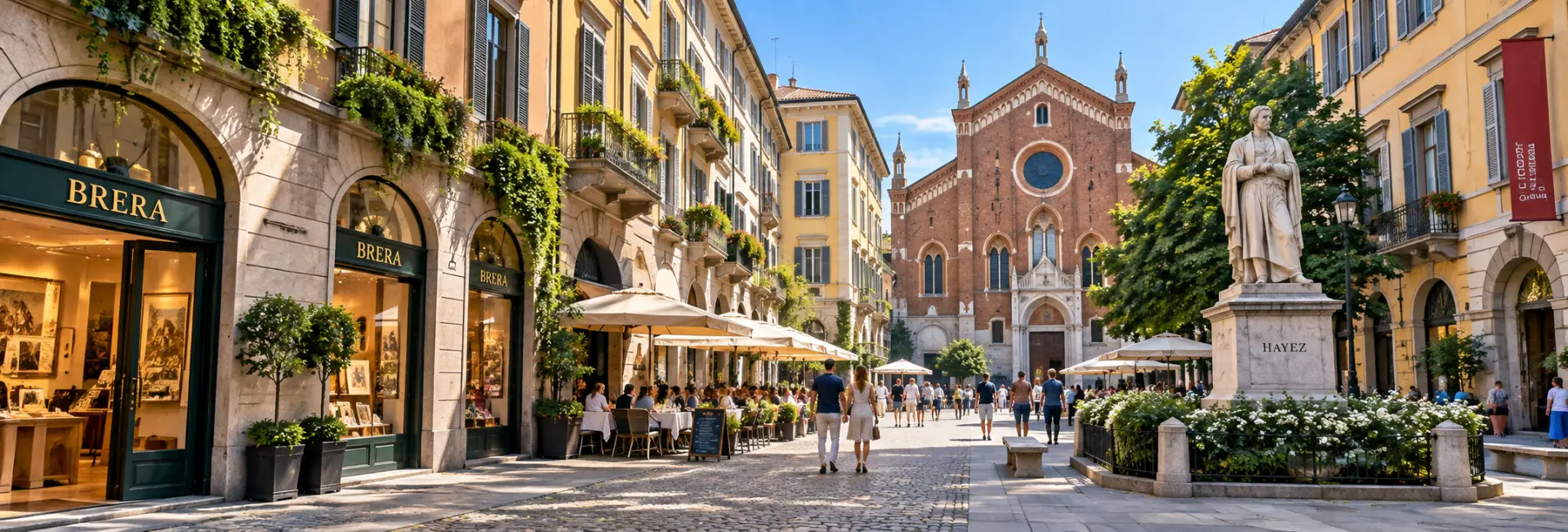
Brera is the small, tightly packed neighbourhood at the heart of central Milan that most visitors picture when they imagine the city's artistic side: cobbled lanes, wrought-iron balconies, and a density of galleries, ateliers, and cafés out of proportion to its size. It sits between two of Milan's other major landmarks, Sforza Castle and the La Scala opera house, close enough to reach either on foot in a few minutes.
The district takes its name from an old Lombardic word for a stretch of open ground once kept clear outside the city's medieval walls. That open plot eventually became the site of a large religious complex, later converted into an academy of art, a picture gallery, a library, a botanical garden, and an astronomical observatory, all under one roof. Around that single building, a genuine artists' quarter grew up from the late eighteenth century onward, earning Brera its long-standing nickname as Milan's answer to Montmartre.
Today the neighbourhood is as much about atmosphere as any single sight: an evening spent drifting between its squares, church façades, and outdoor tables tells you as much about Brera as any single museum visit does. Locals and regular visitors tend to treat it less as a checklist of attractions and more as a place to slow down for a few hours between the city's larger, busier landmarks.
History
From Open Ground to Religious Complex
Around the year 900, the area later known as Brera lay just outside Milan's city walls and was deliberately kept free of buildings for defensive reasons, giving the district its name. Over the following centuries it was settled and, from the early seventeenth century, became the site of a large complex built for the Jesuit order, designed chiefly by the architect Francesco Maria Richini, with construction beginning around 1615.
Academy, Gallery, and Napoleonic Growth
After the Jesuit order was suppressed, the building and grounds passed into public use. In 1776, under the rule of the Austrian Empress Maria Theresa, an Academy of Fine Arts was established on the site, and a picture gallery grew alongside it as a teaching collection. Both expanded significantly during the Napoleonic period, when the gallery absorbed artworks gathered from churches and religious houses across the region, transforming it from an academic study collection into one of Italy's major public museums. A bronze statue of Napoleon, cast by the sculptor Antonio Canova, still stands at the centre of the building's courtyard.
An Artists' Quarter
Through the nineteenth and twentieth centuries, the streets around the academy filled with painters, writers, and intellectuals drawn by cheap studios and a concentration of artistic life, giving Brera its bohemian reputation. Cafés such as Bar Jamaica, open since the early twentieth century, became informal meeting points for this circle, with regulars over the decades including poets and artists associated with Milan's postwar literary and art scenes. That original bohemian character thinned out from the 1990s onward as rents in the district rose and the working artists who had once filled its studios were gradually priced out, though the neighbourhood has kept much of its creative identity through its galleries, antique dealers, and the students who still study at the academy today.
Brera's history is not purely artistic, either. The district has also long been associated with its astronomical observatory, founded within Palazzo Brera in the eighteenth century, which by the nineteenth century had become one of Italy's leading scientific institutions and a source of local pride distinct from the neighbourhood's reputation for painting and design.
Streetscape & Architecture
Brera's charm is largely a matter of scale: narrow cobbled streets, low building heights by Milanese standards, and façades in ochre, red, and cream that read as distinctly older and more intimate than the wide boulevards of the city centre nearby. Wrought-iron balconies, many spilling over with plants, are a recurring feature of the district's residential buildings.
The neighbourhood has no single dominant architectural style; instead it layers a handful of churches with medieval or early Christian origins, a grand seventeenth-century institutional building at its centre, and later apartment blocks from the nineteenth and early twentieth centuries, all connected by a dense, largely pedestrian-friendly street grid that discourages cars and rewards walking. Ground-floor spaces along the main streets are given over almost entirely to galleries, small boutiques, and places to eat and drink, which keeps the district feeling lived-in rather than purely residential or purely commercial.
Palazzo Brera & Its Institutions
The district's anchor building, Palazzo Brera, was built on the site of the former Jesuit complex and today houses several institutions at once rather than a single museum.
- The Pinacoteca di Brera, Milan's principal public picture gallery, holds Italian paintings ranging from the thirteenth to the twentieth century, shown across dozens of rooms.
- The Brera Academy of Fine Arts, founded in 1776, still trains art students on the upper floors of the same building.
- The Braidense National Library occupies part of the complex and holds an extensive historic book collection.
- Milan's Botanical Garden, a quiet formal garden tucked behind the palazzo, is open to visitors free of charge.
- The Brera Astronomical Observatory, founded in the eighteenth century, is where the astronomer Giovanni Schiaparelli made his well-known nineteenth-century observations of Mars.
The building's central courtyard, dominated by Canova's bronze statue of Napoleon, functions as an open, publicly accessible space in its own right.
Notable Landmarks
Beyond Palazzo Brera, the district holds several older religious buildings that are easy to overlook amid the shops and cafés. The Basilica of San Simpliciano traces its origins to the fourth century, making it one of the oldest churches in Milan, and preserves fifteenth-century frescoes in its apse. The Church of San Marco, a short walk away, is linked in local tradition to a young Mozart, who performed there during a stay in Milan. Piazza Santa Maria del Carmine and its church form another of the district's quieter squares.
Beyond individual buildings, Brera's small squares, particularly around Via Fiori Chiari and Via Madonnina, are landmarks in their own right, lined with galleries, antique shops, and outdoor café seating that fills up through the evening. Piazza Formentano and Piazza San Marco each offer a quieter pause from the busier shopping streets, with benches and church façades that make them natural stopping points on a longer walk through the district.
Ways to Experience It
Brera rewards unhurried, on-foot exploration more than a fixed checklist of sights.
- Visiting the Pinacoteca di Brera is the main ticketed activity in the district and typically takes one and a half to two hours.
- Milan's Botanical Garden, behind the palazzo, is free and makes a short, quiet stop after the gallery.
- A self-guided walk through the district's smaller streets, especially around Via Fiori Chiari, Via Madonnina, and Piazza San Marco, is the best way to take in the neighbourhood's atmosphere and its galleries and boutiques.
- On the third Sunday of each month, the Mercatino di Brera antique market fills Via Fiori Chiari and nearby streets with stalls selling vintage objects, books, and jewellery.
- Evenings in Brera centre on its bars and restaurants, many with outdoor seating, making it one of the more popular parts of the city for a pre-dinner aperitivo.
Best Time to Visit
Weekday mornings offer the quietest version of Brera, with the Pinacoteca and streets both easier to move through before midday. Evenings, by contrast, are when the district comes alive, as café tables fill and the narrow streets take on their characteristic buzz; this is arguably the best time to experience Brera's atmosphere, even if it is not the quietest.
The third Sunday of the month adds the antique market to the mix, which is worth timing a visit around for shoppers but adds noticeably more foot traffic to the main streets. Spring and early autumn bring comfortable weather for walking and outdoor dining, while summer weekday mornings remain a reasonable option for avoiding both heat and crowds.
Visitor Tips
- The district is compact enough to see on foot; most of its streets are pedestrian-friendly or lightly trafficked.
- The nearest metro stops are Lanza and Montenapoleone, both a short walk from the centre of the district.
- Cobblestones are common throughout Brera, so comfortable, flat footwear is worth choosing over anything with thin or high heels.
- The Botanical Garden and the courtyard of Palazzo Brera are free to enter even without a museum ticket.
- Restaurants and bars in the district's most photogenic streets can be pricier than elsewhere in Milan, so it is worth wandering a block or two further out for better value.
- Opening hours for the Pinacoteca, the Botanical Garden, and the Observatory vary and are best confirmed on their official sites shortly before visiting.
Nearby Attractions
Brera's location in the heart of Milan's historic core puts several major landmarks within easy walking distance. Sforza Castle and the parkland of Parco Sempione lie just to the west, reachable in ten to fifteen minutes on foot through the district's northern edge. To the south, the Teatro alla Scala opera house and the Galleria Vittorio Emanuele II shopping arcade are close enough to combine with a Brera visit on the same afternoon, with the Duomo and Piazza del Duomo only a little further beyond them.
To the east, the Montenapoleone fashion district's boutique-lined streets form a natural continuation of a Brera walk for visitors interested in shopping alongside art and architecture.
FAQs about visiting the Brera District
What is the Brera district known for? +
It is known as Milan's historic artists' quarter, built around the Pinacoteca di Brera art gallery and the Academy of Fine Arts, with cobbled streets, galleries, antique shops, and a lively café and restaurant scene.
Is Brera free to visit? +
Walking through the district's streets and squares is free, as is entry to the Botanical Garden and Palazzo Brera's courtyard; the Pinacoteca di Brera picture gallery requires a paid ticket.
How much time should I plan for a visit? +
A couple of hours covers a relaxed walk through the main streets, while adding the Pinacoteca di Brera and the Botanical Garden brings a fuller visit closer to half a day.
When is the Brera antique market held? +
The Mercatino di Brera takes place on the third Sunday of every month along Via Fiori Chiari and nearby streets.
How do I get to Brera? +
The district is reachable on foot from central Milan, with the Lanza and Montenapoleone metro stops both a short walk away, and it sits directly between Sforza Castle and La Scala.
Is Brera suitable for an evening visit? +
Yes, evenings are one of the best times to experience Brera, when its cafés, bars, and restaurants fill the narrow streets with outdoor seating and a lively atmosphere.
What else is nearby that I can combine with a visit? +
Sforza Castle and Parco Sempione lie a short walk to the west, while La Scala and the Duomo are both within easy walking distance to the south and east.
Is Brera walkable, or do I need transport? +
It is entirely walkable; the district is small and largely pedestrian-friendly, and most of its landmarks sit within a few minutes of each other on foot.
