Table of Contents
Overview
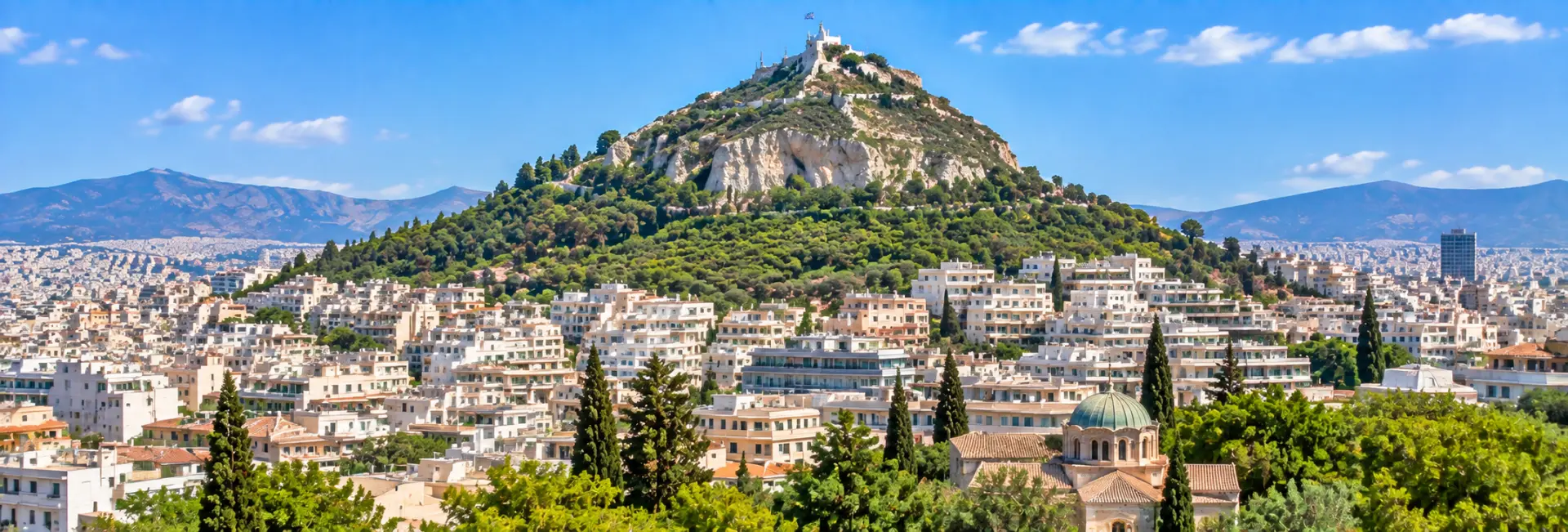
Mount Lycabettus rises 277 meters above central Athens, making it the highest point in the city and, on a clear day, the best place to see the whole of it at once. The hill's bare limestone cap sits above a thick collar of pine forest, a green wedge that stands out sharply against the dense apartment blocks spreading out below.
Unlike the Acropolis or the Agora, Lycabettus has almost nothing to do with ancient ruins. Its appeal is simpler: a short climb or a five-minute funicular ride trades city noise for open air, a small whitewashed chapel, and a 360-degree view that stretches from the Acropolis and the Saronic Gulf to the mountains ringing the Attic basin.
The hill functions almost like a second center of gravity for the city, visible from dozens of neighborhoods and used by residents as a natural point of reference. For visitors, it works well both as a sightseeing stop in its own right and as an easy way to get oriented early in a trip, since so many of Athens's other landmarks can be picked out from the summit at once.
Origins & Mythology
Geologically, Lycabettus is a block of Cretaceous limestone that has simply outlasted the softer rock eroded away around it over millions of years, leaving it standing well above the surrounding city. Ancient Athenians had a tidier explanation: according to legend, the goddess Athena was carrying a huge limestone rock from the Pallene peninsula, intending to add it to the Acropolis, when a raven brought her bad news and startled her into dropping it exactly where the hill now stands.
The hill's name is thought to come from "lykos," the Greek word for wolf, tied to old stories that wolves once roamed its slopes, though a second theory traces the name to a much older, pre-Greek word for a mound or hillock shaped like a mastoid bone. Either way, the hill has loomed over the same patch of Attica since long before Athens grew up around it.
The wolf story in particular has stuck in local memory partly because of its connection to Aristotle's Lyceum, an ancient school of philosophy whose name shares the same root. Whether or not wolves genuinely denned on the hill's slopes, the association was strong enough that ancient Athenians folded it into how they talked about the area for centuries.
History
A Long Empty Hilltop
For most of its history, Lycabettus stayed largely undeveloped, valued more as a landmark and a lookout than a destination in its own right. A small chapel dedicated to Saint Isidore was built into the rock on the hill's western side sometime in the 15th or 16th century, and it remains one of the oldest structures on the hill today. The more recognizable chapel near the summit, dedicated to Saint George, dates to the 19th century and quickly became the focal point for a modest religious festival still held there every April, drawing local families up the hill for an evening of music and food around the chapel grounds.
Reforestation and Military Use
The hill's now-famous pine forest is not original. Between 1880 and 1915, Athenian authorities carried out a large-scale planting project to green what had been a mostly bare, rocky slope, and the results are what visitors walk through today. During the Second World War, the hill also took on a more secretive role: tunnels and chambers were dug into the rock to house an air-defense command post, a reminder that even a scenic viewpoint had a wartime job to do. Parts of that underground network still exist inside the hill, though they are not part of the standard visitor route.
The Funicular Era
Getting to the top became dramatically easier in 1965, when the Greek National Tourism Organisation opened the Lycabettus Funicular, an underground cable railway connecting Kolonaki to the summit in about five minutes. Built after several years of planning and tunneling through the hill's limestone core, the funicular gave ordinary visitors an option that avoided the walk entirely, and it quickly became one of the more novel ways to see the city.
The system was thoroughly overhauled in 2002, replacing its original mechanical and electrical systems along with both passenger cars, and it still carries an estimated 300,000 passengers a year. Around the same period, management of the hill's café, restaurant, and funicular operations passed to a group of private catering companies, who continue to run the summit's food and drink venues today.
What's at the Summit
The summit is compact but has enough to justify lingering past the view itself. The whitewashed Chapel of Saint George anchors the highest point, its small bell tower visible from much of the city below, and its interior is open to visitors outside of services.
- The Chapel of Saint George, the hill's best-known landmark and the site of a religious festival each April
- A café and restaurant terrace built into the rock, popular for coffee, drinks, or a meal with a view
- An open-air amphitheatre partway down the hill, historically used for concerts, though it has hosted events only intermittently in recent years
- Multiple viewing terraces circling the summit, each offering a slightly different angle over the city
The amphitheatre has its own smaller history worth noting. Built in the 1960s alongside the funicular, it hosted a run of major international concerts through the following decades, drawing acts from across the music world who wanted a stage with an Athens skyline as a backdrop. Its schedule has thinned out considerably since then, and it now stands mostly quiet between occasional events, though its concrete tiers remain a striking sight on the way up.
Ways to Reach the Top
Most visitors choose between two options: a short, scenic walk or the funicular. Three main footpaths wind up through the pine forest from different neighborhoods, including Kolonaki and Dexameni, and a typical ascent on foot takes 30 to 45 minutes at an easy pace along paved, switchbacking paths. The Kolonaki-side path is generally considered the easiest to follow after dark, since it is fully paved with steps, while the other routes are better tackled in daylight.
The Lycabettus Funicular offers a faster alternative, running through an enclosed tunnel from a lower station on Aristippou Street in Kolonaki to a terminus near the Chapel of Saint George. The ride itself takes about five minutes and passes entirely underground, so the payoff comes only once passengers step out at the top. The nearest metro stop to the funicular's lower station is Evangelismos, a short walk away.
A popular strategy among visitors is to combine both: walk up while there is still daylight to enjoy the forest and the gradually widening views, then take the funicular back down once it gets dark and the paths are harder to see. This also saves the legs from a steep descent after an already active day of sightseeing.
Best Time to Visit
Sunset is the hill's signature moment, when the Acropolis and the rest of the city turn gold and then slowly light up as evening falls. Arriving at least an hour before sunset is worth it, since the best viewing spots fill up quickly, especially in the warmer months.
Spring and early autumn offer the most comfortable conditions for the walk up, avoiding both summer heat and winter wind. Clear days are more common from May through September, which also gives the best odds of an unobstructed view all the way to the sea.
Midday visits, while less atmospheric, do have one advantage: the light is sharpest for photography of the Acropolis and the rest of the historic center, and the summit itself tends to be noticeably less crowded than in the hour around sunset.
Visitor Tips
- Wear proper walking shoes if hiking up, since the paths are paved but steep in sections
- Bring a light jacket even in summer, as the exposed summit can be windy after sunset
- Check current funicular operating hours and ticket prices before visiting, since these can change seasonally
- Arrive well before sunset if that is the goal, since the summit gets crowded at that hour
- Carry water, especially if walking up, as there are no shops along most of the trail
- Keep valuables secure and stay aware of your surroundings after dark, as with any popular viewpoint
Nearby Attractions
Lycabettus sits right above some of Athens's most walkable neighborhoods, making it easy to pair with a stroll through the surrounding streets before or after the climb.
- Kolonaki, an upscale neighborhood at the base of the hill known for boutiques, galleries, and cafés
- The Benaki Museum, a short walk downhill, covering Greek history and art across several eras
- The National Garden and the Panathenaic Stadium, both reachable on foot within 20 to 30 minutes
- Syntagma Square and the Greek Parliament, a similarly short walk toward the city center
For visitors staying in Kolonaki, the hill is close enough to fold into an ordinary evening rather than a dedicated excursion, whether that means a pre-dinner sunset climb or a quick loop through the neighborhood's galleries before heading up.
FAQs about visiting Mount Lycabettus
Is Mount Lycabettus worth visiting? +
Yes, it offers the single best panoramic view of Athens, taking in the Acropolis, the Saronic Gulf, and much of the city skyline, and the visit itself is short enough to fit into almost any itinerary.
Should I walk up or take the funicular? +
Both are good options. Walking up takes 30 to 45 minutes through pine forest and lets you enjoy the gradually opening views, while the funicular covers the climb in about five minutes but runs entirely underground, so many visitors walk up and ride down.
How long does a visit take? +
Most visitors spend one to two hours at the summit, including time for photos, a drink at the café, and a look inside the chapel, not counting the walk or funicular ride itself.
Is Mount Lycabettus free to visit? +
Reaching the summit on foot is free. The funicular charges a fare, and prices should be checked at the station or the operator's website, since they are adjusted periodically.
What is the best time of day to go? +
Sunset is the most popular and rewarding time, when the city lights up as the sun sets behind the Acropolis, though mornings offer a quieter visit and clearer air for photography.
Is the hike suitable for kids or less mobile visitors? +
The paths are paved but involve a steady, sometimes steep climb, which can be tiring for young children or visitors with mobility issues; the funicular is the easier option for them.
Can you see the Acropolis from Mount Lycabettus? +
Yes, the Acropolis is clearly visible from the summit and is one of the main reasons visitors make the climb, especially at sunset when it is illuminated.