Table of Contents
Overview
The Temple of Olympian Zeus, known in Greek as the Olympieion, stands just southeast of the Acropolis in the heart of Athens. Once the largest temple ever built in Greece, it was designed to honor Zeus as ruler of the Olympian gods, and its sheer scale was meant to outshine every other sanctuary in the ancient world.
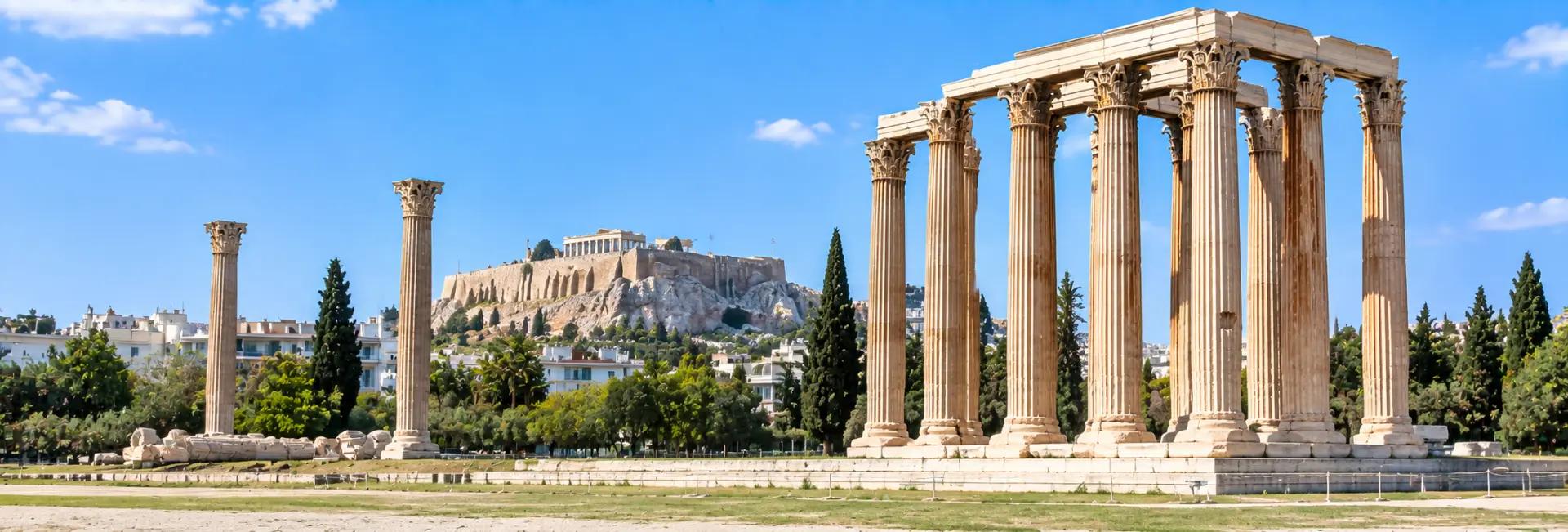
Today only fifteen of its original 104 Corinthian columns remain upright, with a sixteenth lying where it toppled centuries ago. Even reduced to a fraction of its former self, the site conveys an unmistakable sense of ambition, and its open field of marble columns against the Athenian skyline makes it one of the most photographed ruins in the city.
History
Origins Under the Tyrants
Work on the temple began around 515 BC, commissioned by the sons of the Athenian tyrant Peisistratos. Their goal was audacious: a temple so vast it would dwarf anything built before it in Greece. Construction relied on marble quarried from Mount Penteli, the same source later used for the Parthenon.
The project stalled almost as soon as it began. When the Peisistratid family was overthrown in 510 BC, the new democratic government had little interest in finishing a monument tied to tyranny, and the half-built temple was left abandoned for centuries.
Centuries of Delay
Several later rulers attempted to revive the project. The Hellenistic king Antiochus IV of Syria funded a renewed building push around 174 BC, hiring the Roman architect Cossutius to redesign the temple on an even grander scale. Antiochus died before it was finished, and the temple sat unfinished once again for hundreds of years.
Completion Under Hadrian
It was the Roman emperor Hadrian, an enthusiastic admirer of Greek culture, who finally brought the temple to completion in 131 AD, nearly 650 years after the first stones were laid. Hadrian marked the occasion with a dedication ceremony and placed a colossal chryselephantine statue of Zeus inside the cella, alongside a statue of himself, a gesture that did not go unnoticed by contemporaries.
Decline and Ruin
The temple's completed form did not last long. In 267 AD, invading Herulian tribes plundered Athens and damaged the sanctuary, and it was never fully repaired afterward. Over the following centuries, the site was gradually stripped for building material, and by the time European travelers began documenting Athens in the 15th century, only a couple dozen columns remained standing.
Excavation and Rediscovery
Serious archaeological study of the site did not begin until the 19th century, when the British architect Francis Penrose led an early survey of the ruins. Further excavations followed in the 1920s under the German archaeologist Gabriel Welter, and again in the 1960s under Greek archaeologist Ioannis Travlos, whose work helped establish the layout and building history now presented to visitors. Today the site is protected and managed by the Greek Ministry of Culture as part of the wider Unification of Archaeological Sites of Athens.
Architecture & Design
Scale and Layout
In its finished state, the temple measured roughly 110 by 44 meters, making it the largest temple ever constructed in mainland Greece, larger even than the Parthenon. It followed a dipteral octastyle plan, meaning it was surrounded by a double row of columns along its long sides and a triple row across its short ends.
The Corinthian Columns
The temple's 104 columns were built in the Corinthian order, distinguished by ornate capitals carved with acanthus leaves, a departure from the plainer Doric style used on the nearby Parthenon. Each column stood about 17 meters tall with a diameter of roughly 1.7 meters, proportions so large that visitors often need a moment to register the true scale from ground level.
The choice of the Corinthian order was itself a statement of ambition. At the time construction began, Doric temples like those on the Acropolis were the norm in Athens, and the more decorative Corinthian style was still relatively new to Greek architecture. By the time Hadrian completed the building centuries later, the ornate columns had come to symbolize the temple's long, layered history, blending Athenian origins with the tastes of the Hellenistic and Roman periods that eventually finished it.
- Overall footprint: approximately 110 x 44 meters
- Column height: around 17 meters
- Column order: Corinthian, with carved acanthus-leaf capitals
- Layout: double row of columns on the long sides, triple row on the short ends
The Fallen Column and What Remains Today
Of the original 104 columns, only fifteen still stand in their original positions, clustered together at the eastern end of the site. A sixteenth column lies on the ground exactly where it fell, toppled by a violent windstorm in October 1852, its individual marble drums scattered in a line across the grass.
Nothing survives of the cella, the temple's inner chamber, nor of the great statue of Zeus that once stood inside it. What remains is essentially a skeleton of the original structure, but that skeleton is large enough to give a genuine sense of the temple's original grandeur, and walking among the surviving columns remains one of the most striking experiences in central Athens.
Cultural & Religious Significance
The sanctuary of Olympian Zeus was among the most important religious sites in ancient Athens, tied by legend to Deucalion, the mythical survivor of a great flood who was said to have founded the first altar to Zeus on this spot in gratitude for his salvation. Whether or not that origin story is historical, it reflects how central the site was to Athenian identity long before the temple itself existed.
For Hadrian, completing the Olympieion was as much a political statement as a religious one. By finishing a project the Athenians themselves had abandoned centuries earlier, he positioned himself as a patron and protector of Greek civilization, reinforcing his broader project of reviving Athens as a cultural capital within the Roman Empire.
The temple also became closely linked with the wider Panhellenic festival culture of the Roman era, drawing worshippers and visitors from across the Greek-speaking world during its dedication. Even after the temple fell into disuse, the site retained enough symbolic weight that its ruins were referenced by later travelers and historians as one of the defining relics of ancient Athens, long before the Acropolis became the city's primary tourist focus.
Ways to Experience It
The Temple of Olympian Zeus is an open-air archaeological site, and most visitors explore it independently on foot along the marked pathways that wind between the standing columns and the excavated foundations. There is no reconstructed interior to tour, since the cella and its statues are long gone, so the experience is centered entirely on walking the grounds and viewing the surviving columns from different angles.
- Self-guided visit: wander the site at your own pace, typically taking 30 to 45 minutes
- Combined archaeological ticket: entry is included on the multi-site Athens ticket that also covers the Acropolis, Ancient Agora, and other nearby ruins
- Guided walking tours: local guides often pair the temple with Hadrian's Arch and the surrounding historic district for a fuller picture of Roman-era Athens
- Photography: the cluster of standing columns with the Acropolis visible in the background is one of the most popular vantage points in the city
Best Time to Visit
Early morning, shortly after opening, is the most comfortable time to visit, with softer light for photographs and noticeably smaller crowds than midday. The site has very little shade, so visiting outside the peak summer heat, either early or in the last couple of hours before closing, makes for a more pleasant walk around the ruins.
Spring and autumn offer milder temperatures than the intense heat of an Athens summer, while a clear winter morning can make the columns stand out dramatically against a blue sky with far fewer visitors on site. Weekday visits also tend to be quieter than weekends, especially outside the busy midsummer tourist season, when large groups often arrive on combined tours that stop at both the temple and the Acropolis in the same day.
Visitor Tips
- Wear comfortable shoes, as the ground is uneven gravel and exposed stone
- Bring water and sun protection, since the site offers almost no shade
- Check current opening hours and ticket prices before visiting, as these can change seasonally
- The combined Athens archaeological ticket is usually the most economical option if you plan to visit the Acropolis as well
- Allow extra time to also see Hadrian's Arch, which sits just outside the site's northwest corner
- The site has restrooms near the entrance but limited facilities beyond that, so plan accordingly for longer visits
Nearby Attractions
- Hadrian's Arch, a monumental gateway built to honor the emperor, standing just steps from the temple
- The Acropolis and Acropolis Museum, roughly a 10 to 15 minute walk northwest
- The National Garden, a shaded park bordering the site to the north
- Syntagma Square and the Greek Parliament, about a 10 minute walk away
- The Panathenaic Stadium, a short walk to the southeast
FAQs about visiting the Temple of Olympian Zeus
How long did it take to build the Temple of Olympian Zeus? +
Construction began around 515 BC and was not completed until 131 AD under Emperor Hadrian, spanning roughly 650 years across several rulers and long periods of abandonment.
How many columns are still standing? +
Fifteen of the original 104 Corinthian columns remain upright, and a sixteenth lies on the ground where it fell during a storm in 1852.
How much time should I plan for a visit? +
Most visitors spend 30 to 45 minutes exploring the site, though history enthusiasts may want closer to an hour to take in the details.
Is the Temple of Olympian Zeus included in the Acropolis ticket? +
Yes, entry is typically included on the combined Athens archaeological sites ticket, which also covers the Acropolis, Ancient Agora, and several other nearby ruins.
Is the site accessible for visitors with mobility needs? +
The main entrance area is wheelchair accessible, though some of the surrounding ground is uneven gravel and stone, so assistance can be helpful for reaching every part of the site.
What is the best time of day to visit? +
Early morning shortly after opening offers the softest light and smallest crowds, and is also more comfortable since the site has very little shade.
Can I combine this visit with other attractions nearby? +
Yes, Hadrian's Arch sits right next to the temple, and the Acropolis, National Garden, and Syntagma Square are all within a short walk, making it easy to fit into a longer walking route through central Athens.
Is there an entry fee? +
Yes, a paid ticket is required, though the exact price should be confirmed against the official current rate, since archaeological site fees in Greece are set by the Ministry of Culture and can change.